
Missed call text back is not enough on its own to capture every lead, because it only reaches callers who reply, and most people who call a business want to talk to a person right away. It works as a safety net that recovers some of what would otherwise be a dead end, but it cannot ask follow-up questions or qualify a caller the way a live conversation can.
For real estate agents and home-service owners, missed calls becoming lost leads is the daily reality of working in the business, not on it. You are on a roof, in a showing, or driving between job sites, and the phone rings anyway. At DH Digital Consulting, I built EchoAssist to answer those calls live instead of waiting for someone to miss them in the first place, and I want to walk through where text back fits and where it runs out of road.
Missed call text back sends an automatic SMS the moment a call goes unanswered, while an AI receptionist like EchoAssist answers the call itself and collects far more detail in real time. Both aim at the same problem: calls that go unanswered because you cannot get to the phone. The difference is what happens in the thirty seconds right after the ring stops.
Key Takeaways
- Missed call text back recovers some leads by texting callers after the call ends, but it depends on the caller replying.
- An AI receptionist answers the call live and can ask qualifying questions, collect details, and send a summary without waiting on a text reply.
- Real estate agents and home-service owners often get the most coverage by using both together, with text back as a backstop behind live answering.
What Happens After an Unanswered Call?
When a call goes unanswered, the caller typically lands in one of two places: a voicemail box or a missed call text. Neither one is the same as talking to a person, and the gap between them matters more than it looks.
With plain voicemail, the caller has to leave a message, hope someone checks it, and wait for a callback. Many callers hang up without leaving one at all. A missed call text changes that by sending an automated SMS within seconds of the missed call, something like “Sorry we missed you, how can we help?” The caller can reply by text instead of waiting on hold or leaving a message nobody might hear until after business hours.
Missed call texting works whether the call happened at 2 p.m. or 2 a.m. The trigger is the missed-call event, not the clock. That is useful for after-hours calls, but it still asks the caller to do something: type a reply, describe what they need, and wait again. Some callers will do that. Others move on to the next business in their search results, especially if they are comparing a handful of providers at once.
The practical difference between a text back and a voicemail is response speed and format, not full customer service. A text back acknowledges the miss and invites a reply. It does not ask follow-up questions on its own, qualify the caller, or hand off urgent requests to the right person. For a deeper look at why voicemail alone loses leads, see why prospects hang up voicemail and voicemail is not a lead response strategy.
What Can a Text Collect vs. a Live AI Conversation?
A text back can only collect what the caller chooses to type, while a live AI conversation can ask for exactly what the business needs to know. That gap shows up most clearly when you compare the two side by side.
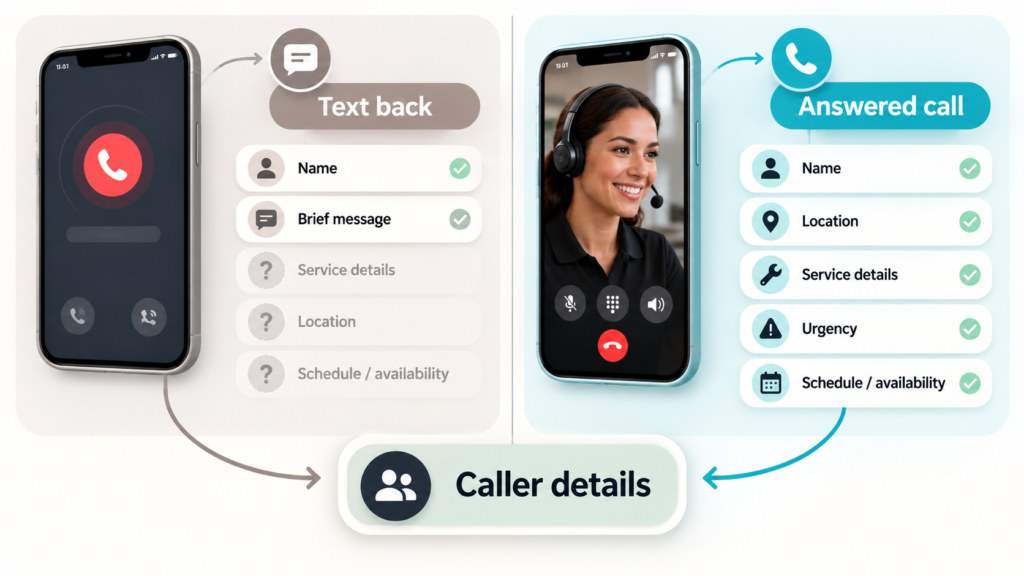
A missed call text puts the burden on the caller to text back, describe their issue, and wait for a human to respond. If they do not reply, the lead data stops at a name and a phone number. An AI virtual receptionist stays on the call and asks the qualifying questions the business actually needs answered: what service they need, their location, their timeline, whether it is urgent. EchoAssist is configured around each client’s real services, service area, and common caller questions, so the questions asked on the call match how that specific business actually works.
That live back-and-forth is also what drives customer satisfaction. A caller who gets a clear answer and a next step on the first call feels handled. A caller who gets a text and has to keep explaining themselves in follow-up messages is doing more work to get the same outcome. EchoAssist delivers a call summary after the conversation ends, so the business owner sees what was discussed without replaying a recording or piecing it together from a text thread. Compare this directly against hiring a human receptionist at ai receptionist vs hiring a receptionist.
How Do You Set Up Text-Back and Handle Replies?
Setting up missed call text back usually means picking a phone system or missed call text back software with that feature, writing a response template, and turning it on. The deeper setup work is in handling what happens after the text goes out, not the text itself.
Most missed call text back service options route through call forwarding or a VoIP-based business line, since the system needs to detect the missed call event before it can fire the SMS. Some tools also offer voicemail transcription, so a left voicemail turns into readable text alongside the automated reply. Once the text sends, someone still has to watch the mobile app or inbox, read the reply, and respond with the right next step: a quote, a scheduling link, or a question back. That monitoring step is easy to underestimate. A text back system that fires correctly but gets a slow human reply afterward loses much of its advantage over voicemail.
An AI receptionist setup works differently. Instead of configuring a trigger and a template, you configure the conversation itself: the services offered, service area, hours, common questions, and escalation rules for urgent calls. EchoAssist is built around that information so the call gets answered and handled in one pass, without needing someone to monitor a separate reply thread. For a walkthrough of what that setup actually requires, see ai receptionist setup what it needs to know and calls you should not send to voicemail.
When Should You Use Text-Back, an AI Receptionist, or Both?
Text-back tools and AI receptionists solve overlapping but different problems, and several well-known products sit on each side of that line. GoHighLevel (often shortened to HighLevel), Grasshopper, Weave, Podium, RingCentral, Google Voice, Allo, and Enzak are commonly used for missed call text back and related call-handling automation. These tools are built primarily around the text-after-the-miss model: detect the missed call, send the SMS, let the reply come in through a shared inbox.
An AI receptionist operates earlier in the sequence. Instead of waiting for the call to be missed, it answers the call. That distinction matters most for businesses where the caller’s intent is urgent or time-sensitive: a home-service emergency, a buyer calling about a listing they are standing in front of right now, a lead comparing multiple providers in the same afternoon.
The two approaches are not mutually exclusive. A business can run EchoAssist to answer live during the hours it is configured for, with a missed call text as a backstop for edge cases where a call still slips through. What does not make sense is treating a text-back tool as a full substitute for live answering if the business depends on fast responses to win jobs. Real estate agents comparing coverage options can see how live answering applies to their work specifically at how ai receptionist works home service real estate and ai receptionist one person business.
Choose the Response Your Callers Actually Need
Missed calls and lead capture come down to one question: what does the caller get in the moment they reach out? A text back gets them an acknowledgment and a chance to reply. An AI receptionist gets them an answer, right then, with the qualifying questions already built in.
The “just text me” instinct makes sense on the surface. If you cannot answer the phone while you are working, it feels reasonable to assume texting solves it. But texting has the same underlying problem as the missed call itself: if you cannot stop to answer a call, you usually cannot stop to answer a text either, and replies that come hours later often arrive after the prospect has already called someone else. That is not a knock on anyone who prefers texting. It is a reminder that the bottleneck is attention, not the channel.
For agents and home-service owners who are out doing the job that earns the money, EchoAssist answers calls live, 24 hours a day, using the qualifying questions specific to that business, then delivers a summary so nothing gets missed in the catch-up. Standard pricing is $497 a month with a $397 setup fee, month to month with no contract. I am currently offering $297 a month, locked for one year, to the first ten founding clients in exchange for a testimonial. You can see how it fits your call volume with a free 10-minute demo, or look at a real example in action at echoassist missed call demo. For a closer look at the true cost of calls that slip through, see how missed calls cost service businesses and the opportunity cost of unanswered calls.
Frequently Asked Questions
Does missed call text back replace an answering service?
No, it does not replace a live answering service or receptionist. It sends an automatic text after a call goes unanswered, but it cannot have a conversation, ask follow-up questions, or resolve what the caller actually needs the way a person or an AI receptionist can.
How fast does a missed call text usually go out?
Most missed call text back systems send the text within seconds of the call ending, often five to ten seconds. The speed matters because callers comparing several businesses at once tend to respond to whoever reaches them first.
Will every caller respond to a missed call text?
No, not every caller replies to a missed call text. Some callers want to speak with someone directly and will call a competitor instead of texting, which is one reason a live answering option can recover leads a text back alone would miss.
Can I use missed call text back and an AI receptionist together?
Yes, the two can work together. An AI receptionist like EchoAssist can answer calls live during its configured hours, while a missed call text serves as a backup for any call that still slips through.
What does EchoAssist do differently from a text back tool?
EchoAssist answers the call live instead of waiting for it to be missed, using business-specific qualifying questions to gather caller details and deliver a real-time call summary. It also filters spam and solicitor calls before they reach you.