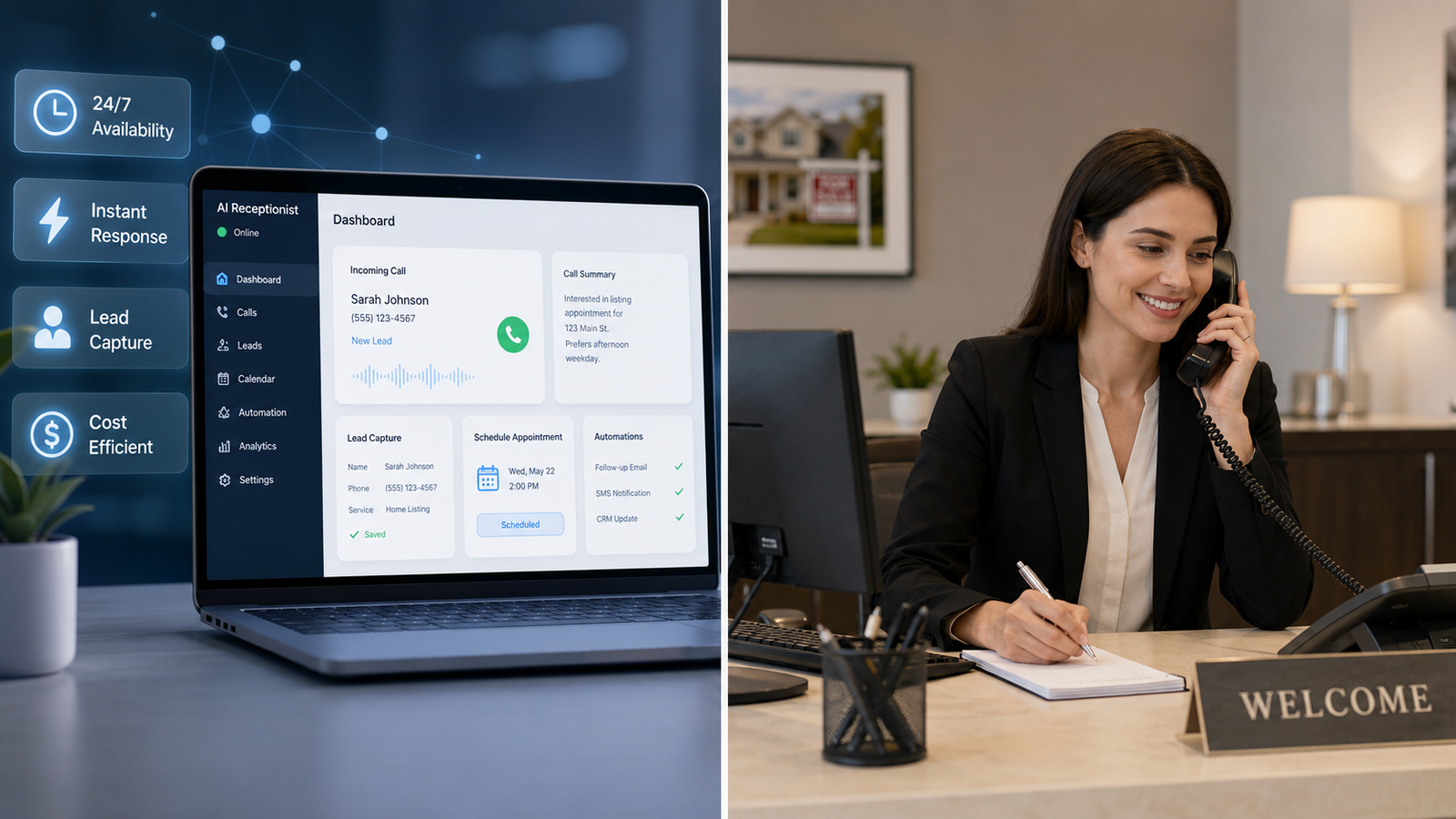
A side-by-side look at cost, coverage, and consistency, so you can decide with real numbers instead of a gut feeling.
By Derrick Houston, Founder of DH Digital Consulting
You have a business that’s growing fast enough to need help answering the phone, and slow enough that you’re doing the math twice before you spend the money. I get that. Most of the owners I talk to are stuck between two options that both feel risky: hire a person and take on payroll, training, and turnover, or bring in an AI receptionist and worry it’ll sound cheap and cost you the lead anyway.
Here’s the direct answer. An AI receptionist like EchoAssist typically costs a fraction of a full-time hire, answers every call including nights, weekends, and lunch breaks, and never quits without notice. A human receptionist brings judgment, rapport, and flexibility an AI can’t fully replicate, but only during the hours they’re scheduled and only as long as they stay in the role. The right choice depends on your call volume, your budget, and how much of your business actually needs a human voice versus reliable coverage.
Neither option is universally better. What matters is matching the tool to the job in front of you.
Key Takeaways
- A full-time receptionist costs significantly more than the salary you post in the job ad once benefits, hiring, and training are factored in.
- Customer service and reception roles have some of the highest turnover rates of any job category, which means the cost of hiring rarely ends after the first hire.
- A single full-time receptionist physically cannot cover all the hours your phone rings, even before accounting for breaks, sick days, and vacation.
- An AI receptionist answers every call, every time, but it only performs as well as the setup behind it.
- Most service businesses don’t actually face an either-or choice. The real decision is which calls need a human and which calls need to simply get answered.
Why This Decision Feels Harder Than It Should
I’ve sat across from business owners who describe this exact fork in the road. They know a full voicemail box is costing them leads. They also know that hiring the wrong person, or hiring right and losing that person eight months later, creates its own kind of chaos. So they freeze. The phone keeps ringing into voicemail while they wait for a decision that feels big enough to deserve more research.
Part of the problem is that most of the information out there is written by companies selling one side of the comparison. AI receptionist companies will tell you humans are expensive and unreliable. Staffing agencies will tell you AI sounds robotic and customers hate it. Neither one is giving you the full picture, because neither one makes money on the honest answer, which is that this depends on your business.
I’m not in the business of telling you AI replaces people. I’ve built EchoAssist specifically for the businesses I work with, real estate agents and service owners who are out doing the job all day, not sitting at a desk. For a lot of them, the honest comparison isn’t AI versus a great receptionist. It’s AI versus no coverage at all, because that’s the real alternative they’re living with right now.
What the Numbers Actually Say
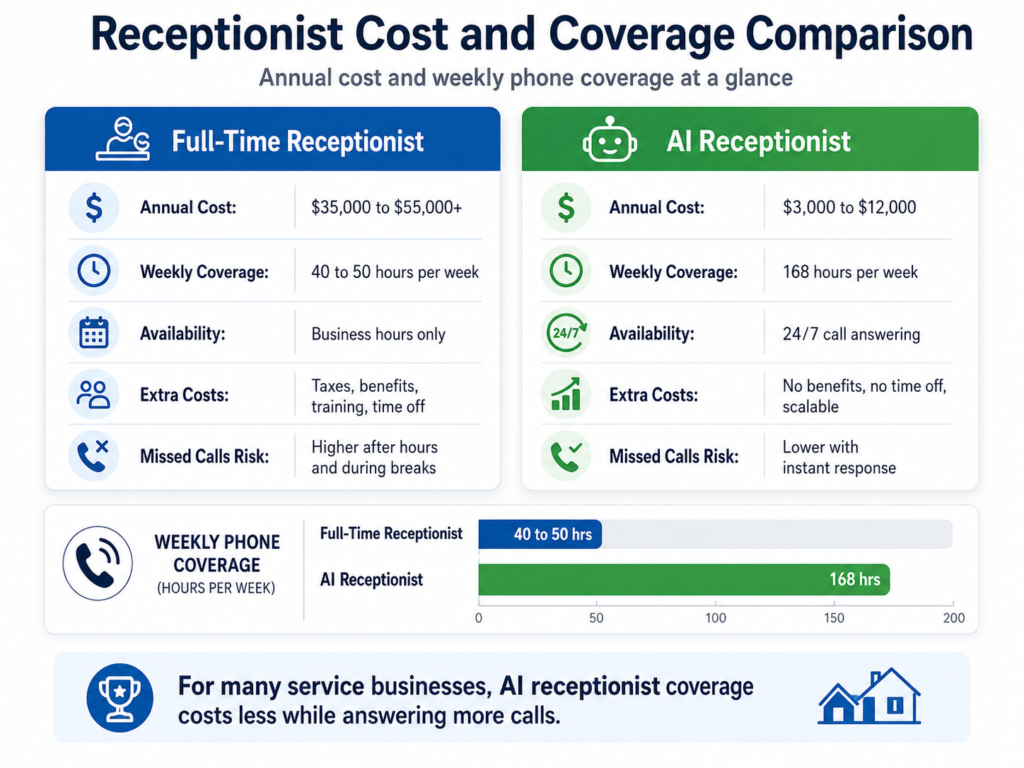
Let’s start with what a full-time receptionist really costs, because the number on a job posting is not the number you’ll pay. The Bureau of Labor Statistics puts the median receptionist wage at $37,230 a year, or about $17.90 an hour, based on its most recent wage data. That’s the starting point, not the total.
Wages only make up about 70 percent of what an employee actually costs a business, once you add payroll taxes, health insurance, paid time off, and other benefits. Applying that ratio to the median receptionist wage puts the fully loaded annual cost closer to $53,000. On top of that, the Society for Human Resource Management reports an average cost-per-hire of $5,475 for non-executive roles as of its most recent benchmarking data, covering job postings, interview time, background checks, and onboarding.
Then there’s turnover. Customer service and reception roles carry some of the highest turnover rates of any job category, with industry research from Insignia Resources putting annual turnover in customer-facing roles between 30 and 45 percent. That means a business with even one or two front-desk employees should expect to go through this hiring cost again within a couple of years, not once and done.
Coverage is the other half of the equation, and it’s simple math. A 40-hour work week covers 40 of the 168 hours in a week, which is about 24 percent. The other 76 percent, including evenings, weekends, and holidays, has no phone coverage at all from a single full-time hire. That’s before subtracting lunch breaks, sick days, and the days someone is simply out.
None of this means hiring a receptionist is a bad decision. It means the honest cost of that decision is higher and less complete than most owners assume when they start the process.
The Real Question Isn’t AI vs. Human
Here’s where I think most of this comparison goes wrong. It gets framed as a replacement decision, like you’re choosing between a person and a machine to fill one identical role. That’s not actually the choice in front of you.
The real question is what happens on the calls that fall outside your coverage window. The lead who calls at 7pm because that’s when they finally had a free minute. The existing client who calls during your lunch. The prospect who calls while your receptionist is out sick and nobody thought to forward the line. Those calls don’t care that you have a great receptionist. They only know whether someone answered.
An AI receptionist isn’t trying to be your best employee. It’s trying to make sure the phone never goes unanswered, so the calls that would have hit voicemail actually get captured, qualified, and handed to you or your team to close. A human receptionist brings something AI can’t fully replicate: the judgment to read a difficult situation, build rapport in a longer conversation, and handle the exceptions that don’t fit a script. Those are real strengths, and for some businesses, especially ones with high-touch, complex front-desk work, they matter enough to justify the cost.
The businesses I work with most often need both problems solved, and rarely have the budget to solve either one perfectly with a person alone.
How to Actually Compare the Two for Your Business
This is where I tell clients to stop comparing features and start comparing what each option does for the specific calls their business gets. Here’s how that plays out.
If your call volume is low and mostly happens during business hours, a part-time or full-time receptionist may genuinely be the better fit. You’re not paying for coverage you don’t need, and you get the human judgment on every call.
If your calls come in around the clock, or you’re the one answering the phone between job sites and showings, an AI receptionist closes the coverage gap that a single hire physically cannot. This is the scenario I built EchoAssist to solve.
If you already have a receptionist but you’re bleeding leads after hours, on weekends, or during lunch, you don’t have to choose one or the other. Plenty of my clients run both: a person during the day, EchoAssist filling in every hour that person isn’t at the desk.
If setup quality is your worry, that’s a legitimate concern, but it’s a setup problem, not a category problem. An AI receptionist that doesn’t know your services, your service area, or your qualifying questions will sound generic and lose the caller’s trust fast. That’s true of a poorly trained human receptionist too. The fix isn’t avoiding AI. It’s building the system correctly before it ever answers a call, which is exactly what I walk through with every EchoAssist setup.
Steps to Make the Decision With Real Numbers
- Calculate your true coverage gap. List the hours your phone rings each week and compare that to the hours you currently have someone answering it. The difference is your exposed window.
- Total the full cost of a hire, not just the wage. Use the BLS median wage as a starting point, then add roughly 40 to 50 percent for benefits, plus your one-time hiring cost, before comparing it to any alternative.
- Identify the calls that can never go to voicemail. Emergency service calls, new leads, and existing clients with urgent issues belong in this category. Everything else has more flexibility.
- Decide whether you need judgment or coverage on your hardest calls. If your toughest calls require nuanced, in-the-moment decisions, weight that toward a human. If they mostly require fast, accurate information and a booking, that’s a strong fit for AI.
- Consider a hybrid model before assuming it’s one or the other. A person for scheduled hours and an AI receptionist for everything outside that window often costs less than a second hire and closes the coverage gap completely.
- Test before you commit long term. Whichever direction you go, run it for 30 days and track how many calls were captured that would have otherwise gone unanswered.
Frequently Asked Questions
Can an AI receptionist handle scheduling and calendar bookings?
Yes. A properly configured AI receptionist can check availability, book appointments directly into your calendar, and send confirmations, the same way a human receptionist would. The key is connecting it to the calendar and booking system you already use so nothing has to be entered twice.
Does adding an AI receptionist mean I have to let my current receptionist go?
No. Many service businesses keep their receptionist for scheduled hours and add an AI receptionist to cover evenings, weekends, and lunch breaks. The two roles complement each other instead of competing, since the AI only handles what would otherwise go unanswered.
Will customers know they’re talking to AI instead of a person?
A well-built AI receptionist identifies itself honestly while still sounding professional and matching your business’s tone. The goal isn’t to trick callers. It’s to make sure whoever answers, human or AI, gives the caller accurate information and a clear next step.
What happens when the AI can’t answer a caller’s question?
A good AI receptionist setup includes escalation rules for exactly this situation. Complex or unusual questions get routed to you, a team member, or a callback request, so the caller never hits a dead end even when the AI reaches the edge of what it can handle.
What is an AI receptionist, exactly?
An AI receptionist is a software service that answers incoming business calls, asks qualifying questions, books appointments, and routes urgent issues, all using a script built around your specific business. It functions like a virtual front desk that never clocks out.
The Bottom Line
I don’t think this comparison should end with a winner. It should end with clarity about what your business actually needs covered and what it can afford to leave uncovered. A great receptionist is worth every dollar for the business built to use one well. An AI receptionist is worth every dollar for the business that’s been quietly losing leads to a full voicemail box for months.
The expensive mistake isn’t picking the wrong option. It’s not picking either one, and letting the phone keep ringing into nothing while you decide.
If you want to see what real coverage looks like for your specific call volume, book your free EchoAssist demo and I’ll walk you through it using your own numbers, not a generic pitch.
Keep Learning
- How Missed Calls Become Lost Revenue for Service Businesses — The math behind what an unanswered call actually costs you.
- Why Voicemail Is Not a Lead-Response Strategy — What a prospect experiences the moment they hit your voicemail box.
- What an AI Receptionist Should Know About Your Business Before It Answers a Call — what actually goes into making an AI receptionist sound like a trained hire.
- How an AI Receptionist Works for a Busy Home-Service or Real-Estate Business — see the coverage this comparison is built around, call by call.
About the Author
Derrick Houston is the founder of DH Digital Consulting, LLC, where he helps solo entrepreneurs and small service business owners put AI to work in their business instead of adding one more thing to their plate. He built EchoAssist, DH Digital’s AI receptionist service, after watching real estate agents and service business owners lose leads to missed calls they had no time to answer themselves.