

TLDR
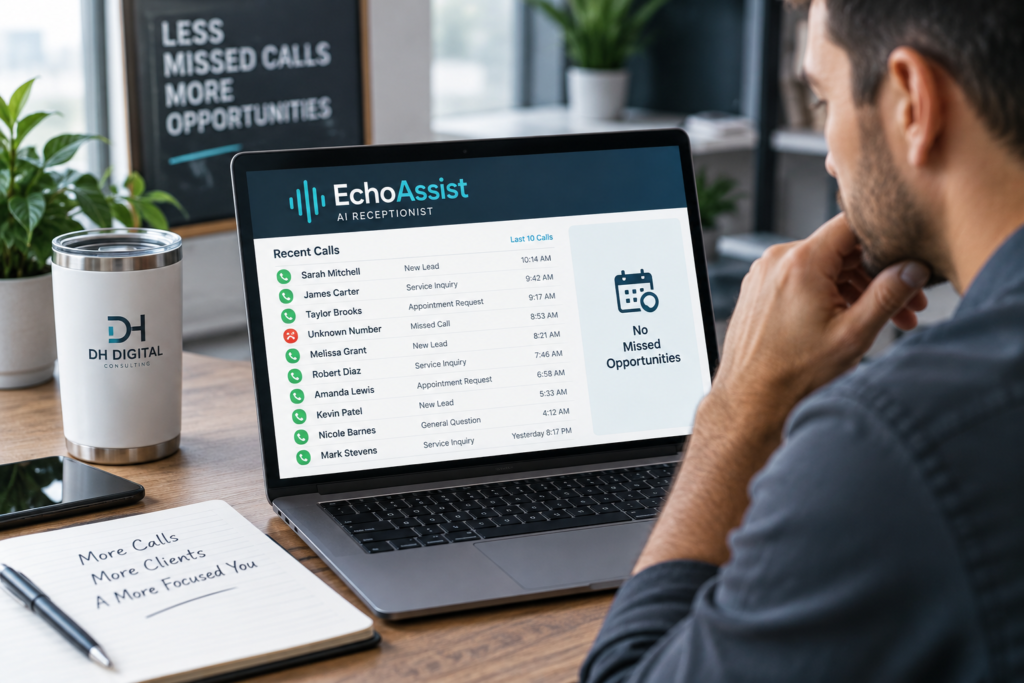
Pull up your phone right now, look at your last ten missed calls, and this EchoAssist missed call demo walks through what would have happened to each one if EchoAssist had answered instead of your voicemail. Some calls were quick questions. Some were ready to book. A few were probably gone for good the moment they hit voicemail. This post shows you how to run that exercise yourself, call by call.
Key Takeaways
- Your call log is a better diagnostic tool than any sales pitch; it shows exactly what you lost last week.
- Most missed calls are not spam. They are people who already decided to spend money and needed one more step.
- EchoAssist answers, asks qualifying questions, and books the appointment directly into your calendar before the caller hangs up.
- Voicemail is not a backup plan. Most callers who reach voicemail do not call a second time.
- Running your own ten calls through this exercise takes about five minutes and tells you more than any demo video.
Fun Fact
Phone leads convert at roughly ten times the rate of leads that come through a web form, according to industry benchmarking cited by SchedulingKit. That single number explains why an unanswered phone costs more than an abandoned contact form ever will.
Expert Insight
In my work with real estate agents and small service business owners, the call log tells a more honest story than any sales conversation I could have with them. Owners assume most missed calls are wrong numbers or robocalls. When we actually sit down and listen to the voicemails together, the pattern I see in roughly half these reviews is that six or seven of the last ten calls were real, ready buyers who simply called at the wrong moment. That is not a marketing problem. That is a coverage problem, and it has a direct fix.
Pull Up Your Call Log Before You Read Another Word
Take out your phone and open your recent calls. Filter for missed calls and count back ten. This EchoAssist missed call demo only works if you have real numbers in front of you, not a hypothetical business. Write down the time each call came in and whether the caller left a voicemail.
Ten missed calls is not an abstract number. It is ten specific moments when someone needed your business enough to dial the number, and something on your end kept that conversation from happening. Some were during a job site visit. Some were at 9 p.m. Some were probably during your lunch.
What Is an EchoAssist Missed Call Demo?
An EchoAssist missed call demo is a walkthrough that takes a business owner’s actual recent missed calls and shows, one by one, how EchoAssist would have answered, qualified, and booked each caller instead of sending them to voicemail. It uses real data from the reader’s phone rather than a scripted example, which makes the value concrete instead of theoretical. The point is not to impress you with features. The point is to show you what specifically happened to your last ten calls and what would happen differently going forward.
EchoAssist is an AI receptionist built to answer, screen, and book calls for small service businesses without a human on the line. It handles the conversation the way a trained front desk person would, then drops the outcome directly into your calendar.
Call One: The After-Hours Caller Who Never Tried Again
Look at your list. Chances are one of those ten calls came in after 6 p.m. or on a weekend. That caller heard ringing, then silence, then maybe a generic voicemail greeting. Nothing in that sequence told them you were reliable.
A missed call after hours is not a lead lost to bad timing; it is a lead lost to the absence of a system.
EchoAssist answers that same call at 9 p.m. with the same tone it would use at 9 a.m. It asks what the caller needs, confirms the service area, and offers the next available slot. The caller books before they even consider calling your competitor.
Call Two: The Quick Question That Didn’t Need a Human
One of your ten calls was probably someone asking a simple question. Do you service their zip code. What are your hours. Do you take a certain type of payment. These calls rarely need a live person, but they still need an answer in the moment.
EchoAssist has your business information loaded and answers these directly. No hold music, no callback promise. The caller gets what they need and, in many cases, keeps talking long enough to book anyway.
Call Three: The Ready Buyer Who Called a Competitor Next
This is the expensive one. Somewhere in your ten missed calls is a person who had already decided to spend money and just needed someone to say yes. Davinci Virtual’s research on missed call costs shows these losses run into real dollar ranges depending on industry, from home services to legal to dental work.
The most expensive missed call is never the one from a stranger; it is the one from someone who already chose you and got no answer.
EchoAssist qualifies this caller with a few direct questions, confirms the job scope, and books the appointment on the spot. No callback window, no chance for them to change their mind or find someone else.
How Do Businesses Lose Money From Missed Calls?
Businesses lose money from missed calls because most callers who reach voicemail simply hang up and call the next option instead of waiting for a callback, and each of those calls represents a customer who had already decided to spend money. SchedulingKit’s data shows 62 percent of small business calls go unanswered and 85 percent of those callers never call back. Multiply that against the average value of your typical job or appointment and the number stops being abstract.
The pattern repeats across industries. A missed call at a dental office is a lost patient exam. A missed call at a plumbing company is a lost service ticket. A missed call for a real estate agent is a lost showing request. None of these are hypothetical losses; they are calendar slots that stayed empty.
Call Four Through Seven: The Ones You Probably Forgot About
Keep scrolling your list. Somewhere in calls four through seven you will find a mix: a wrong number, a solicitor, and at least one or two more genuine customers. This is where the exercise gets useful, because it forces you to separate noise from real revenue.
- A caller asking about pricing before deciding whether to book.
- A returning customer trying to reschedule.
- A referral from a friend who does not know your normal hours.
- A caller comparing you against two competitors in the same afternoon.
EchoAssist treats each of these differently based on what the caller says, following conversational branches rather than a rigid script. The rescheduling caller gets moved directly on the calendar. The comparison shopper gets qualified and offered a slot before they finish calling the second business on their list.
Call Eight: The One That Came in While You Were Already on the Phone
At least one of your ten missed calls probably happened while you were talking to someone else. A single phone line means every incoming call competes with the one already happening. That is not a staffing failure; it is a structural limit of having one person answer one phone.
EchoAssist has no such limit. It handles simultaneous calls the same way a multi-line answering service would, without needing a second employee on payroll. TechnologyAdvice’s independent review of AI answering services confirms this kind of simultaneous handling and CRM integration is now standard among the top-rated platforms in the category.
Call Nine and Ten: The Late-Night and Early-Morning Gaps
Round out your list with the earliest and latest calls in your ten. These usually cluster right before opening or right after closing, exactly the windows most businesses treat as off-limits. Dialfyne’s data on call timing backs this up, showing high-intent calls concentrated outside standard hours.
The gap between when customers call and when businesses answer is where most missed revenue actually lives.
EchoAssist closes that gap entirely. It does not have a shift schedule, so the 6:45 a.m. call and the 11:15 p.m. call get the same qualifying questions and the same booking flow as a call at noon.
What Do You Do With This List Once You’ve Reviewed It?
Once you’ve reviewed your ten missed calls, tally how many were genuine business opportunities versus noise, then estimate the dollar value of the jobs or appointments you likely lost from that single week. That number, multiplied across a month or a year, is the real cost of relying on voicemail. It is also the clearest way to decide whether an AI receptionist like EchoAssist is worth adding to your business.
Most owners run this exercise and find at least half their missed calls were real. That is not a marketing claim; it is what shows up when you actually count.
See It Work on Your Own Numbers
You do not need to imagine what EchoAssist would do with a stranger’s call log. Bring your own ten missed calls into a live session and we will walk through each one, matching it against how EchoAssist handles that exact scenario in tools like GoHighLevel for scheduling and follow-up. Nothing here is a generic pitch; it is your data against a live system.
Book your free EchoAssist demo and bring your call log with you: Book a Demo. You can also look through our other work at DH Digital Services or browse more posts on DH Digital Blogs.
Frequently Asked Questions
How do I find my last ten missed calls on my phone?
Open your phone’s call log and filter or scroll to the missed calls, which every iPhone and Android device tracks automatically with a timestamp. Note the time of day, whether the caller left a voicemail, and whether you recognize the number, since those three details determine how EchoAssist would have handled each one.
What does an AI receptionist actually say when it answers a call?
EchoAssist answers in a natural voice, states the business name, and asks what the caller needs, the same opening a trained front desk employee would use. From there it follows a script built around your services, asking qualifying questions like the type of job, the location, and the preferred timing before offering available appointment slots.
Does EchoAssist work for calls that come in after business hours?
Yes, EchoAssist answers around the clock, including nights, weekends, and holidays, without needing anyone on staff. Dialfyne’s research found that 45 percent of high-intent calls happen outside standard business hours, which means a huge share of your best leads are currently calling into silence.
Will EchoAssist sound robotic to my customers?
No, EchoAssist uses conversational voice technology designed to sound like a person on the other end of the line, not a menu of button presses. Callers respond to it the way they would respond to a receptionist, answering questions naturally and moving through the booking flow without friction.
Can EchoAssist actually book an appointment on the call?
Yes, EchoAssist checks your calendar in real time and books directly into an open slot before the call ends. The caller hears a confirmation, and the appointment appears on your schedule the same way it would if you had booked it yourself.
What happens to the missed calls I already lost this month?
Those calls are gone in the sense that you cannot retroactively answer them, but the pattern in them is not gone. Reviewing your last ten missed calls shows you exactly what kind of caller you are losing and how often, which is the same information EchoAssist uses going forward to prevent the next ten from disappearing.
How is EchoAssist different from a regular voicemail system?
Voicemail records a message and waits for you to call back, and most callers never wait for that callback. EchoAssist has a live conversation, qualifies the caller, and books the appointment in the moment, so nothing depends on you finding time later.
Next Steps
Go run the exercise. Pull up your last ten missed calls, read through this post again call by call, and count how many of them were real opportunities sitting in your voicemail box right now. That number is your answer to whether EchoAssist belongs in your business.
Book your free EchoAssist demo and bring your actual call log with you: Book Demo now. We will walk through your real calls, not a generic script, and show you exactly what would have happened to each one.