TLDR
An AI receptionist for a one-person business is worth it when missed calls are costing more in lost jobs than the service costs per month, which for most solo operators happens faster than they expect. A solo plumber, electrician, or contractor who is elbow-deep in a job cannot answer a ringing phone, and every unanswered call has a real chance of becoming a competitor’s invoice instead of yours. The math below shows what missed calls actually cost, and where EchoAssist AI fits for a business with no staff to spare.
Key Takeaways
- A solo operator on a job site cannot answer the phone and do the work at the same time; something has to give.
- Missed calls are not neutral. A large share of callers move on to the next business rather than leave a voicemail.
- The revenue lost to missed calls is often several times higher than what call coverage would cost per month.
- An AI receptionist for a one-person business only makes sense if it is priced and built for that scale, not repurposed enterprise software.
- EchoAssist AI is designed specifically for solo operators who need coverage without hiring anyone.
Fun Fact
The average person decides whether to hang up or wait on hold within the first four rings. For a solo operator without a receptionist, that is roughly twelve seconds to either answer, silence the phone, or lose the call entirely. There is no fourth option once the ring stops.
Expert Insight
In my work with real estate agents and small service business owners, the pattern is consistent. The people running a one-person operation are not bad at sales or bad at follow-up. They are simply unavailable at the exact moment a new customer decides to call, because they are on a roof, under a sink, or in someone else’s driveway. The fix has nothing to do with hustling harder. It has to do with making sure the phone gets answered by something other than a voicemail box that most callers never bother to use.
What Happens When a Solo Operator Misses a Call
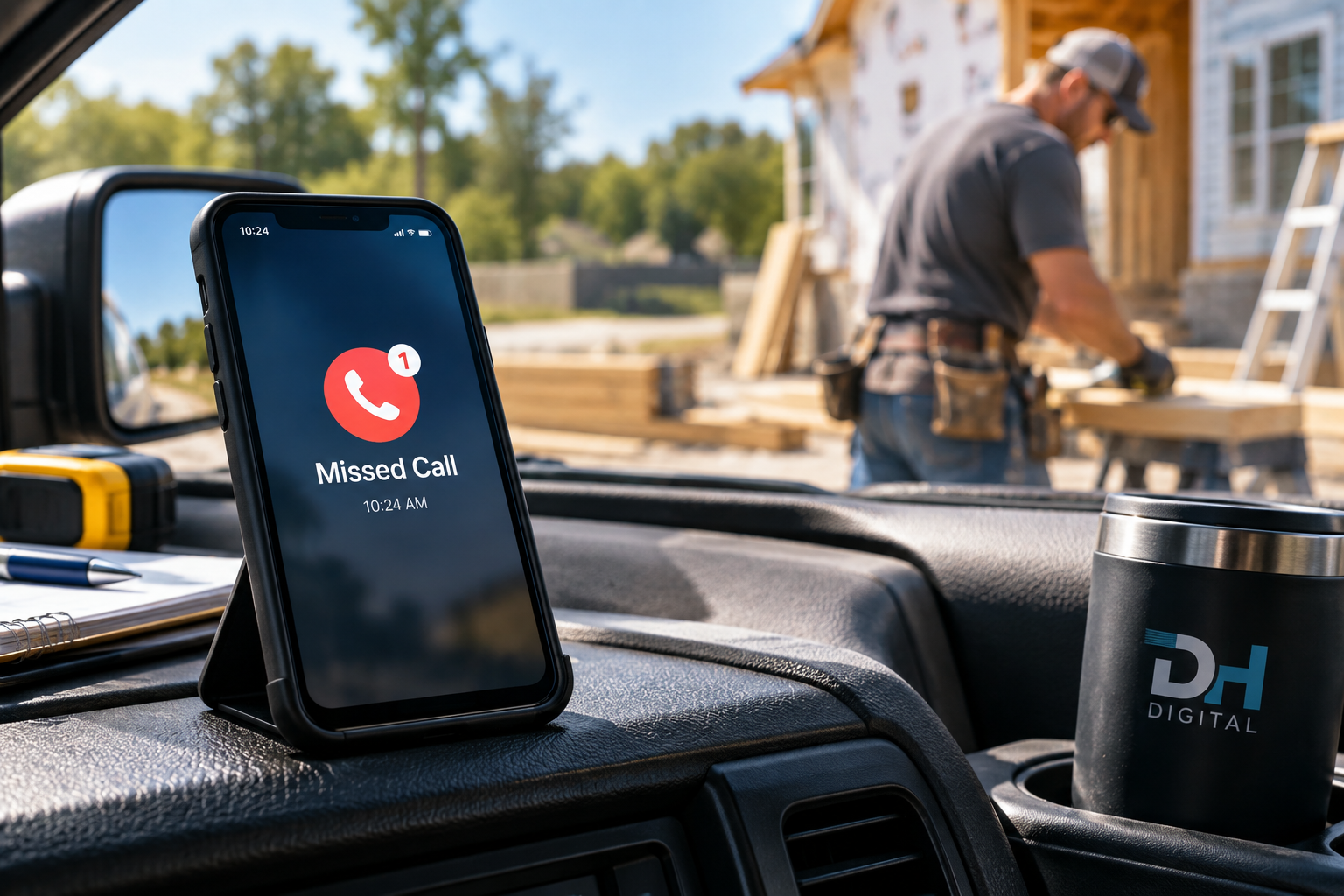
A solo operator loses two things every time the phone rings unanswered: the immediate job and, more often, the customer entirely. Someone calling a plumber, electrician, or contractor rarely waits around. If the call goes to voicemail, many callers hang up and dial the next name on their list instead of leaving a message.
An AI receptionist for a one-person business is a call answering system that picks up every call instantly, asks qualifying questions, and books appointments without a human on the other end. It exists specifically for people who cannot staff a front desk because there is no front desk, just a truck, a toolbox, and a phone that goes quiet the second work starts.
The problem is not effort. It is math. One person cannot be in two places, and a ringing phone during a job means a choice between finishing the work correctly or answering a stranger who might not even leave a message.
How Much Does a Missed Call Actually Cost a Solo Business?
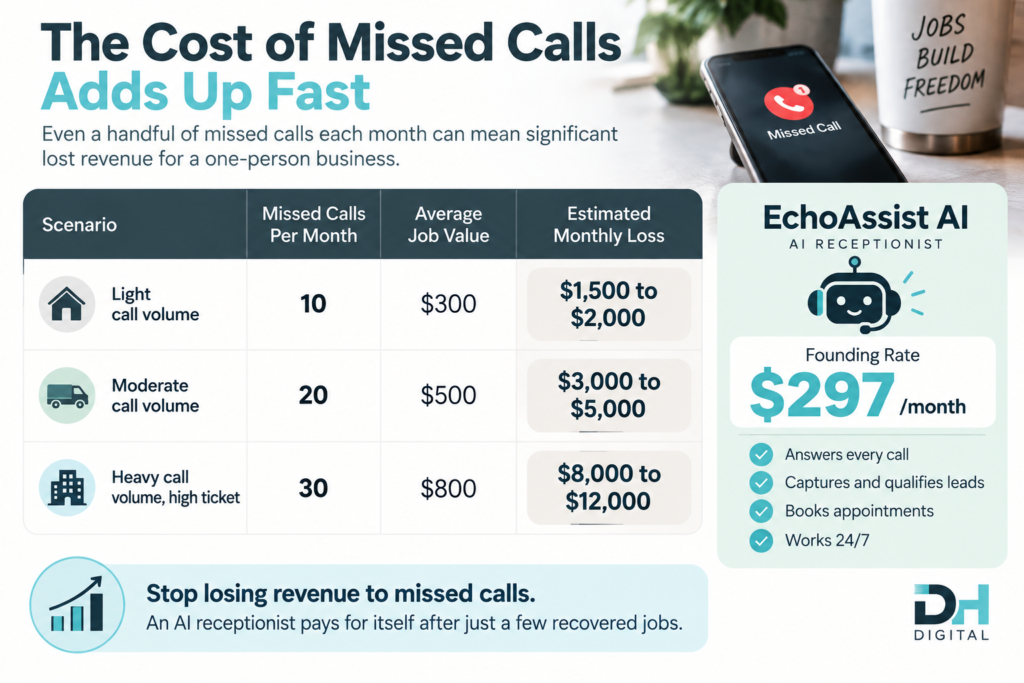
A missed call costs a solo business the value of that job multiplied by the odds the caller does not call back, and research on contractor call behavior shows those odds are worse than most owners assume. Independent research on missed calls in home service businesses found that a large majority of callers move on to a competitor rather than leave a voicemail, and that unanswered calls can cost a typical contractor over $75,000 a year in lost revenue.
That number sounds large until you break it down. A separate 2026 study on missed call revenue uses a simple formula: missed calls multiplied by conversion rate multiplied by average job value. Under that formula, missing just thirty calls a month can translate into $25,000 to $75,000 a year in lost work, depending on job size.
A missed call is not a neutral event. It is a lost customer waiting to happen.
Another breakdown from after-hours call answering research for contractors walks through a familiar scenario: a solo contractor finishing a twelve-hour day, letting an unfamiliar number go to voicemail, and missing two calls a week at a $500 average job. That alone works out to roughly $52,000 a year in lost revenue, all from calls that were never picked up.
- One missed call at a $500 job value equals $500 in immediate risk.
- Two missed calls a week at that value equals over $50,000 a year.
- A single missed high-ticket job can outweigh months of any call coverage expense.
Is Call Coverage Overkill for a Business With No Staff?
Call coverage is not overkill for a solo business; it is closer to a requirement, because the owner is the only line of defense between a ringing phone and a lost customer. A business with employees can shift an unanswered call to someone else on the team. A solo operator has no one to hand it off to, which makes every missed call a direct hit to that person’s own income.
The real question is not whether coverage helps. It is whether the cost of coverage is lower than the cost of what gets missed without it. Vendor-neutral research on AI receptionist costs and ROI for small businesses shows that a trades business missing about twenty calls a month can recover roughly $1,350 a month in revenue with a service costing $100 to $200 a month. That same research is honest that very low-ticket businesses may not break even, which matters for anyone deciding if this fits their specific job values.
These are estimates, not guarantees, but the pattern holds across every source above. The cost of missing calls scales with job value and volume, while the cost of an AI receptionist does not scale nearly as fast.
What Does an AI Receptionist Actually Do for a One-Person Business?
An AI receptionist answers every incoming call in real time, asks the right qualifying questions, and books the job or schedules a callback, all without the owner having to stop what they are doing. It does not replace judgment on complex jobs. It handles the repetitive first step every call needs: someone or something picking up the phone.
EchoAssist AI was built around this exact scenario, a business of one, with no receptionist and no plans to hire one. It answers calls around the clock, captures the caller’s information, and routes anything urgent straight to the owner instead of leaving it buried in a missed call log.
Coverage built for a team of twenty does not fit a team of one, and pricing should reflect that difference.
Solo operators do not need enterprise call center software. They need something closer to a dependable extra set of hands that only handles the phone, priced in a way that matches a one-person budget instead of a corporate one.
When Does the Math Favor an AI Receptionist?
The math favors an AI receptionist as soon as the estimated monthly loss from missed calls exceeds the monthly cost of the service, which for most solo trades and service businesses happens within the first ten to twenty missed calls. Below that threshold, a simple voicemail message with a callback promise might be enough.
- Estimate how many calls you miss in a typical week while working.
- Multiply that by your average job value.
- Multiply that by the rough percentage of callers who convert into paying customers.
- Compare that number against the monthly cost of an AI receptionist service.
If the loss number is higher, coverage pays for itself. If it is lower, the business may not yet need it, and that is a fair outcome too. Not every solo operator has the same call volume or job value, and the decision should follow the numbers rather than a trend.
A one-person business does not need more software. It needs the one system that stops revenue from leaking out through a silent phone.
For a business of one, every hour spent on the tools instead of the customer is an hour without income. Call coverage exists to close that specific gap, nothing more and nothing less.
Deciding whether an AI receptionist for a one-person business is worth it comes down to a direct comparison: what you lose by missing calls against what you spend to stop missing them. The research consistently shows the loss side is larger than most solo operators assume, which is why this decision is worth running the numbers on rather than guessing.
Frequently Asked Questions
Do I need an AI receptionist if I work alone?
You need one if missed calls are turning into lost jobs, which is common for solo operators who cannot check the phone while working.
How much money do missed calls actually cost a solo business?
It depends on your average job value and how many calls you miss, but even a handful of missed calls a week can add up to tens of thousands of dollars a year in lost revenue.
What is an AI receptionist for a one-person business?
It is a call answering system that picks up, qualifies, and books calls automatically so a solo operator never has to choose between working and answering the phone.
Is an AI receptionist worth it if I only get a few calls a day?
Yes, because even low call volume carries risk if those calls are high-value jobs, and one missed call at a high price point can outweigh months of service fees.
Will callers know they are talking to an AI receptionist?
Most callers care more about getting a helpful, fast answer than about who or what answers, and a well-configured system handles scheduling and basic questions without frustrating the caller.
How is this different from a regular answering service?
A traditional answering service still relies on a human being available to take the call, while an AI receptionist answers instantly, every time, without needing shifts or staffing.
Does EchoAssist AI work for solo contractors and tradespeople?
Yes, EchoAssist AI is built for exactly this kind of business, where one person handles both the work and the phone.
Next Steps
If missed calls are eating into jobs you should be winning, the fix is not hiring help you cannot afford or budget for yet. Book your free EchoAssist demo here and see how call coverage built for a one-person business actually works before you commit to anything.