A prospect who finds you online is not a lead yet. They are a person deciding, in seconds, whether you are worth the next click.
By Derrick L. Houston, Founder of DH Digital Consulting
A complete service-business lead path needs six things: clear positioning that tells a visitor what you do and who you do it for, a visible path to your services, proof that you deliver, a clear expectation for how fast you respond, more than one way to make contact, and one obvious next step. Miss any one of those and the path breaks somewhere between interest and inquiry, no matter how good your marketing was at getting the visitor there in the first place.
This is a planning guide, not a guarantee. Building a complete lead path does not promise a certain number of leads or a certain close rate. What it does is remove the friction that turns interested visitors into people who leave without ever reaching out.
Key Takeaways
- A lead path is everything a visitor experiences between finding you and contacting you, and every weak link in that chain costs you leads.
- Roughly 88 percent of “near me” local searches lead to a phone call within 24 hours, according to BIA Advisory Services research, which means your phone handling is part of your lead path, not separate from it.
- Typical service-business website conversion rates run 2 to 5 percent, and most of the gap between a weak site and a strong one comes down to clarity, proof, and an obvious next step, not traffic volume.
- Response time is part of the path, not an afterthought. A visitor who cannot tell how fast you will respond often assumes the worst.
- This is a planning framework, not a promise. Building a complete path improves your odds. It does not guarantee results.
Why Good Marketing Still Loses Leads
Plenty of businesses spend real money getting people to notice them. Ads, referrals, a strong Google listing, word of mouth. All of that work is designed to do one thing: get a person who needs your service to show up somewhere you can reach them, whether that is your website, your phone, or your inbox.
Here is what I see constantly. That marketing works. The visitor shows up. And then the business loses them anyway, not because the service is bad, but because the path from “interested” to “contacted you” has a gap in it somewhere. Maybe the site never clearly says what the business does or who it serves. Maybe there is no proof that this business is actually reliable. Maybe the phone number is buried, or worse, the phone rings and nobody answers.
Every one of those gaps is invisible from the inside. You know your business is good. You know you show up and do the work. A visitor does not know any of that yet. They are deciding, often in the first few seconds, whether to trust you enough to reach out, and a broken path gives them every reason to leave and try the next result instead.
What the Data Shows About the Path to Contact
BIA Advisory Services research, cited widely in local search studies, found that approximately 88 percent of “near me” searches result in a phone call within 24 hours. For service businesses and real estate agents, that number tells you something important: the phone is not a secondary contact option. It is often the primary one, and it is directly downstream of the search that brought the visitor to you in the first place.
Website conversion benchmarks for service businesses typically run between 2 and 5 percent, meaning for every 100 visitors, somewhere between two and five actually take a next step, whether that is calling, filling out a form, or booking an appointment. The gap between the low end of that range and the high end is rarely about traffic quality. It usually comes down to clarity of the offer, visible proof, and how easy the site makes it to take the next step.
The MIT and InsideSales.com Lead Response Management Study, which analyzed more than 15,000 leads across six companies, found that leads contacted within five minutes were 21 times more likely to qualify than leads contacted after thirty minutes. That finding applies just as much to a lead path as it does to a phone call. If your path does not set a clear response expectation, or worse, if a call comes in and nobody answers it, the strongest positioning and the best proof in the world will not save that lead.
The Reframe: A Lead Path Is a Chain, Not a Page
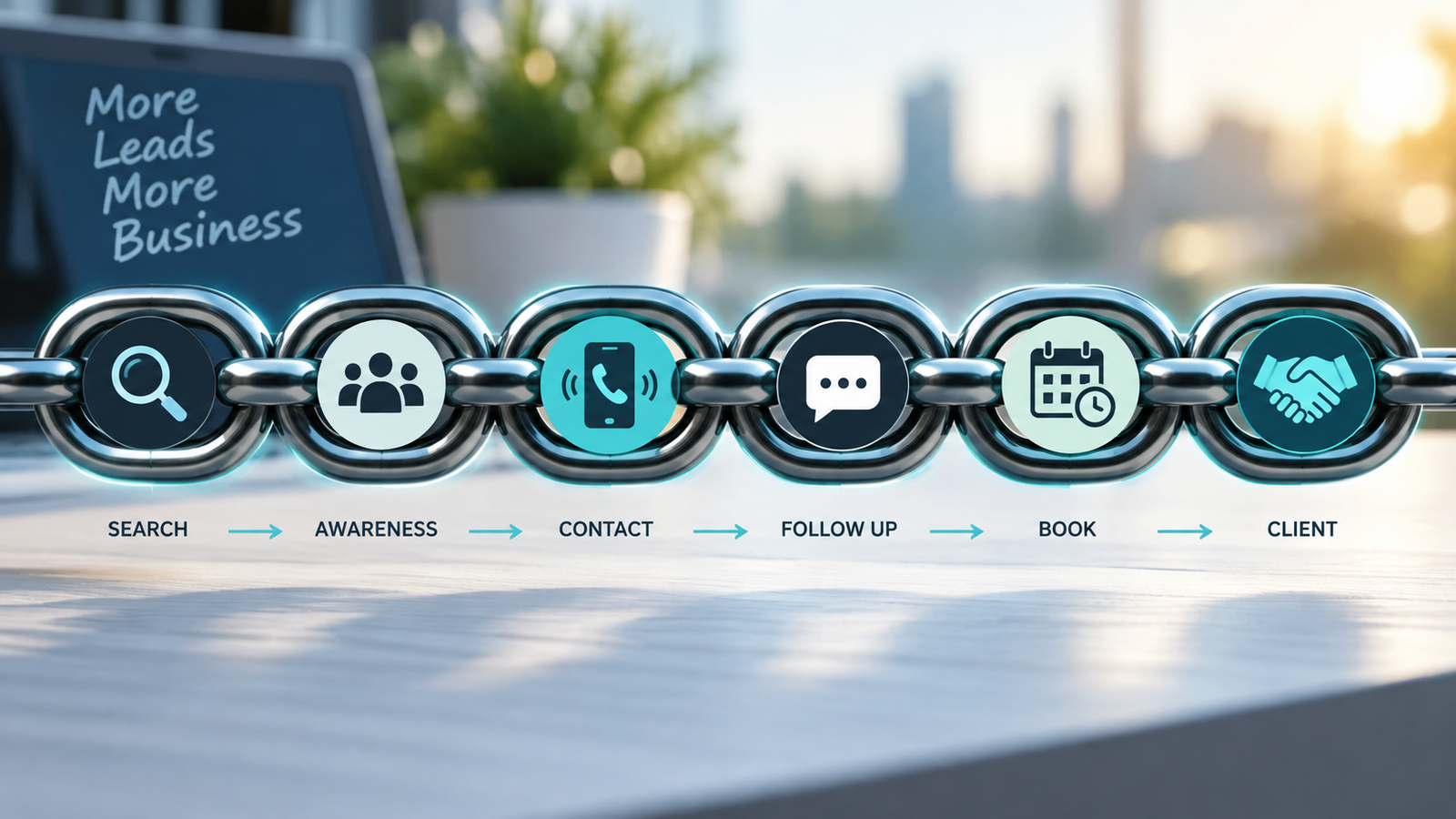
Most owners think about their website as the thing that generates leads. That framing misses what is actually happening. The website is one link in a longer chain that starts with a search or a referral and ends with a person deciding to trust you enough to reach out.
A chain is only as strong as its weakest link, and the weakest link is rarely the one owners spend the most time worrying about. I have seen beautifully designed websites lose leads because the phone number was hard to find. I have seen strong personal reputations lose leads because nobody explained what to expect after making contact. The fix is never “redesign everything.” It is finding the specific link that is breaking and repairing that one.
Thinking in terms of a chain, rather than a single page or a single tactic, is what lets you diagnose the actual problem instead of guessing.
The Six Links Every Lead Path Needs
1. Clear positioning. A visitor should be able to tell, within seconds, what you do and who you do it for. Not a slogan. A plain statement: what service, what area, what kind of client. Vague positioning forces the visitor to do work to figure out if you are relevant, and most will not bother.
2. A visible path to your services. Once a visitor knows what you do broadly, they need an easy way to see the specific service they need. Buried service pages, confusing navigation, or a single generic “services” page that does not distinguish between offerings all create friction here.
3. Proof that you deliver. Reviews, past work, credentials, years in business. Proof is what turns “this looks like what I need” into “I trust this business enough to reach out.” Without it, a visitor is taking your word for it, and most will not.
4. A clear response expectation. Tell the visitor what happens after they reach out. Will you call back today? Within the hour? Immediately? An unclear expectation makes visitors assume the worst, which is often that nobody will respond at all.
5. More than one way to make contact. A phone number for people ready to talk now, and a form or email for people who prefer to write first. Given that most local searches end in a phone call, the phone option needs to be the most visible one, not an afterthought at the bottom of a contact page.
6. One obvious next step. Every page should point toward a single, clear action, whether that is calling, booking, or requesting a quote. A page with five competing calls to action gives the visitor permission to do nothing.
How to Audit Your Own Lead Path
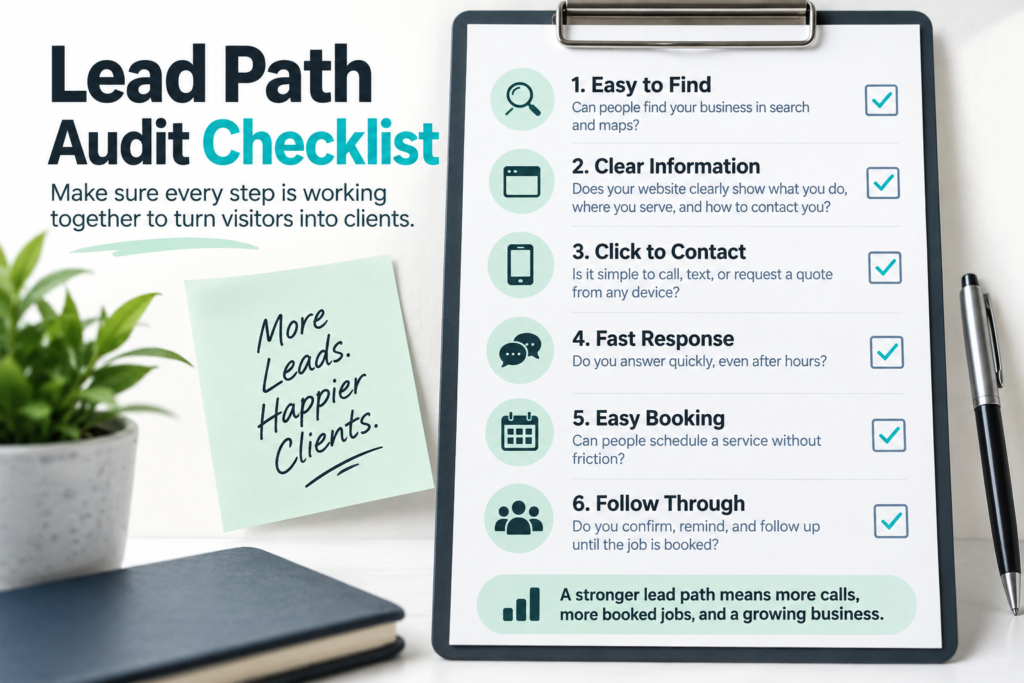
- Pretend you are a stranger and read your homepage cold. Can you tell, in the first ten seconds, what the business does and who it serves? If you have to search for the answer, a real visitor will not bother.
- Find your phone number on your own site, on a phone, in under five seconds. If it takes you longer than that, it is too hard to find. Given how often local searches turn into calls, this is one of the fastest fixes with the biggest payoff.
- Look for proof on your key pages. Reviews, examples of past work, credentials. If a page asks a visitor to trust you with no evidence, add proof before you touch anything else on that page.
- Check whether you state a response expectation anywhere. If a visitor has no idea whether you will call back in an hour or a week, add a specific, honest expectation, and then make sure your actual call handling meets it.
- Count your calls to action on your busiest pages. If a single page asks the visitor to call, fill out a form, download something, and follow you on social media, pick one primary action and make the rest secondary.
- Test your own contact path end to end. Call your own business number during business hours and see what happens. If it goes to voicemail, or nobody picks up, you have found your weakest link, and it is likely costing you more leads than any page-level fix would.
Frequently Asked Questions
Which link in the lead path matters most?
It depends on your business, but for most service businesses and real estate agents, the response link, what happens after someone calls or reaches out, tends to have the biggest impact. Strong positioning and proof get a visitor to make contact. What happens next determines whether that contact becomes a client.
Do I need to fix all six links at once?
No. Audit all six, but fix the weakest one first. A single serious gap, like an unanswered phone or no visible proof, usually costs more leads than several smaller issues combined.
Does a complete lead path guarantee more leads?
No, and it should not be presented that way. A complete path removes friction and improves your odds of converting the visitors you already have. It does not control how many visitors you get or guarantee any specific outcome.
How does call handling fit into a website-focused lead path?
Given that a large share of local searches end in a phone call, your call handling is part of your lead path whether you have thought of it that way or not. A great website with an unanswered phone is still a broken path.
Should real estate agents think about this differently than service businesses?
The six links apply the same way, but the proof and response-time expectations often carry more weight in real estate, since buyers and sellers are making a much larger decision and frequently reach out to more than one agent at once.
Every Gap Is a Lead You Already Paid For
You already did the hard part. Something, an ad, a referral, a search result, brought this person to you. The only question left is whether the path from there to a real conversation is clear enough for them to follow.
Walk your own path today. Call your own number. Read your own homepage like a stranger. Every gap you find and close is a lead you already earned, and almost lost for a reason that had nothing to do with whether you could actually help them.
See How EchoAssist Closes the Response Gap
Once you have audited your path, the call-handling link is usually the one with the biggest payoff. Book your free EchoAssist demo and see how EchoAssist makes sure every call that reaches your business gets answered, every time.
Keep Learning
- Why Won’t a Better Website Fix a Broken Lead-Response Process?: A closer look at why traffic and conversion are two different problems.
- Why Voicemail Is Not a Lead-Response Strategy: What actually happens to a lead when your response link breaks.
- How to Prepare Your Business for Better Lead Qualification: A framework for tightening the qualifying step once contact is made.
- The First Five Minutes After a Lead Calls: A Practical Follow-Up System: What should happen the moment a lead reaches out, once your path has done its job.
About the Author
Derrick L. Houston is the founder of DH Digital Consulting, LLC, based in Dallas-Fort Worth. He built EchoAssist, an AI receptionist service for real estate agents and small service businesses, after seeing how often a strong marketing effort got undone by a single broken link in the path to contact, most often an unanswered phone. Derrick works directly with each business to build a call-handling setup around how they actually operate, rather than selling a one-size-fits-all platform.