
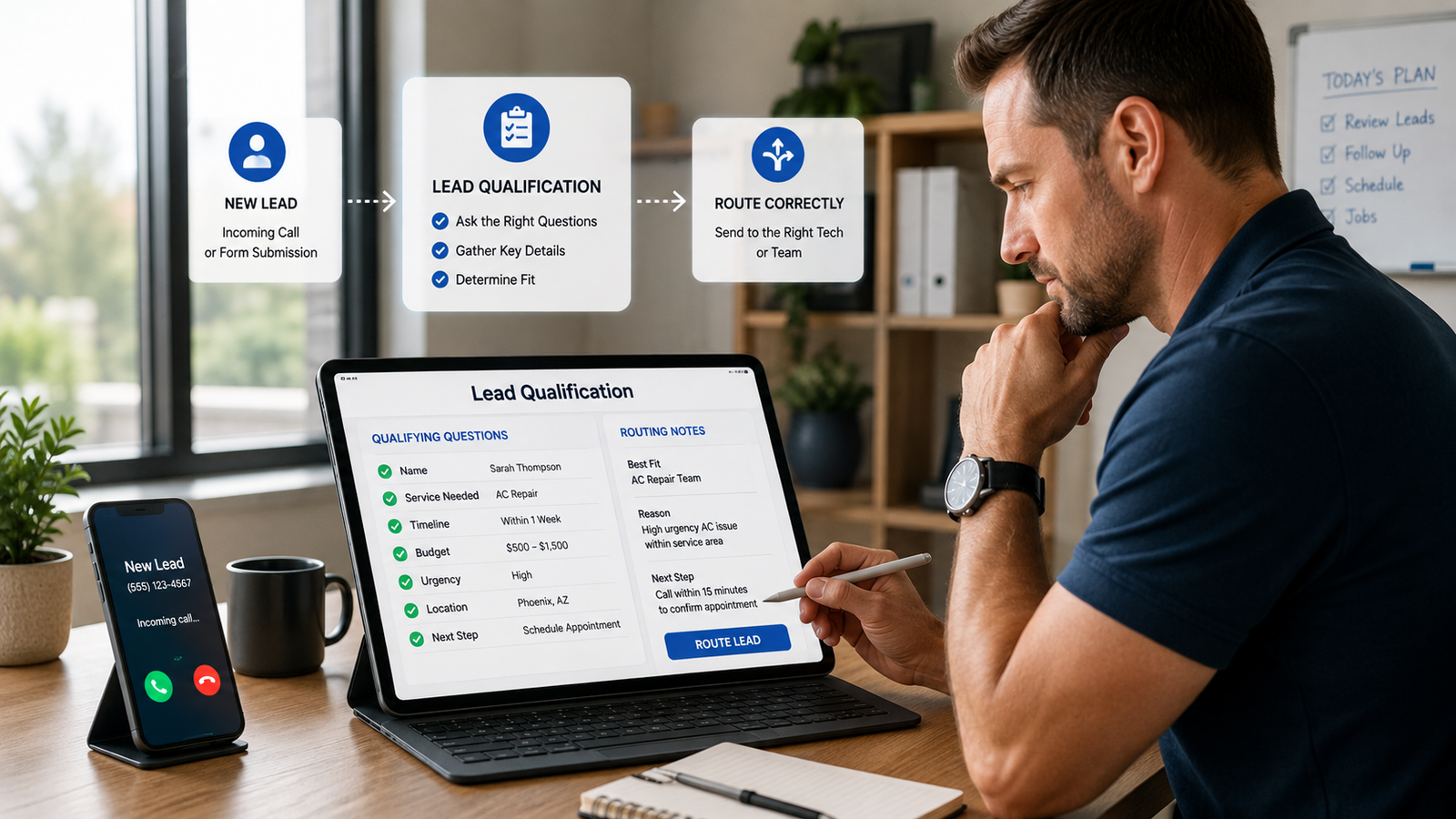
A lead qualification process is a written list of the questions you ask every new inquiry and the routing decision each answer triggers, so you know within minutes whether you are looking at a ready buyer, a nurture, or a pass.
By Derrick Houston, Founder of DH Digital Consulting
Ask ten service business owners what a “qualified lead” looks like and you will get ten different answers. Ask them to write it down and most of them cannot. They know it when they see it. That is the problem.
I hear a version of the same story from almost every real estate agent and service business owner I talk to: they are not short on leads, they are short on time, and the time gets spent in the wrong place. An agent spends an afternoon driving a buyer through four houses only to learn the buyer cannot get financing. A plumber quotes a full repipe, then finds out the homeowner was only ever going to spend two hundred dollars on a patch. Neither of those conversations was wasted because the lead was bad. It was wasted because nobody asked the right question early enough to know.
Here is the direct answer to the question in the headline. Better lead qualification is not about becoming pickier or interrogating people who call you. It is about deciding, in advance and in writing, what you need to know to route a lead correctly, then asking for that information the moment someone reaches out, not somewhere in the middle of a showing or a service call. Get the criteria and the questions right, and every lead sorts itself. Get them wrong, or skip them entirely, and every lead looks the same until you have already spent an hour finding out otherwise.
Key Takeaways
- A qualified lead is defined by a short, specific list of criteria your business sets in advance, not a gut feeling in the moment.
- Most owners lose time not because leads are low quality, but because nobody asks the questions that would sort a lead in the first sixty seconds of contact.
- Three to five qualifying questions, asked consistently, do more for your close rate than any amount of extra lead generation spend.
- Response speed and qualification work together. A fast response to an unqualified lead still wastes time; a slow response to a qualified one still loses the deal.
- Your CRM fields should mirror your qualifying questions exactly, so the answer a lead gives becomes data you can act on, not a note you forget.
Why Does Lead Qualification Feel So Hard to Pin Down?
The hard part is not the concept. Everyone agrees that some leads are worth more time than others. The hard part is that most service business owners never sat down and defined what “worth more time” actually means for their specific business, at their specific price point, in their specific service area.
So the qualification happens by accident, mid-conversation, after time is already spent. The agent finds out about financing on the drive to the third showing. The HVAC company finds out the homeowner is comparing five quotes only after sending a technician out for a free estimate. The lead was qualifiable from the first call. Nobody built the system to qualify it that early.
I have been building this exact system for my own business over the past few months. EchoAssist is still pre-launch, and every conversation I have with a real estate agent or a service business owner about becoming a founding member is, underneath it, a qualification exercise. I need to know quickly whether I am talking to someone who is out doing the work all day and missing calls because of it, or someone who has a receptionist on staff already and does not have the problem I solve. Neither answer is wrong. But if I do not ask, I spend thirty minutes on a call that a two-question form could have sorted in advance.
That is the trap. It feels productive to talk to everyone. It is not the same as talking to the right people first.
What Does the Research Say About Lead Qualification and Follow-Up?
Three data points, from three different corners of the industry, point at the same conclusion: speed and qualification are not competing priorities. They work together, and businesses that treat them separately lose on both.
The National Association of Realtors has found that roughly 78 percent of homebuyers end up working with the first agent who responds to their inquiry. Speed alone decides the majority of that market before a single showing happens. But the same research shows that the average agent converts internet leads at well under two percent, while agents and teams using a structured, rapid-response system report conversion rates closer to five percent. The gap between those numbers is not effort. It is process. The agents converting at five percent are not working harder than everyone else. They are responding faster and sorting faster, at the same time.
Research from InsideSales.com and MIT on lead response timing found that contact odds fall off sharply within the first minutes after an inquiry. A lead reached within five minutes is dramatically more likely to engage than the same lead reached thirty minutes later, and by the two-hour mark, most of that window has closed. This is the same research I have referenced in earlier posts about missed calls, and it applies just as directly here. A slow response does not just delay the sale. It delays, and often eliminates, the chance to even ask the qualifying questions that would have told you whether the sale was worth pursuing.
Real Trends research on buyer lead conversion adds the persistence piece: leads who receive six or more contact attempts convert at rates 70 percent higher than leads who receive only one or two. Most owners give up long before that. Not because the lead was unqualified, but because nobody had a system telling them whether to keep going or move on. That is what qualification criteria give you. Without them, persistence is a guess. With them, it is a decision.
Put those three findings together and the picture is clear. Speed gets you in the door. Qualification tells you whether it is worth staying. Persistence, guided by what you learned in qualification, closes the gap between the two.
The Real Problem Is Not the Lead. It Is the Missing Criteria.
Here is the reframe I want you to sit with. Most owners think a bad lead is the problem: the tire-kicker, the price shopper, the person who was never going to buy. But a lead cannot be good or bad in the abstract. It can only be qualified or unqualified against criteria you have not written down yet.
If you have not defined what a qualified lead looks like for your business, then every single inquiry, the ready buyer and the window shopper, gets treated exactly the same way. Same amount of your time. Same lack of urgency. Same generic response. The ready buyer waits in the same queue as the person who was just curious, and by the time you sort out which one is which, the ready buyer has already called someone else.
Qualification is not a filter you apply to be less generous with your time. It is a system that tells you where to put your generosity first.
How Do You Build a Lead Qualification System for Your Business?
Start with the criteria, not the questions. Before you write a single question to ask a lead, write down what makes someone a fit for your business in the first place. For a real estate agent, that might be financing status, timeline, and whether they are working with another agent. For an HVAC company, it might be the type of job, the service address, and whether they are the decision maker on the account. For a plumber, it might be emergency versus routine, and whether the property is owner-occupied or a rental where a landlord has to approve the work first.
Once you have the criteria, the qualifying questions almost write themselves. Each question exists to answer one piece of your criteria, nothing more. A lead does not need to answer twelve questions. They need to answer the three to five that actually determine whether you are the right fit for them and they are the right fit for you.
This is where the qualification work connects directly to a customer persona. If you have already built out who your ideal client actually is, the criteria for a qualified lead should map almost one to one with that persona’s decision triggers and disqualifiers. If you have not done that work yet, qualification criteria is a fast, practical way to start, because it forces you to name specifics instead of staying in generalities.
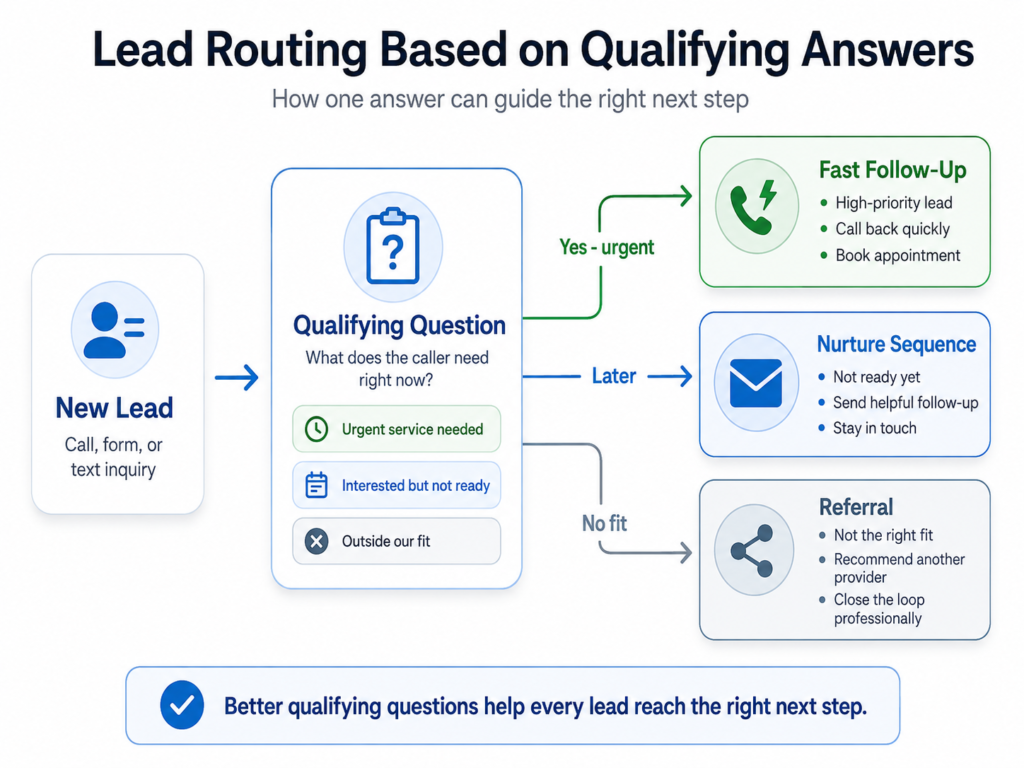
The last piece is routing. Every answer a lead gives should point to a next step. A qualified lead with an urgent need gets an immediate call or booking link. A qualified lead with a longer timeline gets added to a follow-up sequence, not dropped. An unqualified lead gets a polite, honest response that respects their time and yours, and if there is a referral partner who is a better fit, that is where you send them. Nothing goes into a black hole. Every lead gets an outcome.
A Practical Way to Set This Up in Your Business
- Write your qualified-lead definition in one sentence. For example: “A qualified lead is a homeowner in our service area with an active need, the authority to approve the work, and no competing bid already accepted.” Keep it specific enough that a new hire could read it and know exactly who fits.
- Draft three to five qualifying questions. Each question should map directly to a piece of your definition. Do not ask anything you will not use to make a routing decision.
- Decide the routing rule for every possible answer. Before you go live, write out what happens for a yes, a no, and a maybe on each question. This is the step most businesses skip, and it is the one that makes the whole system actually work under pressure.
- Build the questions into your CRM as fields, not notes. If the answer to a qualifying question lives in a free-text note instead of a searchable field, you cannot report on it, sort by it, or trust that the next person to touch the lead will see it.
- Ask the questions at first contact, not after. Whether that first contact is a call, a form, or an AI receptionist answering after hours, the questions belong at the very front of the conversation, not somewhere in the middle after time has already been spent.
- Test the system against ten real inquiries before you trust it. Run your last ten leads through the new criteria on paper. If the system would have sorted them the way you actually would have sorted them by instinct, you have a good starting point. If it would not have, adjust the criteria before you rely on it.
- Review the criteria every quarter. Your service area, your pricing, and your capacity change. A qualifying question that made sense a year ago might be filtering out business you would now happily take.
Frequently Asked Questions
What is the difference between a qualified lead and an unqualified lead?
A qualified lead meets the specific criteria your business has defined in advance, things like budget fit, timeline, service area, and decision-making authority. An unqualified lead does not meet those criteria right now. Neither label is a judgment on the person. It is simply a routing decision based on facts you have gathered.
How many qualifying questions should I ask a new lead?
Three to five is the range that works for most service businesses. Fewer than three usually means you are missing information you need to route correctly. More than five starts to feel like an interrogation and can cost you leads who would have converted with a lighter touch.
Should I qualify a lead before or after I respond quickly?
Both happen at the same moment. Fast response and qualification are not sequential steps, they are the same first contact. The questions belong inside that first response, not in a follow-up call that happens after the window for engagement has already narrowed.
Can an AI receptionist actually ask qualifying questions the right way?
Yes, when it is set up with your specific criteria and business details in advance. The receptionist needs your qualifying questions, your service area, and your routing rules the same way a new employee would on their first day. Setup quality determines whether the questions feel natural or generic.
What should happen to a lead that does not qualify?
They deserve an honest, respectful response, not silence. If you have a referral partner who is a better fit for their situation, send them there. A well-handled no protects your reputation and often earns a referral back to you later, even from someone you could not help this time.
The Lead Was Never the Problem
Go back to the agent driving a buyer to a fourth showing, or the plumber quoting a full repipe on a two-hundred-dollar problem. Neither of them had a bad lead. They had no system for finding out, early, what they were actually dealing with.
You do not need more leads to fix this. You need three to five questions, written down, asked the moment someone reaches out, with a routing rule attached to every answer. That is the whole system. It is not complicated. It is just something most businesses never sit down and build.
Write your qualified-lead definition today. Everything else in this article follows from that one sentence.
Keep Learning
- How Missed Calls Become Lost Revenue for Service Businesses : the financial case for treating every unanswered call as a lost opportunity, not a minor inconvenience.
- Why Voicemail Is Not a Lead-Response Strategy : why sending a prospect to voicemail creates the same qualification blind spot this article addresses.
- The First Five Minutes After a Lead Calls: A Practical Follow-Up System : the full follow-up framework that qualification questions feed directly into.
- What an AI Receptionist Should Know About Your Business Before It Answers a Call : how to hand your qualifying questions and routing rules to an AI receptionist so it sorts leads the way you would.
About the Author
Derrick Houston is the founder of DH Digital Consulting, LLC, based in the Dallas-Fort Worth area. He works with real estate agents and small service business owners to put AI to work capturing and qualifying the leads they already pay to generate, starting with EchoAssist, his AI receptionist system. He built the qualification framework in this article while setting up EchoAssist’s own founding-member process, sorting real conversations with real estate agents and service business owners in real time.