
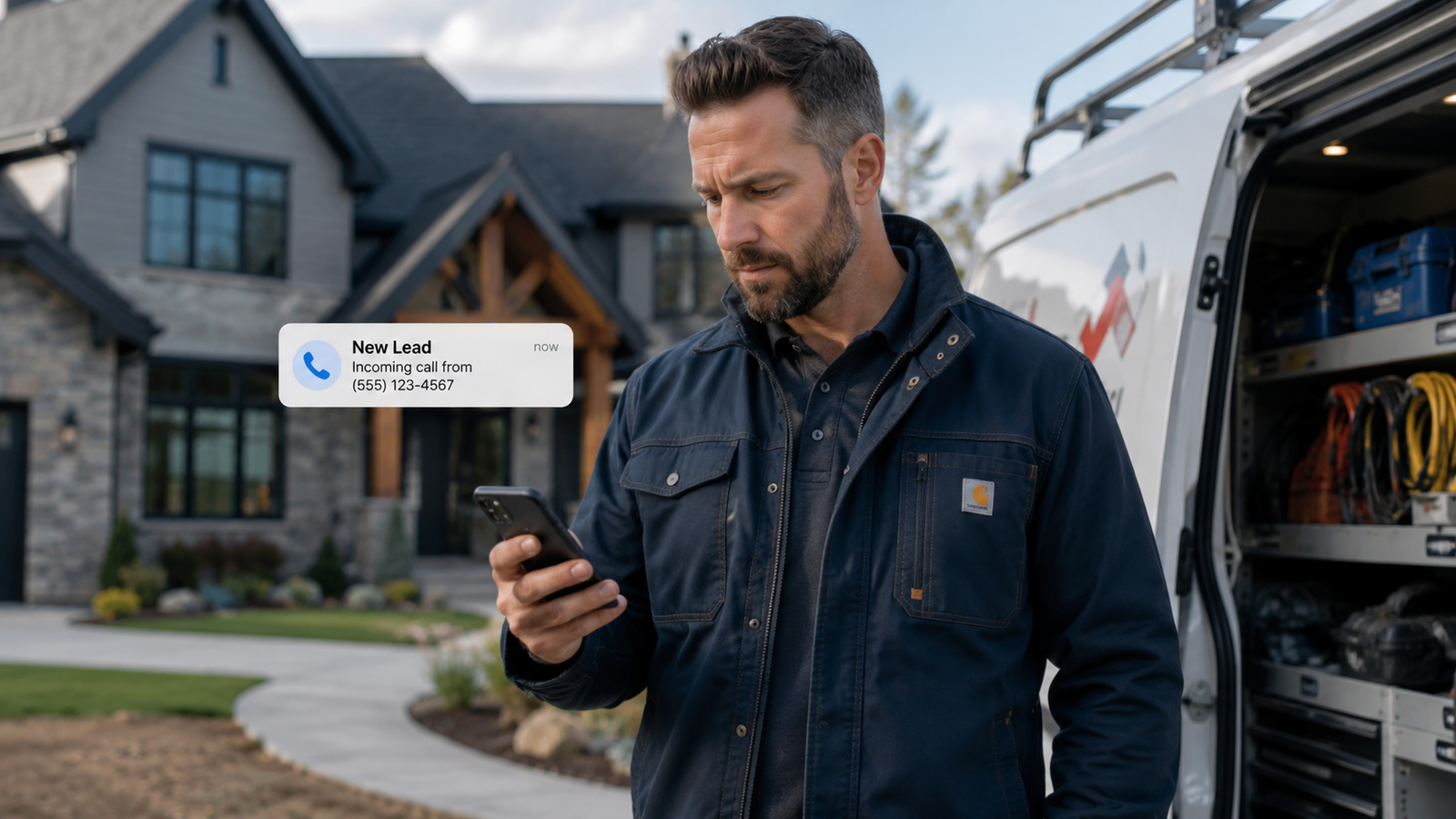
A practical follow-up system for service businesses that cannot afford to let good leads go cold.
You are under a house or on a roof or in someone’s kitchen at 2 p.m. on a Tuesday. Your phone rings, you cannot answer, and it goes to voicemail. By 6 p.m., when you finally get a minute to sit down and call back, the prospect has moved on.
That is not a maybe. That is what the data says happens.
Most service businesses treat the follow-up window as a general guideline. Call back when you can. Respond when things slow down. The problem is that there is no window. There is a five-minute cliff, and almost everything happens in those first five minutes after a lead calls. What you do — or do not do — in that window determines whether the prospect becomes a client or becomes someone else’s client.
Here is what a reliable lead response system looks like, step by step. If you do not have one in place, this is where to start.
Key Takeaways
- Research from MIT and InsideSales.com shows you are 21 times more likely to qualify a lead if you contact them within five minutes versus waiting 30 minutes.
- The average business responds to inbound leads in 42 hours, according to HubSpot. That gap is your competitive advantage if you close it.
- A follow-up system has six parts: answer, qualify, notify, assign, book, and confirm. Every part matters.
- The most expensive gap in most service businesses is not marketing — it is what happens between the phone ringing and the owner calling back.
- EchoAssist handles the first three parts of this system automatically, so nothing falls through the gap while you are doing the actual work.
Why the First Five Minutes Are Not a Metaphor
When someone calls your business, they are at the top of their decision curve. Their problem feels urgent. They picked up the phone. That is not a casual action — people avoid calling. When a prospect calls, they want someone to pick up.
Research from MIT and InsideSales.com found something stark: companies that contact leads within five minutes are 21 times more likely to qualify that lead compared to those who wait 30 minutes.
That is not a typo. Twenty-one times more likely.
And waiting even longer makes things worse: according to Harvard Business Review research, odds of qualifying a lead drop by 400% when response time increases from five to just ten minutes.
Most service businesses are nowhere close to five minutes. The average B2B lead response time is 42 hours, according to HubSpot research. For service businesses where the owner is in the field all day, it can be longer.
The gap between what the research says and what most businesses actually do is enormous. That gap is your competitive advantage — if you close it.
What Most Service Businesses Actually Have (And Why It Breaks Down)
Here is the typical process I see when I talk with agents and service owners: the phone rings, they miss it, the prospect hears a voicemail message, and then at some point — an hour later, four hours later, that evening — the owner calls back.
This process fails at the first step, and everything downstream fails with it.
The most common objection I hear is: “I’ll just text them back when I get a break.” That one has the same flaw as calling. Almost 66% of buyers expect a response within 10 minutes to any marketing, sales, or customer service inquiry. A text sent three hours after the call does not meet that expectation. By then, the prospect has already moved on, and in most cases, someone else has already answered their call.
The follow-up problem is not a discipline problem. Most service business owners I work with are not lazy — they are working. They are on a job site, under a house, in a showing, driving to the next call. The problem is structural. There is no system between the phone ringing and the owner calling back.
That structural gap is what a lead response system is designed to close.
Why Speed Matters More Than Charm
Here is the part that surprises people when I explain it: the quality of your follow-up matters far less than the timing of it. A plain, professional response within five minutes beats a thoughtful, personalized message sent four hours later.
InsideSales.com research found that 35 to 50 percent of all sales are won by the vendor that responds first. Not the cheapest vendor. Not the most polished one. The first one.
In markets where service businesses compete for the same pool of leads, speed is the differentiator. Most of your competitors are on the same lag that you are. If you build a system that responds first, you will win more of the leads you are already generating — without spending more on marketing.
This is the reframe that changes how I talk to service owners about their lead flow: you do not have a marketing problem. You have a handoff problem. The lead was generated. Something failed between the ring and the callback.
The Six-Part Lead Response System
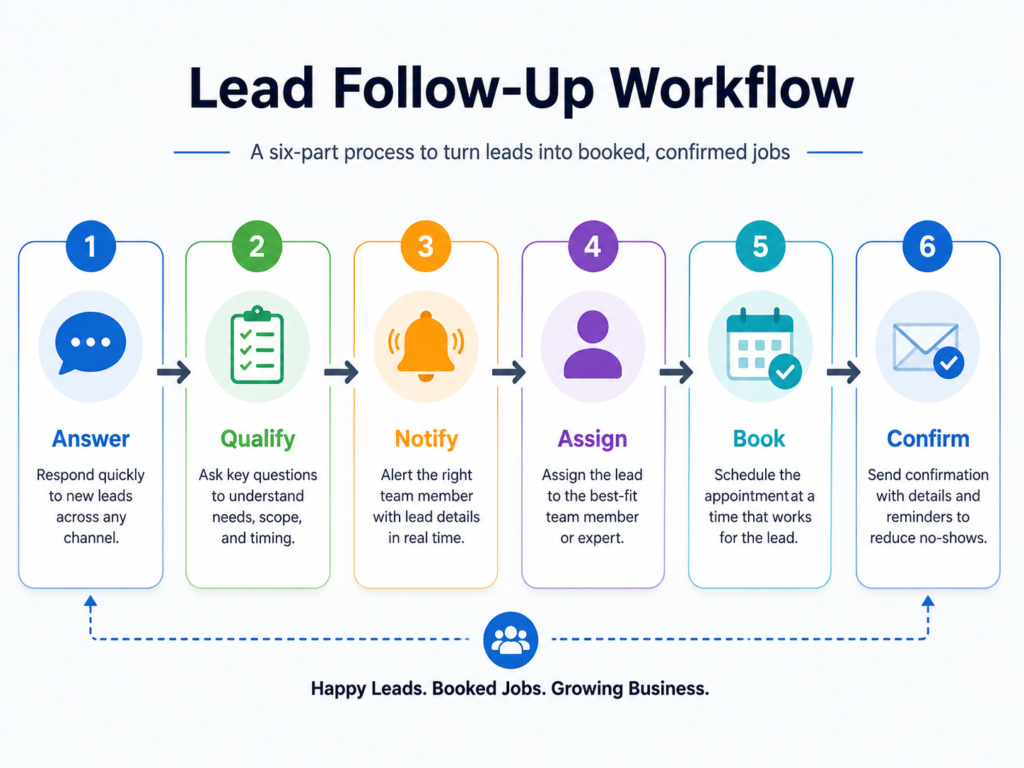
A reliable follow-up process has six parts. They happen in order. Skipping or delaying any one of them creates a gap where leads fall through.
Step 1: Answer the call.
This sounds obvious, but it is the step most businesses fail at first. Someone has to answer. Not route to voicemail. Not send a text to call back. Answer. If you are in the field during business hours, that means your phone needs a coverage plan, whether that is a trained team member, a call handling service, or an AI receptionist that picks up on the first ring and responds in your business’s voice.
The coverage plan is not optional. If no one answers, the entire system below is irrelevant.
Step 2: Qualify the lead on the call.
Not every call is the same. A new prospect calling to ask about your services has a very different need than an existing client with a service question. The person who answers — whether that is you, a team member, or an AI receptionist — needs to capture the right information: name, contact number, nature of the request, service area, urgency level, and the next step they need.
This is not an interrogation. It is a short, structured set of questions that tells you whether this is someone you can help and what they need right now. (If you want to see what those questions should cover, the EchoAssist setup page walks through exactly what a well-configured AI receptionist should know before it answers your phone.)
Step 3: Notify the owner immediately.
The moment a new lead call ends, the owner needs to know about it. Not in the next batch of messages. Not at the end of the day. Immediately. This can be a text, an email, a push notification — whatever reaches you fastest while you are working.
The notification should include the caller’s name, number, what they need, and any urgency flag. It should take you 15 seconds to read and know exactly who to call and why. If you have to dig through a voicemail to figure that out, the system is not built correctly.
Step 4: Assign a response owner.
If the business is just you, this is easy — you are the response owner. But if you have any team at all, the follow-up call needs to be assigned to a specific person with a specific time window. “Someone will call back” is not an assignment. “Marcus calls within 30 minutes” is.
This step also includes the escalation rule: what happens if the assigned person cannot reach the prospect on the first attempt? One unreturned call is not the end of the lead. It is the beginning of the follow-up sequence. (We will get to that in a minute.)
Step 5: Book the appointment or next conversation.
The goal of the follow-up call is not to have a conversation — it is to secure a commitment. That might be a consultation call, a site visit, a demonstration, or a project estimate. Whatever the appropriate next step is for your business, the follow-up call should end with it on the calendar.
If the prospect is not ready to book on the first call, that is fine. But the follow-up call should end with a specific next action: a time to reconnect, a proposal sent, a question answered and a next step named. “I’ll think about it and get back to you” is not a next step.
If you are booking consultations or demos for EchoAssist, you can schedule that directly here.
Step 6: Confirm with the prospect.
Once the appointment or next step is set, send a confirmation. This does not have to be elaborate — a brief text or email with the date, time, what to expect, and your contact information is enough. It does three things: it reduces no-shows, it signals professionalism, and it gives the prospect a record of the conversation.
If you send email follow-ups after a call, the email copywriting service at DH Digital can help you build that sequence so it matches your voice and serves the right purpose at each stage.
The Follow-Up Sequence When the First Call Does Not Connect
Sometimes you call back and the prospect does not answer. That is not the end of the lead. Here is the minimum sequence that keeps the lead alive:
Attempt one happens within five minutes of the notification. Attempt two goes out within one hour if attempt one did not connect — a call plus a brief text explaining who you are and why you are reaching out. Attempt three follows the next day.
Most businesses make one attempt and give up. Forbes research found that sales reps often give up too soon, making 1.3 call attempts on average before moving on — missing critical conversion opportunities.
Three attempts is the minimum viable sequence. Some businesses go to five. The key is that each attempt is a real effort to reach the prospect, not just a voicemail left and forgotten.
Frequently Asked Questions
What is a realistic response time goal for a service business owner in the field?
Five minutes is the research benchmark, but it requires a system, not a personal commitment. If you are doing the physical work, you cannot personally answer every call within five minutes. That is why coverage — a team member, AI receptionist, or call handling service — is required for any owner who is regularly in the field. The goal is five minutes from ring to answered call, not five minutes from ring to owner callback.
How many follow-up attempts should I make before moving on from a lead?
The minimum is three attempts across 24 to 48 hours: one within five minutes, a second within an hour (call and text), and a third the following day. Research consistently shows most businesses give up after one or two attempts. A three-attempt sequence costs you less than 15 minutes and meaningfully increases the chance of contact. Some businesses go to five attempts without being intrusive.
Does texting after a missed call actually work?
Yes, when it is combined with a phone call, not used as a replacement for one. A text immediately after a missed call attempt tells the prospect you are serious and gives them a low-friction way to respond. Texting alone, without a follow-up call, puts the entire burden on the prospect to re-engage. Use both.
What information should the first follow-up notification include?
At minimum: the caller’s name, phone number, reason for calling, service area if relevant, and any urgency indicators they mentioned. The owner reading that notification should know within 15 seconds whether this is a priority callback and what to say when they dial. A notification that just says “new voicemail” is not a system — it is a delayed version of the same problem.
Can an AI receptionist actually qualify leads well enough to replace a human on the first call?
For structured, repeatable intake — capturing name, contact information, service type, service area, and urgency — yes. A well-configured AI receptionist following a clear call script can qualify a lead just as consistently as a human, and far more consistently than a voicemail box. Where human judgment still matters is in edge cases: a caller who is upset, a situation that needs an immediate decision by the owner, or a call type the system was not built for. EchoAssist is set up to handle the structured intake and escalate the edge cases. You can see how that works at the EchoAssist page.
The System Is the Solution
Here is the honest version of this: the follow-up process I described is not complicated. Answer the call. Qualify the lead. Notify the owner. Assign the response. Book a next step. Confirm. Six parts.
But if any one of those six parts is missing or delayed, the lead is at risk. And most service businesses are missing parts one and two entirely because the owner is in the field when the call comes in.
The cost of that gap is real. Every unanswered call is a prospect who made a decision to pick up the phone, and who will make another decision — to call your competitor — within the next few minutes.
You do not need a bigger marketing budget. You need a system that closes the gap between the ring and the response.
Book a free EchoAssist demo and we will walk through exactly what your call handling looks like right now, and what a well-built first-response system would look like for your specific business.
The lead already called. The only question is whether your system was ready.
Keep Learning
- How Missed Calls Become Lost Revenue for Service Businesses — Understand the financial math behind unanswered calls before building your response system.
- Why Voicemail Is Not a Lead-Response Strategy — What a prospect experiences when they reach your voicemail, and why the comparison to live handling matters.
- What an AI Receptionist Should Know Before It Answers Your Call — The setup checklist that makes EchoAssist sound like your business, not a generic robot.
- How an AI Receptionist Works for a Busy Home-Service or Real-Estate Business — where this follow-up system fits inside a full call walkthrough.
About the Author
Derrick Houston is the founder and CEO of DH Digital Consulting, LLC, based in Dallas–Fort Worth. He helps solo entrepreneurs and service business owners put AI to work on the operational problems — missed calls, unqualified leads, inconsistent follow-up — that slow growth when the owner is doing the actual work. EchoAssist, his AI receptionist service, is built specifically for service businesses where the phone needs to be answered even when the owner is not at a desk. He works directly with clients on setup, tailors every system to how their business actually runs, and supports them as they grow.