

A new website will not save leads that die in an unanswered call or an ignored form. If your close rate hasn’t moved after a redesign, the problem probably isn’t the site. It’s what happens the moment someone tries to reach you.
By Derrick L. Houston, Founder of DH Digital Consulting, LLC
I’ve watched more than one business owner sink real money into a website redesign expecting it to fix a revenue problem, only to end up with a nicer-looking site and the exact same number of closed jobs. The traffic came. The leads still leaked out. A website’s job is to get someone to raise their hand. What happens after they raise it, whether that’s a call, a form, or a booking request, is a completely different job. If that handoff is broken, no amount of design work touches it.
Key Takeaways
- A website generates interest. It does not answer the phone, respond to a form, or qualify a lead. Those are separate jobs, and confusing them is where the money leaks out.
- In home services specifically, phone calls convert the most leads but often have the lowest match rate into a paying job, which points to a handling problem, not a traffic problem.
- Contact forms convert at roughly 1.7% on average, and most people who start filling one out never finish it.
- A redesign can raise your traffic and your click volume without raising your revenue if the response layer behind the site stays the same.
- The fix isn’t a prettier homepage. It’s a reliable, fast, consistent process for what happens the second someone tries to reach you.
The Trap of Blaming the Website
Here’s the pattern I keep running into. A service business owner or agent feels like leads have dried up. They look at their website, decide it’s dated, and hire someone to rebuild it. New photos, cleaner layout, a punchier headline. Six weeks later, traffic is up. Inquiries might even be up. But closed jobs stayed flat, or barely moved.
That’s a hard thing to sit with after spending real money on a rebuild. It feels like the website failed. Usually, it didn’t. The website did what it was built to do: it got someone curious enough to click “call now” or fill out the contact form. What happened after that click is where the business actually won or lost the lead, and a homepage redesign has zero effect on that moment.
I get why this mistake happens. A website is visible. You can look at it, judge it, hand someone money to change it. A missed call or a form that sat in an inbox for six hours is invisible. Nobody screenshots that. So the visible problem gets the fix, and the invisible one, the one actually costing the business money, keeps quietly bleeding leads.
What the Data Actually Shows
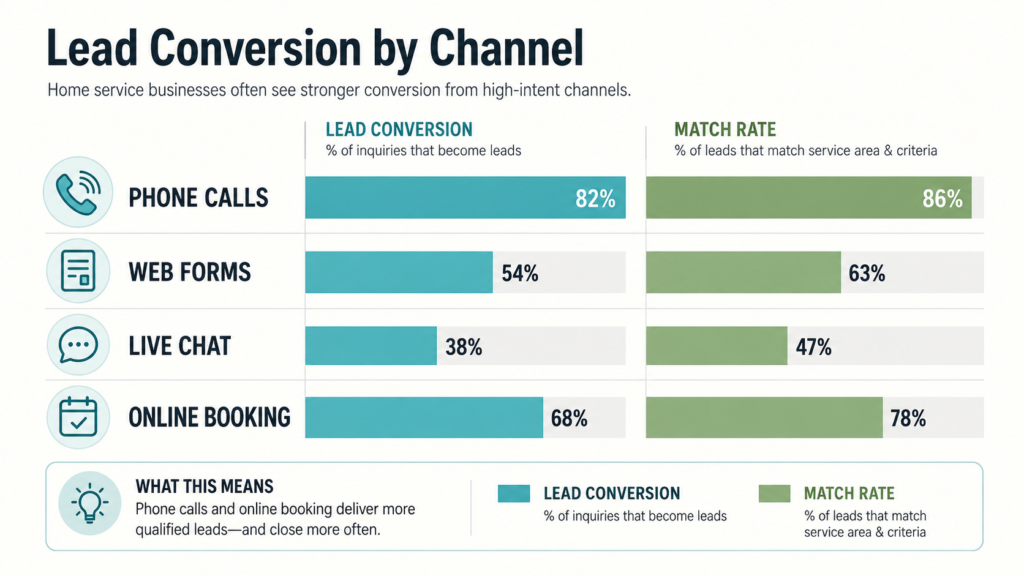
The numbers back this up, and they point in a consistent direction: the leak isn’t traffic, it’s response.
Website conversion rates across most industries sit in a fairly narrow band. Industry benchmarking from FirstPageSage puts most B2B service categories between roughly 1% and 7%, depending on the field, with the overall average landing around 2% to 3% of visitors converting into a lead of any kind. Contact forms specifically convert even lower. Research compiled by Prospeo found the average web form converts at about 1.7%, and worse, 81% of people who start filling out a form abandon it before hitting submit.
Home services tells a more specific story. A guest analysis published through Schedule Engine, examining more than 16,000 paid leads for HVAC contractors, found that 78% of leads converted through phone calls, far outpacing online booking and chat tools combined. But phone calls also carried the second-lowest match rate of any conversion channel, at just under 30%, meaning fewer than one in three calls actually turned into a job logged in the CRM. Online booking, by comparison, matched at nearly 73%. That gap isn’t a traffic problem. Every one of those callers already found the business and picked up the phone. The gap is what happened, or didn’t happen, on the other end of that call.
Put those two data points together and the picture is clear. Phone calls are still the primary way home-service customers try to convert. And phone handling, not the website that generated the call, is where most of those leads actually get lost.
The Real Conversion Point Isn’t the Click. It’s the Handoff.
I call this the handoff moment, the second where a visitor stops browsing and tries to become a customer. That’s the true conversion point, not the click on your “Call Now” button, not the form submission. A visitor clicking “call” hasn’t converted. They’ve made a commitment and handed you a small window to honor it.
Most website strategy focuses entirely on getting someone to that moment: better SEO, sharper copy, a cleaner call-to-action. All of that matters. But it’s marketing’s job to get someone to raise their hand. It is not marketing’s job, and it is not the website’s job, to answer once they do. That’s operations. And most small service businesses have poured all their attention into the first job and almost none into the second.
This is exactly why a redesign so often produces more traffic without producing more revenue. You got better at getting people to the handoff moment. You didn’t touch what happens at it.
What Actually Fixes the Leak
Fixing this doesn’t start with the website. It starts with treating every call, form, and booking request as a live commitment with a clock running on it, and building a process that honors that clock every single time, not just when you happen to be free.
For most of the service businesses and agents I talk to, that means separating two things they’ve been treating as one problem. Marketing’s job is to generate qualified interest. Response infrastructure’s job is to make sure every single one of those inquiries gets a fast, professional, consistent answer, whether that inquiry comes in at 10 a.m. on a Tuesday or 8 p.m. on a Saturday while you’re still on a job site.
This is the exact gap EchoAssist is built to close. It answers every call, every time, so the leads your marketing already worked to generate don’t die in a voicemail box or sit in an inbox until you have a free minute. The website’s job stays the website’s job. The answering job gets handled, consistently, regardless of what the site looks like.
How to Check Whether Your Website or Your Response Process Is Actually the Problem
1. Pull your call answer rate before you touch your website. Look at how many inbound calls actually got answered live over the last 30 days versus how many went to voicemail. If that number is below 90%, you have a response problem, not a design problem.
2. Time your form response, not just your form submissions. Count how many contact form leads got a reply within an hour versus a day or more. A form that converts visitors but gets answered slowly is functionally the same as a form nobody ever sees.
3. Check your match rate, not just your lead count. Match rate is the percentage of inquiries that actually turn into a job in your CRM. A high volume of calls or form fills with a low match rate is a signal that something is breaking after the click, not before it.
4. Confirm your after-hours coverage, specifically. Most missed opportunities happen outside business hours or during a job when you can’t get to the phone. If nights, weekends, and mid-job calls all roll to voicemail, that’s your leak, and it has nothing to do with your homepage.
5. Separate your marketing spend from your response spend in your own head. Before approving another redesign, ask what percentage of your current leads are actually getting answered promptly. If that number is weak, redirect the budget toward fixing the handoff before spending more to generate leads that will hit the same broken process.
6. Test your own site like a first-time visitor. Call your own business number from your cell phone during a busy afternoon. Fill out your own contact form. See exactly what a real prospect experiences, and how long it takes before a human, or a system built to sound like one, responds.
7. Fix the response layer before the redesign, not after. If you’re going to invest in your business this quarter, fix what happens after someone clicks “call” or hits “submit” first. A better website sitting on top of a broken response process just brings more people to the same leak.
Frequently Asked Questions
Is a website redesign ever the right move? Yes, when the problem is actually traffic or trust: outdated design, unclear messaging, or poor mobile experience that stops people from reaching out at all. A redesign is the wrong move when people are already reaching out and not converting after that, since that’s a response problem a new website can’t touch.
How do I know if my problem is traffic or response? Check your inquiry volume against your close rate. If you’re generating a reasonable number of calls and form fills but few of them turn into booked jobs, the leak is in your response process, not your site’s ability to attract visitors.
Do phone calls really convert better than online forms for service businesses? In home services specifically, yes. Industry data on HVAC leads found phone calls generated the majority of conversions, far more than online booking or chat. But calls also had a lower match rate into paying jobs, showing that call handling matters as much as call volume.
What’s a good target for answering inbound calls? Aim to answer at least 90% of inbound calls live, without sending them to voicemail. Every call that goes unanswered is a prospect who may already be calling the next business on their list.
Can an AI receptionist actually replace answering calls myself? It replaces the moments you can’t physically get to the phone: nights, weekends, mid-job, or back-to-back calls. It answers every call consistently and captures the lead so it doesn’t depend on whether you happened to be free when the phone rang.
The Website Gets Them to Knock. Someone Has to Answer.
Go back to that owner who rebuilt their website expecting it to fix a revenue problem. The site looked better. The traffic went up. The jobs booked didn’t. That gap is the whole story. A website’s only job is to get someone to raise their hand. Whether that hand gets a fast, professional response, or whether it disappears into a voicemail box nobody checks until Monday, has nothing to do with the site at all.
Fix the handoff before you fix the homepage. The leads you’re already generating are worth more than the ones a redesign might bring in.
Keep Learning
- How Missed Calls Become Lost Revenue for Service Businesses — How to estimate what unanswered calls are actually costing your business.
- Why Voicemail Is Not a Lead-Response Strategy — What a prospect actually experiences when their call rolls to voicemail, and why that experience costs you the lead.
- What Calls Should Your Business Never Send to Voicemail? — A framework for sorting incoming calls by urgency so the highest-value ones never get missed.
- How to Prepare Your Business for Better Lead Qualification — What to define before a call ever comes in so your response process actually converts.
About the Author
Derrick L. Houston is the founder and CEO of DH Digital Consulting, LLC, based in Dallas-Fort Worth, Texas. He built EchoAssist, an AI receptionist service, for real estate agents and service business owners who lose leads to missed calls while they’re out doing the work that earns them. Derrick works directly with each client to build their AI receptionist around how their business actually runs. Contact: dhdigitalconsulting@gmail.com or (469) 689-1107.