

The work that fills your day is rarely the work that grows your business, and most owners never stop long enough to separate the two.
By Derrick L. Houston, Founder of DH Digital Consulting
Start with the task you do the same way every single time, the one that never requires your judgment, just your time. That is the work to hand off first, whether it is answering routine calls, entering the same information into a spreadsheet, or writing the same kind of follow-up message over and over. For most real estate agents and service business owners, that starting point is call handling and lead capture, because it happens every day and it is the easiest to hand to AI without losing quality.
This is not about replacing yourself. It is about identifying the parts of your day that do not need you, so the parts that do get your full attention.
Key Takeaways
- Repetitive work is any task you do the same way every time, with no judgment call involved. That is what makes it a good candidate to hand off.
- Research on entrepreneur time use shows administrative tasks consume more than a third of the average work week, time that is not going toward serving customers or growing the business.
- Call handling, follow-up messaging, and data entry are the three most common repetitive tasks eating into a service business owner’s day.
- AI tools can now take on call answering and lead capture specifically, which used to require a human employee.
- The goal is not to automate everything at once. Start with your single biggest bottleneck and build from there.
The Work That Is Quietly Running Your Day
If you added up every phone call you answered this week, every voicemail you returned, every time you typed the same service description into a text message, you would probably be surprised how much of your week that actually is. It rarely feels like much in the moment. One call here, one follow-up text there. But it adds up into hours you never get back, and none of it is the work that actually moves your business forward.
I hear a version of the same story from agents and contractors constantly: they are the operator, the salesperson, the admin, and the marketer, all in the same body, on the same day. There is no version of their schedule where the growth work gets fresh energy, because by the time the job site work or the showings are done, the tank is empty. The business side gets whatever is left, which is usually not much.
The problem is not that these owners are bad at their jobs. It is that nobody ever sat down and separated the tasks that require a real decision from the tasks that just require repetition. Once you make that split, the repetitive pile is almost always bigger than expected, and almost none of it needs to be done by you specifically.
What the Data Says About Where the Time Goes
A survey of 251 U.S. entrepreneurs, commissioned by virtual assistant company Time etc and reported by Forbes, found that the average entrepreneur spends 36 percent of their work week on small administrative tasks: logging expenses, entering data, managing schedules, creating invoices, and writing routine content. That is more than a third of a working week spent on tasks that do not require the owner’s specific expertise to complete.
The same survey found that 59 percent of respondents log expenses weekly, 49 percent do research, 45 percent manage schedules, and 44 percent create invoices, all as recurring, repetitive parts of a normal week. None of that work requires the owner’s judgment. It requires their time, which is a very different resource, and a much more limited one.
Separately, NFIB’s 2024 Small Business Economic Trends survey found that 73 percent of small business owners named administrative workload as a primary time drain, ranking it above hiring difficulty, regulatory compliance, and cash flow management combined. When the people running these businesses are asked what eats their time, administrative work consistently tops the list, even above problems that sound more urgent.
For service businesses and real estate specifically, one of the biggest slices of that administrative load is call handling. Every call that comes in has to be answered, qualified, and either booked or logged for follow-up, and that pattern repeats dozens of times a week with almost no variation from call to call.
The Reframe: Repetitive Is Not the Same as Unimportant
Owners often resist handing off repetitive work because it feels like part of the job. Answering the phone feels like customer service. Writing the same follow-up message feels like relationship building. It is tempting to treat all of it as too personal to delegate.
But repetitive and important are not the same thing. A task can matter to your business and still not require you personally. Answering the phone matters enormously. It does not require your specific voice, your specific judgment, or your specific hands, as long as whatever answers it can gather the right information and hand it off cleanly. The importance of the task is not the reason to keep doing it yourself. The predictability of the task is the reason you can hand it off.
Once you separate “does this matter” from “does this need to be me,” the list of things you can hand off gets a lot longer than most owners expect.
What This Looks Like in Practice
I built EchoAssist because call handling was the clearest example of repetitive, important work that was eating owners alive. Every real estate agent and service business owner I talked to had the same pattern: the phone rings constantly, and every single call requires the same basic sequence, a greeting, a few qualifying questions, and either a booking or a note for follow-up.
That sequence does not change much from call to call. It is exactly the kind of task that is a strong candidate for AI, because the value is in consistency, not creativity. An AI receptionist built around your business, your hours, your service area, and your qualifying questions can run that same sequence every time, without ever getting tired, distracted, or backed up during a busy afternoon.
What changes for the owners I work with is not the volume of calls coming in. It is what happens to their day once those calls stop requiring their direct attention. The hours that used to go to picking up the phone, or worse, missing the call and dealing with the fallout later, go back to the actual work: the job site, the showing, the client relationship that needed real judgment, not repetition.
How to Take Repetitive Work Off Your Plate
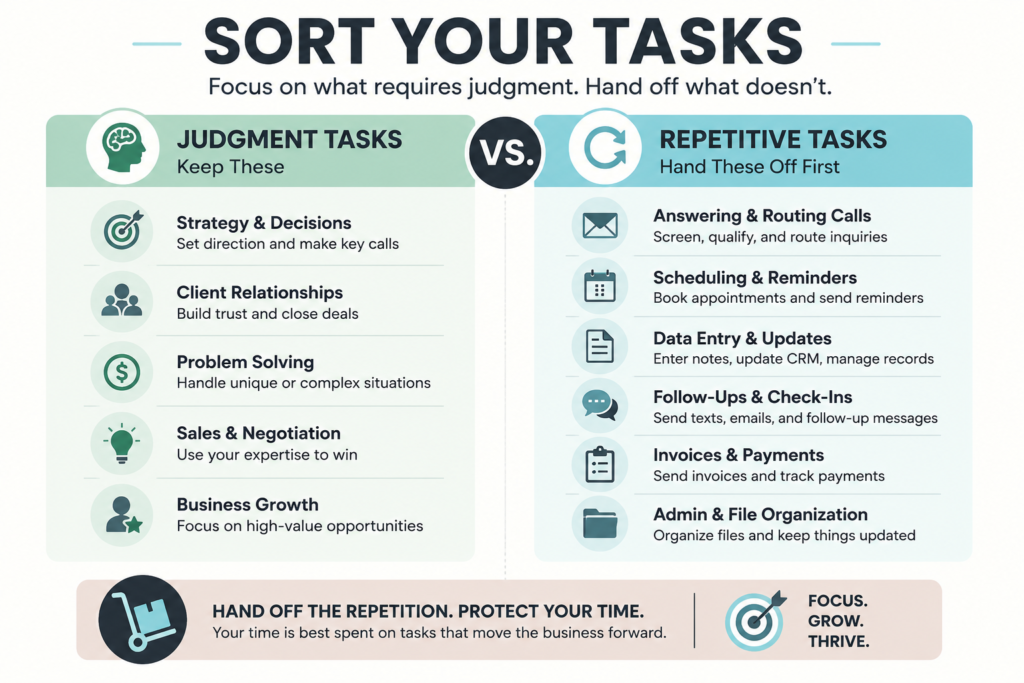
- List every task you did yesterday, in order. Do not filter yet. Write down everything, from answering the first call of the day to the last email you sent before closing up.
- Mark each task as judgment or repetition. A judgment task requires you to weigh options or make a call only you can make. A repetition task follows the same steps every time, regardless of who is doing it.
- Total the time spent on repetition tasks for one full week. Most owners are surprised by this number. It is usually higher than they expected, often close to the third-of-a-week figure the research points to.
- Rank your repetition tasks by frequency, not by how much you dislike them. The task that happens fifty times a week matters more to fix than the one that happens twice, even if the twice-a-week task feels more annoying.
- Start with your highest-frequency bottleneck. For most of the agents and service owners I work with, that bottleneck is call handling and lead capture, since it happens every single day and directly affects revenue.
- Hand that one task off before touching anything else. Resist the urge to fix everything at once. A single working system, built well, beats five half-finished ones.
- Revisit the list in 60 days. Once the first bottleneck is handled, the next one on your list will be more obvious, because you will have more time and attention to actually notice it.
Frequently Asked Questions
How do I know if a task is really repetitive or if it just feels tedious?
Ask whether the steps change based on who is doing it or what situation comes up. If the answer is almost always the same sequence regardless of the specific call or client, it is repetitive. If it requires weighing options each time, it is a judgment task, even if it feels tedious.
Isn’t answering the phone part of good customer service?
Good customer service means the call gets answered promptly, gathers the right information, and treats the caller well. It does not require that you personally do the answering. An AI receptionist built around your business can meet that standard consistently, every time the phone rings.
What if my business is too specialized for AI to handle repetitive tasks well?
Most repetitive tasks, including call handling, are built around structure you provide: your services, your hours, your qualifying questions. The AI does not need to understand your industry from scratch. It needs your specific business details, which is exactly what a proper setup captures before it ever answers a call.
Should I try to automate everything at once?
No. Start with the single biggest bottleneck, usually the highest-frequency repetitive task, and get that working well before moving to the next one. Trying to fix everything simultaneously usually means nothing gets fixed properly.
How much time can I realistically expect to get back?
It depends on your call volume and how much repetitive work you currently handle personally, but the research shows administrative tasks alone consume over a third of the average entrepreneur’s week. Reclaiming even a portion of that is meaningful time back in the business.
Your Time Is the One Resource You Cannot Buy More Of
You can always find more leads, more marketing budget, or more hours in a contractor’s schedule. You cannot find more hours in your own day. Every hour spent on a task that does not require your judgment is an hour you will never get to spend on the work only you can do.
Start with the biggest bottleneck. Hand it off properly. Then watch what happens to the parts of your business that actually needed you all along.
See How EchoAssist Handles Your Biggest Repetitive Task
If call handling is the bottleneck eating your day, book your free EchoAssist demo and see how EchoAssist answers, qualifies, and logs every call, so that hour comes back to you.
Keep Learning
- How an AI Receptionist Works for a Busy Home-Service or Real-Estate Business: A plain-language walkthrough of what happens from greeting to booked appointment.
- How to Prepare Your Business for Better Lead Qualification: A framework for defining the qualifying questions your call handling should be asking.
- What Calls Should Your Business Never Send to Voicemail?: How to sort incoming calls by urgency so the ones that matter most never get the repetitive-task treatment.
- Email Follow-Up After a Missed Call: A Simple Recovery Sequence: What to automate on the follow-up side once call handling is off your plate.
About the Author
Derrick L. Houston is the founder of DH Digital Consulting, LLC, based in Dallas-Fort Worth. He built EchoAssist, an AI receptionist service for real estate agents and small service businesses, after watching owners lose hours every week to repetitive call handling that never required their personal attention. Derrick works directly with each business to build a system around how they actually operate, rather than selling a one-size-fits-all platform.