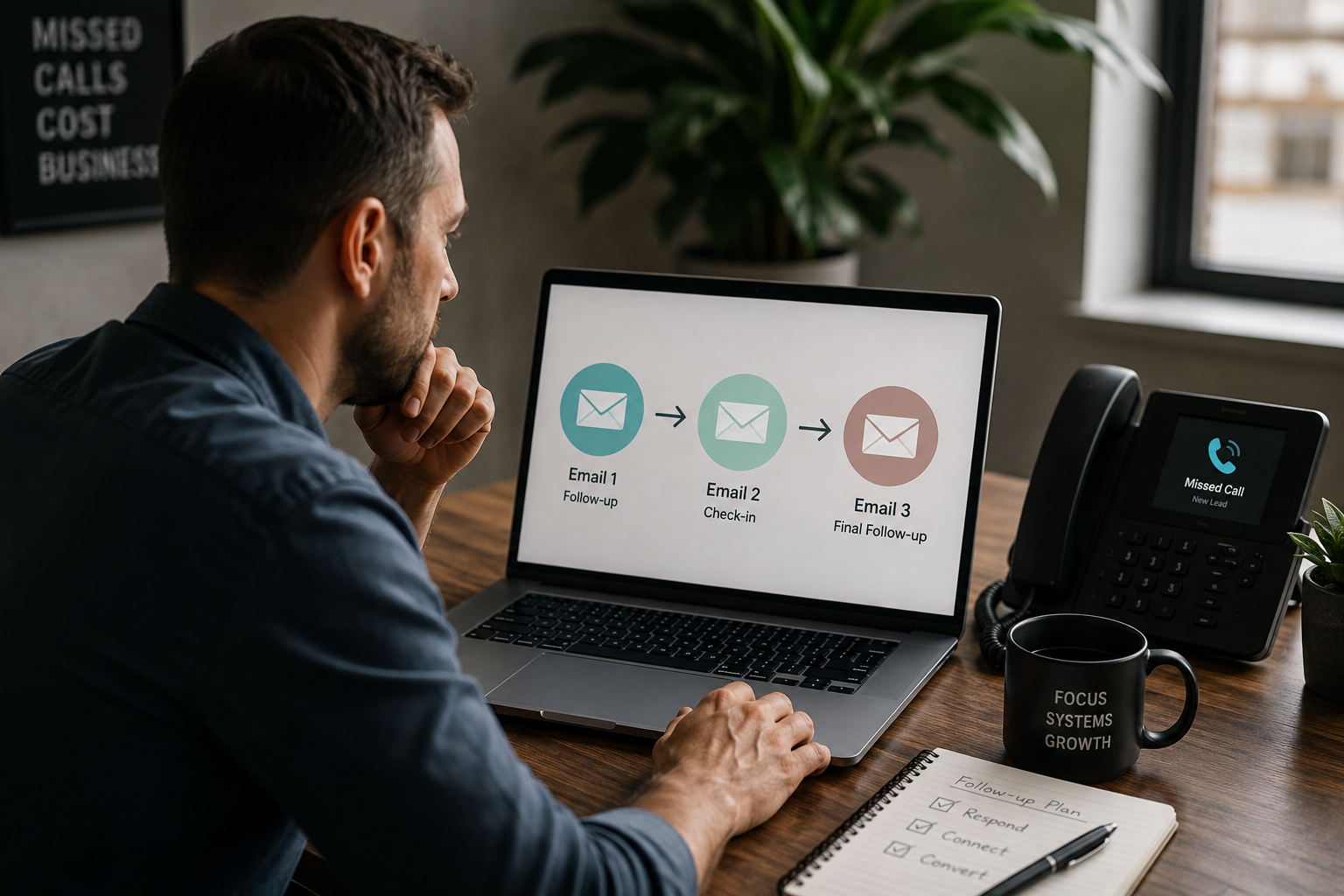
A missed call doesn’t have to mean a lost lead. If you have the person’s email address, a short, well-timed sequence can bring them back into the conversation, even after the phone call itself didn’t happen. Here’s the three-message framework that actually works.
By Derrick L. Houston, Founder of DH Digital Consulting, LLC
Every business misses a call eventually. What separates the businesses that recover that lead from the ones that lose it isn’t luck. It’s whether they have a plan for what happens next. If you captured an email address anywhere along the way, from a form, a booking widget, or a past interaction, you have a second shot. Most businesses either send nothing, or send one generic “sorry we missed you” email and call it done. Neither approach comes close to what a short, deliberate sequence can do.
Key Takeaways
- A missed call isn’t automatically a lost lead if you have an email address and a plan for what to send.
- Response speed still matters even in a recovery sequence. The first message should go out fast, not whenever you get around to it.
- A three-message sequence, acknowledgment, problem and solution, and a booking reminder, covers the psychological ground a single email can’t.
- Permission and accuracy matter more than cleverness. The reader should always know why they’re hearing from you and how to reach you directly.
- This sequence is recovery, not a replacement for answering the phone in the first place. It’s what you do after the miss, not instead of preventing it.
Why One Generic Email Isn’t Enough
Most businesses that even bother following up after a missed call send one message. Something like “Sorry we missed your call, please call us back.” It’s polite. It’s also asking the prospect to do the exact thing that already failed once, initiate contact and hope someone answers.
A single generic email also assumes the reader remembers exactly why they called, is still in the same mindset they were in when they dialed, and is willing to take the first step again. That’s a lot to assume from someone who already tried to reach you once and didn’t get through. The businesses that actually recover these leads treat the missed call as the start of a short conversation, not a one-and-done apology.
I’ve watched service businesses and agents write off missed calls entirely, treating them as leads that are simply gone. Some of them are. But plenty of them are recoverable, if the follow-up actually meets the person where they are instead of just acknowledging the miss and hoping they try again.
What the Data Says About Speed and Follow-Up
Speed matters here just as much as it does for the call itself, and the numbers back that up clearly.
Research compiled by Prospeo, drawing on a benchmark of over 1,000 companies, found that leads contacted within five minutes are 21 times more likely to convert than those contacted later, and that 63% of businesses don’t respond to inbound leads at all. The same research found the average service business takes 47 hours to respond to a lead, nearly two full days. One analysis of nearly 2,850 contractor leads found that responses sent within 60 seconds achieved a 73% appointment booking rate. After 30 minutes, that rate dropped to just 4%.
Follow-up sequencing matters too, not just the first message. Data from Belkins’ analysis of over 16 million cold emails found that roughly 60% of replies come after the first follow-up message, not the initial one. The first follow-up does most of the heavy lifting. That pattern holds for missed-call recovery emails as much as it does for outbound sales: the sequence, not a single message, is what brings people back.
Put together, the data points to the same conclusion from two directions. Send the first message fast. Then follow it with at least one more, because a meaningful share of the people who don’t respond to message one will respond to message two.
Recovery Isn’t One Message. It’s a Short Conversation.
Here’s how I think about this: a missed-call recovery sequence isn’t a single apology. It’s a short, structured conversation that happens over email instead of over the phone. Each message in the sequence does a different job, the same way a good in-person conversation moves from acknowledgment to understanding to a clear next step.
Trying to cram all of that into one email usually means doing all three jobs badly. An email that apologizes, diagnoses the reader’s problem, and asks them to book a call in three sentences reads like a form letter, because it is one. A three-part sequence lets each message actually do its job well, without asking the reader to process everything at once.
The Three-Message Recovery Sequence
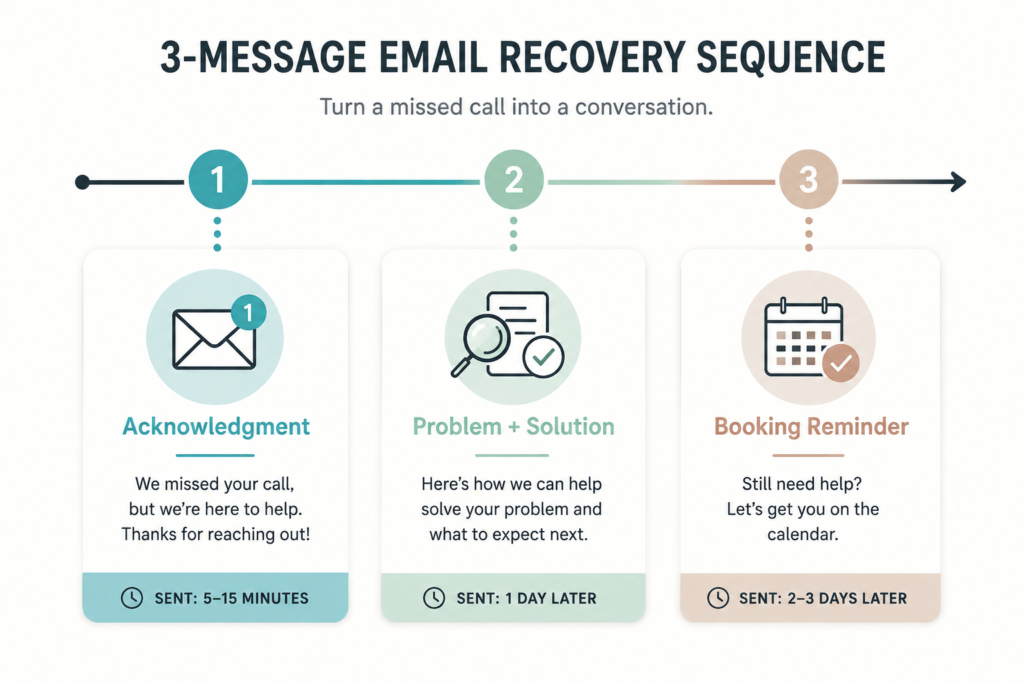
Message 1: Immediate Acknowledgment
Send this as close to the missed call as possible, ideally within minutes, not hours. Its only job is to let the person know you saw the missed call, you’re sorry they didn’t get through, and you’re already working on getting back to them. Keep it short. This isn’t the message that solves their problem. It’s the message that stops them from calling your competitor while they wait.
What it should include: a clear reference to the missed call so they know this isn’t a generic email, a direct way to reach you (phone number and a booking link if you have one), and a sense that a real person is behind it.
Message 2: Problem and Solution
Send this the same day or the next morning if the first message didn’t get a response. This is where you actually address why they likely called in the first place. If you don’t know the specific reason, speak to the most common reason people in their situation reach out, and offer a clear, specific way you solve it.
This message should read less like an apology and more like the conversation you would have had if the call connected. Reference a specific problem your business solves, briefly explain how you handle it, and give the reader a reason to believe you’re worth a second attempt.
Message 3: Booking Reminder
Send this one to two days after message two if you still haven’t heard back. This message assumes the reader is interested but hasn’t taken action yet, not because they lost interest, but because life got in the way. Keep it short and low-pressure. Its entire job is to make the next step as easy as physically possible.
What it should include: a single, specific call to action, ideally a direct booking link rather than “call us back,” and a light acknowledgment that you understand they’re busy. This is not the place for a hard sell. It’s the place for a frictionless yes.
What to Get Right Before You Send Anything
A few things matter more than clever copy here.
Permission matters first. Only send this sequence to people who gave you their email through a legitimate interaction, a missed call where they left a voicemail with contact info, a form submission, or a booking attempt. Sending recovery emails to a purchased list or scraped contact isn’t a recovery sequence, it’s spam, and it damages trust with the people who might have actually become customers.
Accuracy matters just as much. Every message needs your real business name, a real way to reach you, and language that matches how you actually talk to customers on the phone. A recovery sequence that sounds like a corporate template undoes the personal trust a small business or solo agent usually has going for them.
And finally, this sequence is recovery, not a substitute for answering the phone. The goal is always to answer the call in the first place. When that’s not possible, whether it’s after hours, mid-job, or during a busy stretch, an AI receptionist like EchoAssist can capture the call and the callback information immediately, which gives this exact sequence something real to work with instead of a guess.
Frequently Asked Questions
How fast should the first recovery email go out?
As close to immediately as possible, ideally within minutes of the missed call. The longer the gap, the more likely the prospect has already called another business or lost the urgency that made them call in the first place.
Do I need all three messages, or can I send just one?
A single message can help, but a meaningful share of responses come after the first follow-up, not the initial message. A three-part sequence gives the acknowledgment, the explanation, and the easy next step room to each do their job.
What if I don’t know why the person called?
Speak to the most common reason people in their situation reach out. You don’t need to guess correctly every time, you need to show that you understand their likely problem well enough to be worth a second attempt.
Is it okay to send this sequence to someone who didn’t leave a voicemail?
Only if you captured their email through a legitimate interaction, like a form, booking attempt, or caller ID paired with an email on file from a past interaction. Never send recovery emails to a purchased or scraped list.
Can this sequence replace answering calls live?
No. This is a recovery tool for calls that were already missed, not a substitute for answering the phone. The goal is always to reduce how often you need this sequence in the first place by improving your call coverage.
The Second Chance Is Only as Good as What You Do With It
A missed call feels final in the moment. It doesn’t have to be. The businesses that recover these leads aren’t doing anything complicated, they’re just showing up with a plan instead of a single apology, and they’re moving fast enough that the person on the other end still remembers why they called.
If you’re already a DH Digital client and want this sequence written for your business, ask about email copywriting support and we’ll build it around how your customers actually talk to you.
Keep Learning
- Why Voicemail Is Not a Lead-Response Strategy — What a prospect actually experiences when their call rolls to voicemail, and why that experience costs you the lead.
- How to Prepare Your Business for Better Lead Qualification — What to define before a call ever comes in so your response process actually converts.
- How Customer Personas Improve Every Marketing Decision You Make — How knowing your real buyer shapes the language you use in every follow-up.
- Why Won’t a Better Website Fix a Broken Lead-Response Process? — Why generating interest and converting it are two different jobs, and what actually fixes the gap.
About the Author
Derrick L. Houston is the founder and CEO of DH Digital Consulting, LLC, based in Dallas-Fort Worth, Texas. He built EchoAssist, an AI receptionist service, for real estate agents and service business owners who lose leads to missed calls while they’re out doing the work that earns them. Derrick also writes email follow-up sequences for clients so the leads that slip past a missed call still have a real path back into the conversation. Contact: dhdigitalconsulting@gmail.com or (469) 689-1107.