

Every ring that goes to voicemail is a number you can actually put on paper, and once you see it, you cannot unsee it.
By Derrick L. Houston, Founder of DH Digital Consulting
You can calculate the opportunity cost of an unanswered call with three numbers you probably already have: how many calls you miss, how often a call turns into paid work, and what a job is worth to you on average. Multiply missed calls by your close rate, then multiply that by your average job value, and you have a monthly number. Multiply that by twelve, and you have a yearly one.
Most owners never run this math. They know they miss calls. They just never sat down and turned “I miss some calls” into a dollar figure. I want to walk you through the actual calculation, using your own numbers, so you stop guessing and start seeing.
Key Takeaways
- Opportunity cost from missed calls is a math problem, not a feeling. It has a formula and an answer.
- You need three inputs: missed call volume, your close rate, and your average job value.
- Research from 411 Locals puts the average small business’s answer rate at under 40 percent, meaning most of this cost is already happening whether you have measured it or not.
- The calculation is meant to guide a decision, not to shame you. It shows you what fixing the problem is worth.
- A hypothetical example below shows the formula in action so you can plug in your own numbers next.
Why Most Owners Never Run This Number
I get why this math doesn’t happen. When you are the one answering calls, running jobs, and closing out invoices at night, sitting down to calculate a hypothetical loss feels like busywork. There is no invoice for a call you never picked up. Nothing shows up on a bank statement labeled “lost opportunity.” The cost is invisible by design, which is exactly why it survives so long without anyone questioning it.
I have talked to plumbers, agents, and HVAC owners who all say some version of the same thing: “I know I miss calls, but it’s probably not that many.” That sentence is doing a lot of work to protect a number nobody has actually looked at. The truth is usually higher than the guess, because a missed call does not feel like a big deal in the moment. It only adds up when you count it over a month, not a day.
The other reason this math gets skipped is that it requires admitting something uncomfortable: the business could be bigger right now, with the leads it is already generating, if the phone got answered more consistently. That is a harder conversation than “I need more leads.” You do not need more leads. You need to stop losing the ones you already have.
What the Research Says About Missed Calls
A 2024 study by 411 Locals that reviewed 85 businesses across 58 industries found that only about 38 percent of incoming calls were answered by a live person, meaning most small businesses miss well over half of their inbound calls. That is not a fringe number from a struggling business. That is the average.
Separate research from ServiceTitan on the home services industry specifically found missed call rates running near 62 percent industry-wide, which lines up closely with the 411 Locals figure. Whether you run a brokerage or a service business, the pattern holds: the majority of owners are missing more calls than they think.
Speed matters just as much as whether you answer at all. The MIT and InsideSales.com Lead Response Management Study, which analyzed more than 15,000 leads and over 100,000 call attempts across six companies, found that leads contacted within five minutes were 21 times more likely to qualify than leads contacted after thirty minutes. That gap is not small. It means a callback later in the day is not a lesser version of an immediate answer. In many cases, it is close to worthless.
For real estate specifically, the National Association of Realtors’ 2025 Home Buyers and Sellers Generational Trends report found that 78 percent of buyers end up working with the first agent who responds to them. Not the most experienced agent. Not the best-reviewed agent. The first one who picks up.
Put those three findings together and the shape of the problem gets clear: most businesses miss most calls, the calls that do get missed are usually gone for good once a competitor answers first, and speed decides who wins the lead more often than quality of service does.
The Reframe: A Missed Call Is Not a Missed Conversation, It Is a Missed Sale
Most owners think about a missed call as a scheduling inconvenience. I’ll call them back. I’ll catch the next one. That framing treats every call the same, as if a missed call and an answered call carry equal odds of turning into paid work.
They do not. The data above shows that the moment a call goes unanswered, the odds of that person still being available, still interested, and still willing to wait for you drop fast. So the honest way to think about a missed call is not “a conversation I’ll have later.” It is closer to “a sale I already lost, that I have a small and shrinking chance of recovering.”
That reframe matters because it changes what the calculation below is actually measuring. You are not calculating how many calls you missed. You are calculating how much revenue walked out the door while your phone rang.
How to Run the Calculation
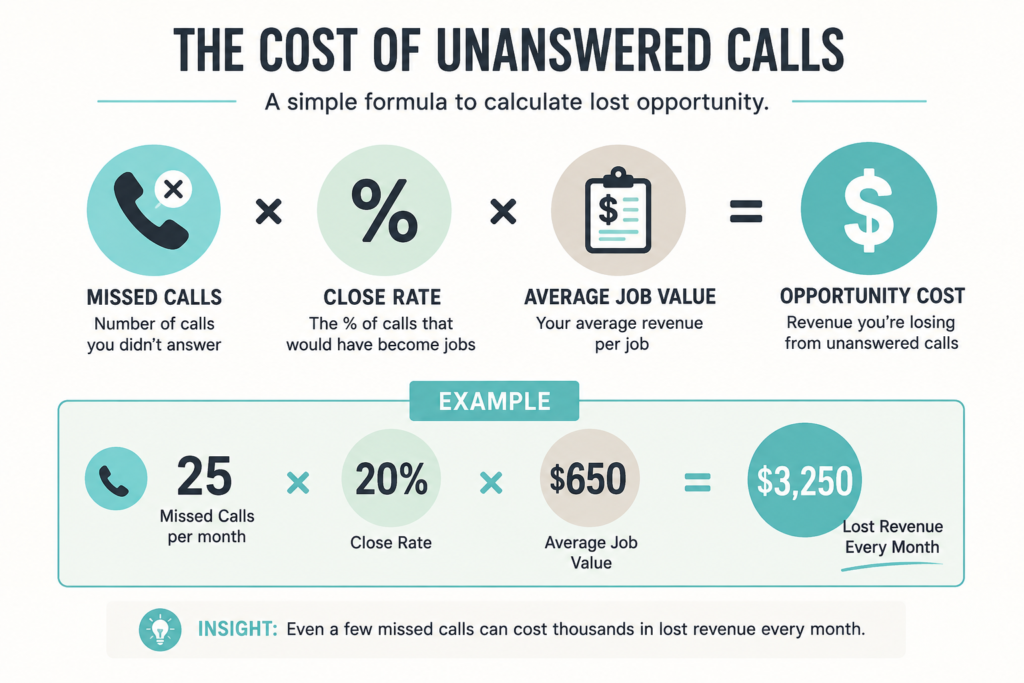
The formula itself is simple. The value comes from using your real numbers instead of an industry average.
Opportunity Cost = Missed Calls per Month × Close Rate × Average Job Value
Here is what each input means for your business:
Missed calls per month. Pull this from your phone system if it tracks it, or estimate from a week of paying attention to your call log. If you truly do not know, use the 38 to 62 percent industry range from the research above as a starting point, applied to your total monthly call volume.
Close rate. This is the percentage of answered calls that become paying work. If you close 1 in 4 calls you actually speak to, your close rate is 25 percent. Most owners already have a rough sense of this number from experience, even without formal tracking.
Average job value. Take your revenue from the last 3 to 6 months and divide it by the number of jobs or transactions you closed. Use a number you can defend, not your best month.
A Hypothetical Example
This example is hypothetical and meant only to show how the formula works. Your numbers will be different.
Imagine a home-service business that gets 200 calls a month and misses 40 percent of them, or 80 calls. Of the calls this business does answer, it closes 30 percent into paid work. Its average job is worth $450.
If even half of those 80 missed calls would have converted at the same 30 percent rate the business sees on answered calls, that is 12 jobs a month walking away unanswered. At $450 per job, that is $5,400 a month, or roughly $64,800 a year, in work this business never had the chance to win, because nobody picked up the phone.
That number is not a guarantee. It is an estimate built on reasonable assumptions. But it is a far more useful number than “I probably miss some calls,” because now there is something to weigh a fix against.
What to Do With Your Number
Once you have run your own calculation, the number tells you something specific: what a fix is worth to you, in dollars, per month. That is the number that should drive your decision, not a gut feeling about whether call coverage “seems important.”
Here is how to put the number to work.
- Write down your actual missed-call count for one real week. Do not estimate from memory. Look at your phone log, voicemail box, or call system, and count. A week is enough to get a realistic baseline without waiting a full month.
- Calculate your real close rate from the calls you did answer. Look back at your last 20 to 30 answered calls and count how many became paid work. Divide the number that converted by the total. That is your real close rate, not an industry guess.
- Pull your average job value from actual revenue. Take your last full quarter of closed jobs, add up the revenue, and divide by the job count. Round down if you are unsure, so your final number stays conservative.
- Run the formula with your three numbers. Missed calls times close rate times average job value gives you a monthly figure. Multiply by twelve for the annual number.
- Compare that number to what closing the gap would cost. Check the EchoAssist pricing page against your monthly figure. If covering every call costs less per month than the revenue you are losing to missed calls, the math answers the question for you.
- Decide what “covering every call” actually means for your business. That might mean a dedicated answering process, a call-handling standard for your team, or a system like EchoAssist that answers every call the moment it comes in.
- Re-run the number in 90 days. Once you have made a change, calculate your missed-call rate again and see whether the gap actually closed. The number is only useful if you check it.
Frequently Asked Questions
Is this calculation exact, or just an estimate?
It is an estimate, and it should be treated as one. The formula uses your real call volume, close rate, and job value, but not every missed call would have converted. Use it to understand the scale of the problem and to weigh solutions, not as a guaranteed revenue figure.
What if I do not know my missed call count?
Check your phone system first, since many track missed calls automatically. If yours does not, review one full week of calls manually and use that as your baseline. A rough real number beats a precise guess.
Does this apply if most of my leads come from referrals, not cold calls?
Yes. Referral leads still call your phone, and referral leads are often the most valuable calls you get, since they arrive with built-in trust. A missed referral call is arguably a more expensive miss than a cold one.
How is this different from just tracking missed calls in general?
Tracking counts calls. This calculation converts that count into a revenue figure using your close rate and job value, so you can compare the cost of the problem against the cost of a fix in the same currency: dollars.
Should I run this calculation before or after looking into a solution like EchoAssist?
Before. Knowing your number first means you can evaluate any solution, including EchoAssist, against real data instead of a sales pitch. A demo means more once you already know what the problem is costing you.
The Real Question Isn’t Whether You’re Missing Calls
You already know you are missing calls. Every owner does. The real question this calculation answers is how much that is actually costing you, in dollars you could see in your account if the phone got answered instead.
Once you run your own number, you stop treating call coverage as a nice-to-have and start treating it as what it actually is: the difference between the revenue your marketing already generates and the revenue you actually keep. The leads are already calling. The only question is whether anyone answers.
Keep Learning
- How Missed Calls Become Lost Revenue for Service Businesses: The foundational look at how an unanswered call turns into lost income, and where to start measuring it.
- Why Voicemail Is Not a Lead-Response Strategy: What a prospect actually experiences when they hit voicemail, and why that experience costs you the sale.
- AI Receptionist vs. Hiring a Receptionist: How to Compare the Two Options: A side-by-side look at the coverage options once you know what the gap is costing you.
- The First Five Minutes After a Lead Calls: A Practical Follow-Up System: A framework for what should happen the moment a call turns into a real lead.
See What Your Number Looks Like With Every Call Answered
Once you know what missed calls are costing you, the next step is simple. Book your free EchoAssist demo and see how an AI receptionist built around EchoAssist answers every call, qualifies the lead, and gets you notified, so the number you just calculated stops growing.
About the Author
Derrick L. Houston is the founder of DH Digital Consulting, LLC, based in Dallas-Fort Worth. He built EchoAssist, an AI receptionist service for real estate agents and small service businesses, after watching too many owners lose paid work to a phone that never got answered. Derrick works directly with each business to build a call-handling setup that fits how they actually operate, rather than selling a one-size-fits-all platform.