
A customer persona isn’t a worksheet you fill out once and file away. Done right, it’s the thing that tells you what to say, where to say it, and to whom, every single time you sit down to write an email, a post, or a script for your AI receptionist.
By Derrick L. Houston, Founder of DH Digital Consulting, LLC
I used to think personas were something big companies did because they had the budget to overthink things. Then I watched two businesses in the same trade send nearly identical marketing to two very different customers, and only one of them landed. The difference wasn’t the offer. It was that one business actually knew who they were talking to, and the other was guessing. A customer persona is what closes that gap. It’s a working profile of your real buyer, built from real patterns, that shapes every message you send from that point forward.
Key Takeaways
- A persona is not a demographic snapshot. It’s a working description of what your buyer wants, what stops them from buying, and the exact language they use to talk about their problem.
- Businesses with documented personas consistently outperform those without them on conversion, revenue, and engagement, according to multiple industry case studies.
- Real estate is a clear example of why one generic persona fails: recent buyers span nearly every generation, and a 25-year-old first-time buyer and a 65-year-old repeat buyer are not making decisions the same way.
- A persona should directly shape your marketing copy, your social content, your email sequences, and how your AI receptionist qualifies and talks to a caller.
- Personas decay. A profile built two years ago on outdated assumptions can quietly steer your marketing in the wrong direction without you noticing.
Why Most “Personas” Never Actually Get Used
Here’s where most businesses go wrong with personas. They fill out a worksheet once, maybe during a slow week, list an age range and a job title, and call it done. That document sits in a folder and never touches an actual piece of marketing again.
A persona that isn’t shaping your next email, your next social post, or your next call script isn’t a persona. It’s a filing exercise. I’ve seen agents and service business owners write a “target buyer” profile and then send the exact same generic message to every lead anyway, because the profile never got connected to the actual decisions they make day to day.
The problem isn’t that personas don’t work. It’s that most of them are built once and then ignored. A real persona is a live reference, something you actually check before you write copy, choose a content topic, or decide how your AI receptionist should qualify an inbound caller.
What the Research Actually Shows
The data on this is not subtle. Businesses that build and actually use documented personas consistently outperform the ones that skip the step.
A MarketingSherpa case study on persona-driven campaigns found a 171% increase in marketing-generated revenue and a 111% increase in email open rates once personas replaced generic, one-size-fits-all messaging. Research compiled by Prospeo, drawing on data from Aberdeen Group, found persona-driven campaigns produced 73% higher conversion rates than campaigns without them. And across industries, 71% of companies exceeding their revenue and lead goals report having formally documented personas, compared to a much smaller share of companies that miss those goals.
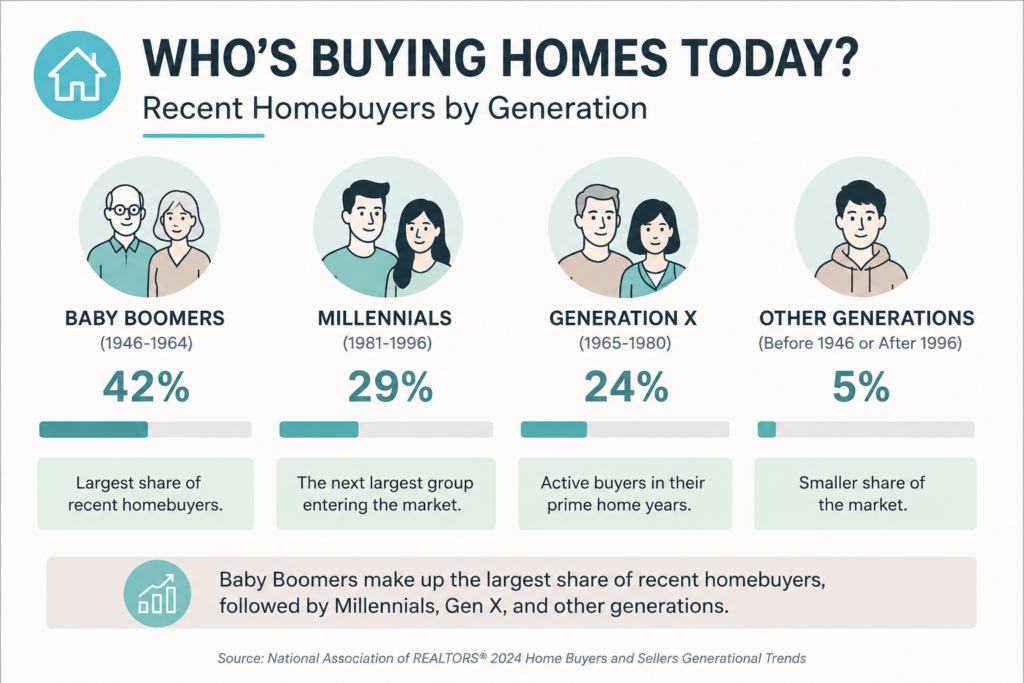
Real estate makes the case even clearer, because “the buyer” isn’t one person. The National Association of Realtors’ most recent generational trends report shows recent homebuyers are nearly evenly split across life stages: baby boomers account for 42% of recent buyers, millennials for 29%, and Gen X for 24%, with smaller shares from the Silent Generation and Gen Z. A first-time buyer in their thirties and a repeat buyer downsizing in their sixties are not researching the same way, asking the same questions, or responding to the same message. One generic “homebuyer” persona flattens all of that into noise.
The Persona Isn’t the Deliverable. The Decisions It Drives Are.
Here’s the reframe I use with clients: a persona’s value isn’t the document. It’s every decision that document quietly makes for you afterward.
Think of a persona as a filter you run every marketing decision through before it goes out. Should this email lead with price or with trust? Should this social post use a casual tone or a more formal one? Should your AI receptionist ask about timeline first or budget first when a new lead calls? A real persona answers those questions before you have to guess, because it’s built from how your actual buyers think, not from an assumption about who they are.
This matters just as much for call handling as it does for content. When EchoAssist qualifies an inbound caller, the questions it asks and the tone it uses should reflect who’s actually calling, a first-time buyer nervous about the process reads very differently than a repeat buyer who just wants a fast answer. A persona built well feeds every one of those systems the same accurate picture of who you’re actually talking to.
What a Persona Actually Needs to Include
A persona that earns its keep goes well past age and job title. From working through this with clients, the profiles that actually change marketing outcomes include a specific set of elements.
Start with the real motivation, not the surface-level goal. A homebuyer doesn’t just want a house, they want to stop feeling behind their friends who already own one, or they want a bigger yard before their kid starts school. A service-business customer doesn’t just want a repair, they want to stop worrying that the problem will get worse while they wait. That underlying want is what your copy should speak to, not the transaction itself.
Next, name the actual objections, in their words. Not “price sensitivity,” but the specific thing they say out loud: “I don’t want to get locked into a contract,” or “I’ve been burned by a contractor before.” Pull this from real conversations, past emails, and calls whenever you can, not from guesswork.
Then map the decision triggers, the specific moment or event that pushes someone from browsing to acting. For a homebuyer, that might be a lease renewal notice. For a service-business customer, it might be the second time something breaks in the same month. Knowing the trigger tells you when to show up, not just what to say.
Finally, capture the language itself. The exact phrases your real customers use to describe their problem, pulled from calls, reviews, and messages, not from how you’d describe it internally. Marketing that mirrors a customer’s own words back to them out-converts marketing that uses your internal vocabulary, every time.
How to Actually Build and Use One
- Pull from real conversations first, not assumptions. Review the last 15 to 20 calls, emails, or messages from actual leads and customers. Note the exact words they use for their problem and their hesitation.
- Separate your buyers into two or three real segments, not ten. Most small service businesses and agents don’t need ten personas. They need two or three that actually reflect meaningfully different buying behavior, like a first-time buyer versus a repeat buyer, or an emergency caller versus a planned-project caller.
- Write each persona around motivation, objection, trigger, and language, in that order. Skip demographics-only profiles. Build each one around what they want underneath the surface, what stops them, what pushes them to act, and how they actually talk about it.
- Run your next three pieces of content through the persona before you write them. Before drafting your next email or post, ask which persona it’s for and what their specific objection or trigger is. Let that answer shape the angle.
- Feed the persona language into your call handling. If you’re using EchoAssist or training anyone to answer calls, make sure the qualifying questions and tone match how your actual personas talk and what they care about first.
- Revisit the personas every 90 days. Buyer behavior shifts with the market, the season, and your own growth. A persona built on last year’s assumptions can quietly steer your marketing toward the wrong audience without you noticing.
Frequently Asked Questions
How many personas does a small business actually need?
Most service businesses and solo agents need two or three, not ten. Build a persona for each meaningfully different buying pattern you actually see, not for every possible demographic variation.
What’s the difference between a persona and a target market?
A target market is a broad group defined by demographics, like “homeowners aged 35 to 55.” A persona is a specific working profile of one buyer type within that market, built around their real motivation, objections, and language.
Can a persona actually improve how my AI receptionist handles calls?
Yes. A persona tells you what a caller is likely worried about and what question to ask first. That shapes the qualifying questions and tone your AI receptionist uses, which affects whether the caller feels understood or feels like they hit a generic script.
How often should personas be updated?
Review them roughly every 90 days, and sooner if your market shifts noticeably, like a change in mortgage rates for real estate or a seasonal shift for home services. A persona built on outdated assumptions can misdirect your marketing without an obvious warning sign.
Do personas only matter for big marketing budgets?
No. A clear persona costs nothing but time and actually matters more for smaller budgets, since every dollar and every message needs to land with the right person the first time, without room to waste on generic messaging that speaks to no one specifically.
The Buyer You’re Picturing Determines Everything You Send Them
Go back to those two businesses sending nearly identical marketing to different customers. The one that landed wasn’t smarter or better funded. They just knew who they were actually talking to, and it showed in every word they chose. That’s the entire value of a real persona: it turns guesswork into a specific, defensible answer for who you’re writing to and why they’ll care.
If you’re already a DH Digital client and want help building personas that actually reflect your real buyers, ask about customer persona support and we’ll build them from your actual leads and conversations, not a generic template.
Keep Learning
- How Missed Calls Become Lost Revenue for Service Businesses — How to estimate what unanswered calls are actually costing your business.
- How an AI Receptionist Works for a Busy Home-Service or Real-Estate Business — A full walkthrough of how EchoAssist handles a call from greeting to booking.
- How to Prepare Your Business for Better Lead Qualification — What to define before a call ever comes in, including the buyer information that should shape your qualifying questions.
- Why Won’t a Better Website Fix a Broken Lead-Response Process? — Why generating interest and converting it are two different jobs, and what actually fixes the gap.
About the Author
Derrick L. Houston is the founder and CEO of DH Digital Consulting, LLC, based in Dallas-Fort Worth, Texas. He built EchoAssist, an AI receptionist service, for real estate agents and service business owners who lose leads to missed calls while they’re out doing the work that earns them. Derrick also works directly with clients to build out customer personas, email sequences, and other add-on support so their entire marketing system speaks to the buyer they’re actually trying to reach. Contact: dhdigitalconsulting@gmail.com or (469) 689-1107.