
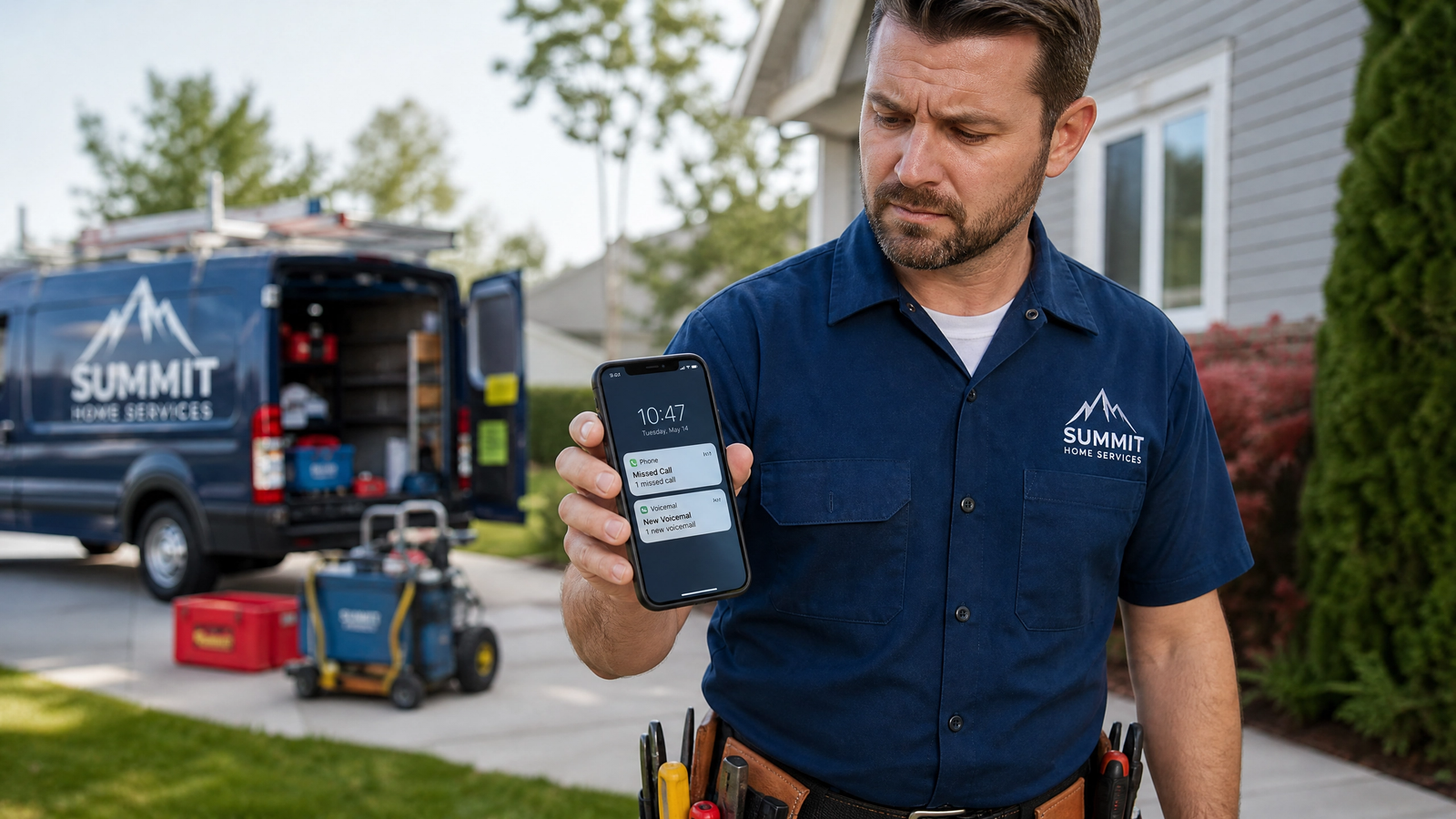
What actually happens when a prospect hits your voicemail, and what to do about it.
You’re out on a job. Hands busy, phone in your pocket. It rings, you can’t get to it, and the call drops to voicemail. You tell yourself you’ll call back when you have a minute.
That’s not a strategy. That’s a gap.
The hard truth is that voicemail is not a backup plan for lead response. It’s where leads go to die quietly while you’re still working the job you already have. And by the time your minute comes around, that prospect has already made another call.
This article is about what actually happens on the other end of that missed call, why the “I’ll call them back later” approach costs more than most service business owners realize, and what a real lead-response process looks like instead.
Key Takeaways
- Most prospects who reach voicemail do not leave a message, and most who do leave one don’t wait around for a callback.
- Response time is the single biggest factor in whether a new lead converts, and the window is measured in minutes, not hours.
- Voicemail is a passive system. It requires the prospect to wait and the owner to remember. Both assumptions fail regularly.
- The right comparison isn’t your warm voice versus an AI. It’s a professional response that captures the lead versus a voicemail box that lets it walk.
- A real lead-response process answers the call, qualifies the inquiry, notifies the owner, and keeps the conversation moving, whether you’re available or not.
What a Prospect Actually Does When They Hit Your Voicemail
Put yourself on the other side of that call for a minute.
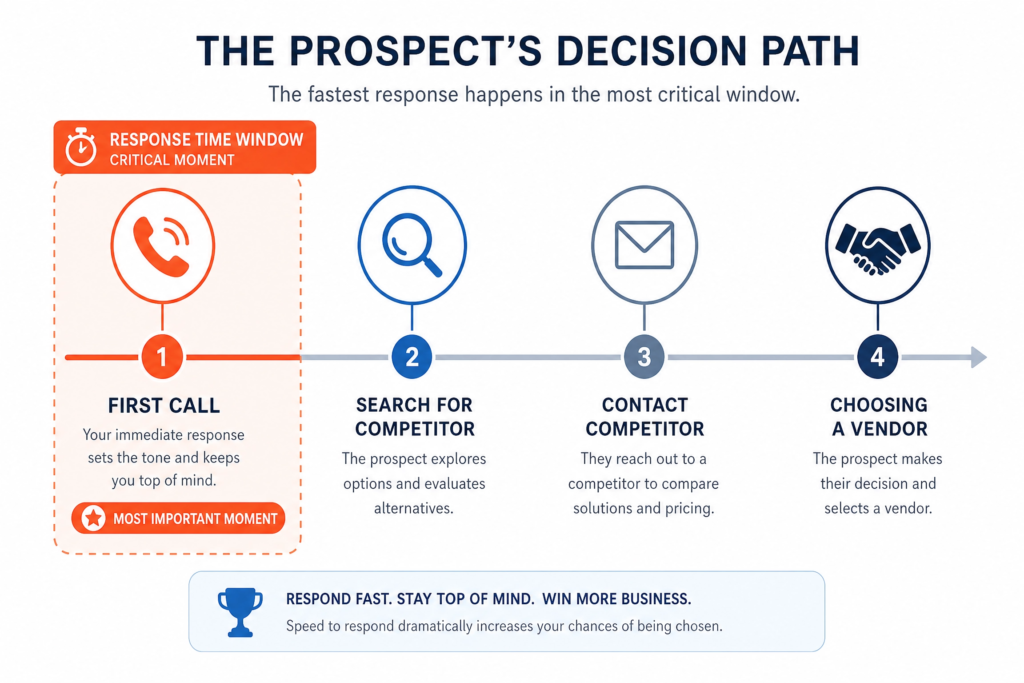
You need a plumber, a landscaper, an HVAC tech, a real estate agent. You search, you find a few options, and you start calling. The first number rings and drops to voicemail. You might leave a message. More likely, you move to the next number.
This isn’t because prospects are impatient or disloyal. It’s because they’re in motion. They have a leaking pipe, a showing that fell through, a project that needs to start this week. They need help now, and the business that picks up, or responds immediately, earns the appointment. The one that doesn’t has a voicemail box full of people who’ve already gone somewhere else.
Research from Harvard Business Review, tracking more than 15,000 leads and 100,000 call attempts, found that companies decrease their odds of qualifying a lead by 400% when their response time goes from 5 to 10 minutes. Not hours. Minutes.
And yet the average business takes 47 hours to respond to a lead. That’s two full days after someone raised their hand and said they were interested.
Voicemail is not closing that gap. Voicemail is creating it.
Why the “Call Them Back” Plan Doesn’t Hold Up
There are two assumptions baked into the voicemail-and-callback approach. The first is that the prospect will wait. The second is that you’ll remember to call.
Neither is reliable.
On the prospect side: 78% of customers buy from the first company that responds, according to research from Lead Connect. When someone contacts an average of three to five vendors for a service need, the race is already underway. The business that responds first doesn’t just get a chance to close the deal, they get to shape the conversation before anyone else can.
On the business side: the callback-when-I-have-a-minute plan requires you to keep mental track of every missed call, prioritize them correctly, and find a moment between jobs to actually follow up. On a slow day, maybe that works. On a day when you’re running back-to-back? The lead falls through a crack and you don’t even notice until it’s been three days.
More than half of all leads that businesses pay to generate through advertising, content marketing, and referrals are simply never followed up on. More than half. That’s not a sales problem. That’s a process problem, and voicemail sitting at the center of your lead response is a major part of why it happens.
The “Just Text Me” Myth Has the Same Flaw
Some owners hear this and say: “I tell my clients to just text me, I respond to texts faster.”
The problem is that texting has the exact same structural flaw as voicemail. If you can’t answer a call while you’re mid-job, you can’t answer a text either. Both sit there waiting for a moment you may not get until evening, and by then the prospect who texted you at noon has already found someone who got back to them at 12:03.
The medium isn’t the issue. The availability is.
A text message sitting in your pocket while you’re under a sink is exactly as effective as a voicemail sitting in your inbox: not effective at all. The notification is there when you resurface, but the prospect moved on an hour ago.
What After-Hours Calls Reveal About Your Coverage Problem
The voicemail problem doesn’t just happen during busy stretches of the day. It happens after hours, on weekends, and during any window when a prospect calls and gets nothing but a recorded voice asking them to leave a message.
Think about when service business inquiries actually come in. Homeowners research contractors in the evening after work. Real estate clients call after their daytime showings, when they’re sitting in their car deciding what to do next. Someone’s water heater fails at 7pm and they need to know someone is going to help them.
If your phone goes to voicemail at 6pm, your competitor’s does not necessarily.
An incredible 78% of customers purchase from the business that responds first, creating a massive opportunity for companies with systems that respond outside of business hours. After-hours call coverage isn’t a nice-to-have. For most service businesses, it’s where a significant portion of new business is either captured or lost.
Voicemail at 6pm is not a response. It’s a gap in your business that someone else will fill.
The Real Comparison You Should Be Making
Here’s where a lot of service business owners get the comparison wrong.
They imagine the choice as: my own voice, personal and warm, versus some robotic AI that will alienate their customers. That framing makes voicemail feel like the conservative, safe option.
But that’s not the actual comparison. The actual comparison is this:
Option A: A prospect calls. They get a professional, knowledgeable response that answers their basic questions, captures their information, and tells them someone will follow up, whether that’s immediate booking or a callback within minutes.
Option B: A prospect calls. They get a generic voicemail prompt. Maybe they leave a message. More likely, they hang up and call someone else.
Which of those is better for your business?
The fear that AI will sound robotic is worth taking seriously as a setup question, because a poorly configured AI receptionist can absolutely feel cold and off-brand. But a well-configured one sounds like your business. It knows your service area, your hours, your most common questions, and the way you want a new client to be treated. It captures the inquiry, qualifies the lead, and gets the right information to you so you can follow up fast.
The voice on the call is your business. The AI just makes sure someone answers.
What a Real Lead-Response Process Looks Like
If voicemail is out, what goes in its place?
A real lead-response process has five components working in sequence. Every one of them can be handled without you picking up the phone in the middle of a job.
1. Immediate acknowledgment. When a prospect calls, something happens right away. Not hours later. The call is answered, greeted professionally, and the prospect is given a clear next step, whether that’s answering their question, taking a message, or booking a time for a callback. The experience signals that this is a business that is on top of things.
2. Lead qualification. Not every call is the same. Before you invest time in a callback, you need to know who this person is, what they need, and whether they fit your ideal client. A good call-handling process asks the right questions up front, so your follow-up is informed and specific, not a cold restart from scratch.
3. Owner notification. The moment a new lead comes in, you get a message. Text, email, or both. Not when you happen to check your voicemail. Right away, so you know there’s a qualified inquiry waiting and you can decide how to respond.
4. Response window. Once you’re notified, you have a real shot at the lead. Call back within a few minutes of the inquiry, and you’re still in the running. The prospect is still thinking about it. That fast follow-up, even if you’re calling back rather than answering live, can still land the job if the turnaround is tight.
5. Follow-up if no contact. If the callback doesn’t connect, there’s a clear next step. An automated text or email that acknowledges the inquiry, tells them when to expect a call, and keeps the door open. Not silence. Not a voicemail from you sitting next to their voicemail to you.
This is what EchoAssist is built to handle. The call gets answered, the lead gets qualified, I get notified immediately, and the follow-up starts before I’ve even put my phone back in my pocket. The prospect never hits a dead end.
What to Set Up Before Your Next Missed Call
If you want to close the voicemail gap, here’s where to start.
Audit one week of calls. Pull up your call log for the last seven days. Count how many calls came in after hours or during a stretch when you were unavailable. Count how many of those got a callback within 30 minutes. That number is the size of your coverage gap.
Define your after-hours standard. What should happen when someone calls your business at 7pm? Who answers? What do they say? What questions should be asked? Write that down, even roughly, because you can’t hand off a process that doesn’t exist yet.
Decide what immediate notification looks like. You need to know about new leads within minutes, not hours. Whether that’s a text to your personal number, an email, a CRM notification, or all three, set up the alert chain so a missed call never just disappears.
Configure what the prospect hears. If someone calls your business right now and can’t reach you, what do they get? Listen to it. Does it sound like a professional business that’s on top of things? Does it give the caller a clear next step? If not, that’s worth fixing before tomorrow’s calls come in.
Consider what handles the call when you can’t. This is where AI call handling earns its place. Not because it replaces your relationship with your clients, but because it makes sure that relationship gets a chance to start. A prospect who gets a real response at 6pm on a Tuesday and books an appointment that night is a client. A prospect who got your voicemail is not.
Frequently Asked Questions
Does voicemail ever work as a lead-response method?
Voicemail can capture a message, but it is not a response. A true lead-response process acknowledges the inquiry immediately and gives the prospect a clear next step. Voicemail requires the prospect to wait and the business owner to remember to call back. Both steps fail more often than most owners realize, and by the time the callback happens, many leads have already moved on.
How fast does a service business actually need to respond to a new lead?
Research consistently points to five minutes or less as the critical window. Leads contacted within five minutes are far more likely to convert than leads contacted 30 minutes later, and significantly more likely than leads contacted after an hour. For service businesses where prospects often contact multiple companies at once, being the first to respond often decides who gets the job.
What if a prospect leaves a voicemail and I call back the same day?
Same-day callbacks are better than no callback, but they’re not fast enough to capture leads who needed a response quickly. If a homeowner’s water heater failed and you call back four hours later, they may already have a technician en route from another company. The same-day standard works for scheduled projects; it fails for urgent needs and for prospects who were comparison-shopping.
Is an AI receptionist really better than a professional voicemail greeting?
The comparison isn’t between a polished voicemail and an AI. It’s between a live, responsive interaction and a recorded message. A well-configured AI receptionist greets callers in your business’s voice, answers common questions, qualifies the inquiry, and notifies you immediately. A voicemail greeting asks the prospect to wait. For a prospect in the research phase, that difference in experience often determines which business earns the appointment.
What about clients who prefer to leave a voicemail and wait for a callback?
Some clients will prefer that, and a good call-handling process can accommodate it. The key is that the call still gets answered, the prospect’s preference is noted, and the follow-up happens quickly with the right context. The problem with pure voicemail isn’t that some clients like leaving messages; it’s that many don’t, and there’s no way to know which type of client is calling until you’ve already sent them to voicemail.
This Comes Down to One Question
You’ve invested in getting the phone to ring. Marketing, word of mouth, a Google Business Profile, referrals from past clients. Every one of those investments is working to put a prospect on the other end of that line.
The question is whether something is working just as hard to make sure that call doesn’t disappear.
Voicemail is passive. It waits for the prospect to do something and then waits for you to do something. Your leads are not that patient, and your schedule is not that forgiving. The owners who are capturing more of the business they generate are the ones who have closed that gap. Not by answering every call themselves, but by having something in place that makes sure every call gets a response.
Your business earns the right to that first conversation. Make sure something is there to have it.
Ready to close your coverage gap? Book your free EchoAssist demo and see how your business would handle a call today.
Keep Learning
- How Missed Calls Become Lost Revenue for Service Businesses — the financial case for treating every missed call like a lost job, not a small inconvenience.
- The First Five Minutes After a Lead Calls: A Practical Follow-Up System — what should happen once a lead is actually captured, so it does not go cold.
- What an AI Receptionist Should Know About Your Business Before It Answers a Call — the setup work that keeps an AI receptionist from sounding generic.
- How an AI Receptionist Works for a Busy Home-Service or Real-Estate Business — see the alternative to voicemail in action, call by call.
About the Author
Derrick Houston is the founder of DH Digital Consulting, LLC, where he helps solo entrepreneurs and small service businesses put AI to work so the busywork runs itself and they can focus on growth. He built EchoAssist to solve the specific problem he kept seeing: business owners generating leads they couldn’t capture because they were too busy doing the work that earned them. Derrick works directly with every client, tailoring each setup to how their business actually runs, not how a software manual says it should.