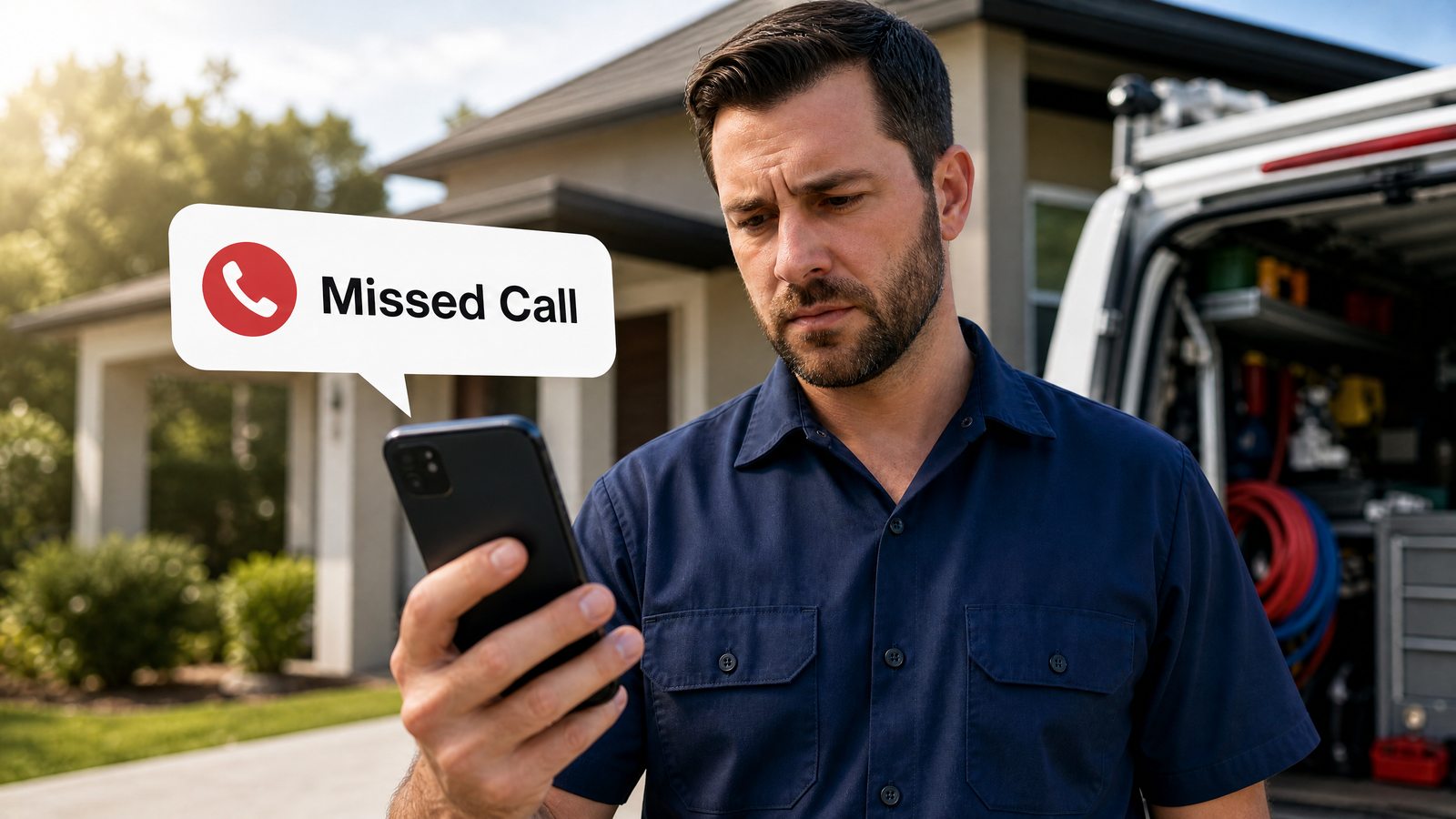
You’re on a job. A real one, the kind that actually pays. Your phone rings, your hands are full, and you let it go. You figure you’ll call back in an hour.
That hour is too late.
Not because the prospect got impatient. Because they made a decision. The moment your phone rang and nobody answered, they started scrolling. They called the next name on the list. And there’s a reasonable chance that business answered, because it doesn’t have someone out doing the actual work.
That’s the missed-call problem in a service business. It’s not about being rude to customers. It’s not about being hard to reach. It’s about what happens in the gap between the ring and the callback — and most business owners have no idea what that gap is costing them.
Key Takeaways
- Most service businesses miss a significant share of inbound calls, including calls during business hours, not just after-hours.
- The majority of callers who reach voicemail won’t leave a message and won’t call back — they call a competitor instead.
- The revenue loss compounds because the lead, the job, and the long-term customer relationship all disappear together.
- Speed-to-lead matters more than most owners realize: research shows that a response within five minutes dramatically outperforms one that arrives even 30 minutes later.
- There’s a simple calculation you can run on your own numbers today to see what this is costing your business specifically.
Why a Missed Call Feels Minor and Isn’t
When you’re a service business owner, the work in front of you demands your attention. You’re not ignoring calls on purpose. You’re wiring an outlet, or walking through a listing, or under a sink. The call comes in, you can’t grab it, and you assume the person will leave a message or try again.
The data says otherwise.
Multiple studies tracking inbound call behavior at small businesses have found that around 85% of callers who reach voicemail don’t leave a message and don’t call back. They don’t wait. They move on. And research consistently shows that approximately 62% of those callers immediately contact a competitor instead of trying again later.
That’s not a customer who drifted away. That’s a customer who made a decision while you were working.
The frustrating part is that this problem is invisible. There’s no invoice for the lead you didn’t capture. No line item in your books that says “Revenue Lost to Voicemail.” The money just never arrives, and nothing in your day signals that it was ever coming.
What the Research Shows About Missed Calls and Service Businesses
The numbers on missed calls are larger than most owners expect, and they’re worse for service businesses specifically — because the nature of the work creates structural gaps in call coverage.
The scale of calls going unanswered is significant. Research from call analytics firms and industry sources consistently shows that small businesses miss a substantial portion of inbound calls during business hours. Home services businesses see some of the highest missed-call rates of any industry because the owner and technicians are physically unavailable while on job sites.
The after-hours exposure is even worse. Research from Ruby Receptionists found that 35% to 45% of calls to service businesses arrive outside standard business hours. These are often the most urgent calls — a broken furnace at night, a pipe that isn’t waiting until Monday. A business that only answers calls between 9 and 5 is missing those calls entirely, every time.
Response time has a direct relationship to close rate. A study published in Harvard Business Review analyzed 1.25 million sales leads and found that responding within an hour makes it seven times more likely you’ll qualify a prospect compared to a two-hour callback. Separate research from InsideSales found that waiting 30 minutes versus responding within five minutes drops your odds of converting a lead by 21 times. That’s not a marginal difference. That’s the gap between closing a job and losing it.
Phone calls are high-intent leads. When someone picks up the phone and dials your number, they’ve already passed through the research stage. They’re not browsing — they’re ready to talk. Research from BIA/Kelsey found that phone calls convert at roughly 10 to 15 times the rate of a web form submission. Missing that call isn’t missing a cold inquiry. It’s missing someone who was close to hiring you.
The Revenue Calculation You Can Run Right Now
Here’s the framework. It isn’t complicated, and you can fill it in with your own numbers in a few minutes.
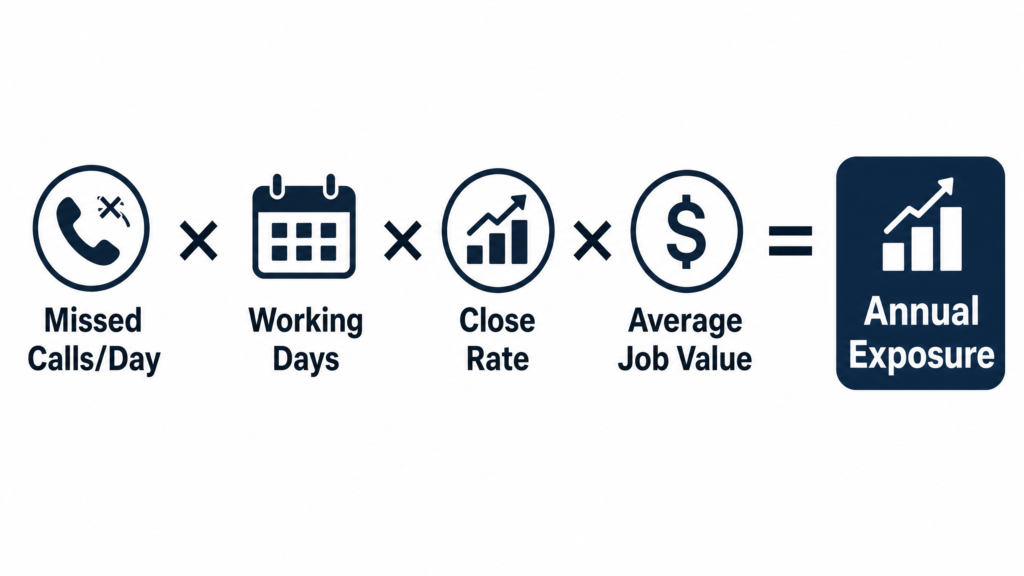
The formula:
Calls you miss per day × working days per year × your close rate on inbound calls × your average job value = annual revenue exposure from missed calls
Let’s run a conservative example for an HVAC owner.
Say you get 15 inbound calls on an average workday. If you’re missing even 20% of them, that’s 3 calls a day. Over 260 workdays, that’s 780 missed calls per year. If you close 35% of your inbound calls and your average job is $800, you’re looking at roughly $218,400 in annual revenue from calls that could have reached someone but didn’t.
That example is deliberately conservative. The miss rate could be higher. The after-hours exposure isn’t included. And it doesn’t account for the lifetime value of those customers — a client who books an HVAC tune-up with you in year one might call you for an emergency replacement in year three.
The actual number for your business depends on your volume, your ticket size, and your close rate. But the direction of the math is consistent: the cost of missed calls compounds over time, and it happens quietly.
The Voicemail Myth That’s Costing You Money
There’s a version of this conversation where the business owner says, “I have voicemail. People can leave a message and I’ll call them back.”
That position doesn’t hold up.
First, most callers don’t leave messages. The data on this is consistent: the majority of people who reach voicemail hang up without leaving anything. They don’t feel like they’re being served — they feel like they’re being screened, or like the business is too busy for them.
Second, a callback and an answered call are not the same thing. Even if someone does leave a voicemail, by the time you’re back in your truck, done with the job, and have a moment to listen and return the call — that’s a 30-minute to two-hour gap in most real-world service businesses. The research on lead response time says that window is too long. The prospect has either made a decision already or has cooled off enough that your call back into a distracted person who is less ready to commit than they were an hour ago.
Third, the comparison isn’t “my warm human voice versus a robotic AI.” The real comparison is between a voicemail inbox that quietly loses leads versus a system that answers the call, sounds like your business, captures the information, and gets you notified in real time. One of those options keeps the lead in play. The other one doesn’t.
How to Start Fixing This Without Hiring Another Person
Hiring a receptionist solves the coverage problem, but it creates new ones. A full-time receptionist costs $35,000 to $50,000 in salary alone, before benefits, before sick days, before the hours when your business is still technically open but they’ve gone home. You still have coverage gaps. You still miss calls on Saturday.
Before hiring, run the audit first.
Step 1: Pull three months of call data. Look at your phone records or your call log from whatever system you use. Count the calls that went to voicemail. Most business owners haven’t done this because it’s uncomfortable to see the number.
Step 2: Note when the missed calls happened. Were they after hours? During a busy stretch mid-morning? Understanding the pattern tells you where the gap actually is so you’re solving the right problem.
Step 3: Calculate your own number. Use the formula above. Plug in your actual average job value and your honest close rate. The result is not a guaranteed loss — it’s the potential revenue at risk in calls that aren’t reaching a person.
Step 4: Decide what level of coverage you actually need. If your gap is primarily after-hours, that’s a different solution than if you’re missing calls during business hours too. Some businesses need seven-day coverage. Others need a backup for when they’re with a customer. Know your pattern before you invest in a solution.
Step 5: Evaluate AI call coverage as a starting point. An AI receptionist doesn’t replace the relationship you build with clients. It handles the front door — the first answer, the qualification, the booking request, the notification to you — so that the call reaches a person or a confirmed next step instead of voicemail. EchoAssist handles inbound calls for service businesses and is built to sound like your business, not like a generic automated system.
Step 6: Track the results for 90 days. If you’re capturing calls that previously went unanswered, you’ll see it in booked jobs within the first month. The math doesn’t take long to show up.
Frequently Asked Questions
How many calls does the average service business miss?
Multiple industry studies suggest small service businesses miss a meaningful portion of inbound calls during business hours, with home services among the hardest-hit sectors. The exact rate depends on your call volume, staffing, and whether you have any after-hours coverage. Running your own three-month call log audit is the most accurate way to know your number.
Does it matter if I call the customer back within an hour?
It matters significantly. Research from Harvard Business Review found that responding to an inbound lead within one hour is seven times more effective than a two-hour callback. Even within that first hour, the earlier the better — some research suggests conversion odds drop sharply after just five minutes. A callback is better than nothing, but it’s not equivalent to answering the call.
What’s the difference between an AI receptionist and a traditional answering service?
A traditional answering service connects callers to a shared call center where operators handle multiple businesses and often can’t answer specific questions about your services, pricing, or availability. An AI receptionist is configured specifically for your business — it knows your services, your service area, your booking process, and your qualification questions. It can capture lead details and notify you in real time without relying on a human operator who may not know your business.
How do I calculate what missed calls are costing my business?
Multiply your daily missed calls by your annual working days, then multiply by your inbound close rate and your average job value. For example: 3 missed calls per day × 260 days × 35% close rate × $800 average job = roughly $218,000 in annual revenue exposure. You can also use the EchoAssist calculator to run this with your own numbers.
What about callers who prefer texting over calling?
Texting has the same core problem as calling: if you’re on a job, you can’t respond to a text any faster than you can return a call. The message sits until you’re free, and by then the prospect has often moved on. A system that captures the inquiry and confirms it immediately — whether the contact came in by call or by text — solves the problem regardless of channel.
The Bottom Line
The leads that cost you the most aren’t the ones who ghost you after a proposal. They’re the ones who called, got voicemail, and never showed up in your CRM at all.
You paid to reach them through marketing, referrals, or reputation. They were ready to hire someone. And then they made the decision to hire that someone while your phone rang without an answer.
The missed-call problem is fixable. Not by working harder or staying more glued to your phone — that path doesn’t end well. It’s fixable by making sure the front door of your business is covered when you can’t be the one to answer it.
Book a free EchoAssist demo and see how other service businesses are handling this. Bring your call volume and your average job value. The math usually makes the case faster than the conversation does.
The calls are coming whether you’re ready or not. The only question is who answers them.
Keep Reading
- Why Voicemail Is Not a Lead-Response Strategy — why a voicemail box does not count as a follow-up plan, and what happens to the lead instead.
- The First Five Minutes After a Lead Calls: A Practical Follow-Up System — a six-step system for what should happen the moment a lead reaches out.
- What an AI Receptionist Should Know About Your Business Before It Answers a Call — the details an AI receptionist needs before it can sound like your business.
- How an AI Receptionist Works for a Busy Home-Service or Real-Estate Business — a full walkthrough of how a call gets answered, qualified, and handed off.
About the Author
Derrick Houston is the founder of DH Digital Consulting and the creator of EchoAssist, an AI receptionist service built for service business owners who are out doing the work instead of sitting by a phone. He works directly with real estate agents and small service businesses to help them build the systems that capture leads and keep them from slipping through the cracks. He is based in Dallas–Fort Worth and can be reached at dhdigitalconsulting@gmail.com or (469) 689-1107.