
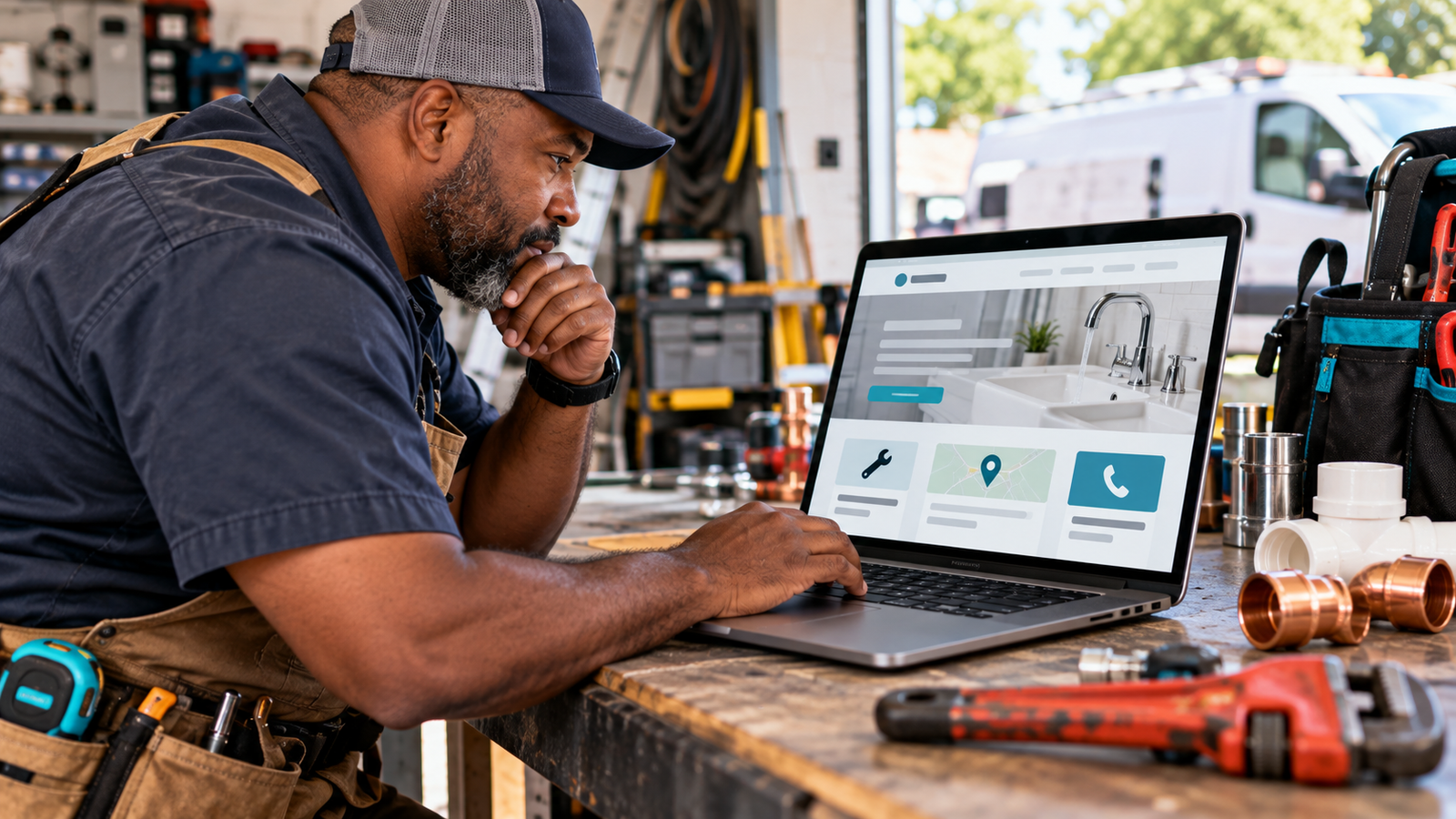
A plumber’s website has one job: turn a visitor with a problem into a phone call. Most plumbing websites fail at this because they load slowly, bury the phone number, or make the visitor hunt for basic information like service area and hours. A site built around website design for plumbers gets the caller to the “Call Now” button in seconds, not minutes.
The difference between a plumbing website that generates calls and one that just sits online usually comes down to a handful of decisions: what shows up before the visitor scrolls, how the services are organized, whether the site loads fast on a phone, and whether it looks trustworthy enough to act on. None of this requires a huge budget. It requires getting the fundamentals right in the right order.
I’ll walk through what belongs above the fold, which pages actually help customers find the right plumber, what builds trust fast enough to beat a competitor’s tab, and what real plumbing companies are doing well right now.
Key Takeaways
- A plumbing website needs to show the phone number, service area, and a clear action button before the visitor scrolls.
- Dedicated pages for each service and each city served help both customers and search engines find the right plumber faster.
- Mobile speed, real reviews, and a secure connection do more for trust than fancy design elements.
What Should a Visitor See Before They Scroll?
The area above the fold on a plumbing website has to answer three questions immediately: what you do, where you work, and how to reach you. A visitor who lands on a slow or cluttered homepage will hit the back button and call the next name on the list.
Good plumbing website design puts these elements in the first screen a visitor sees, without requiring any scrolling:
- Phone number, large enough to read and tapped to dial on mobile
- Service area, so the visitor knows instantly if the business covers their address
- A short headline naming the core plumbing services offered
- Calls to action, such as “Call Now” or “Request Service,” placed in the header and repeated lower on the page
- Emergency plumbing services called out separately if offered, since a burst pipe at midnight is a different search than a routine repair
Online booking belongs here too, but as a secondary option next to the phone number, not a replacement for it. Someone with water on the floor wants a human on the line. Someone comparing water heater installers for next month is more likely to fill out a form.
Avoid cramming the hero section with a long company history or a slideshow of unrelated stock photos. A single clear photo of the team or a truck, paired with a short headline and a visible phone number, does more work than five rotating banners. If a visitor has to scroll before finding out what the company does or how to contact it, the design has already lost the lead. The goal is immediate orientation: this company does plumbing, serves this area, and can be reached right now.
Which Pages Help Customers Find the Right Plumber?
Separate pages for each major service and each city served help customers self-select faster and help the site rank for the exact terms people search. A single page listing every service in one paragraph forces the visitor to read through unrelated content to find what they need.
At minimum, a plumbing website should have dedicated pages for the services that bring in the most calls. Residential plumbing and commercial plumbing services usually need separate pages, since the two audiences ask different questions. A homeowner wants to know about drain cleaning or water heater repair. A property manager wants to know about maintenance contracts, code compliance, and response times for tenant issues.
Specific pages worth building:
- Drain cleaning, since it is one of the most searched plumbing terms
- Water heater repair and installation, often searched separately from general plumbing
- Emergency plumbing, written for someone who needs help today
- Residential plumbing, covering common home repairs
- Commercial plumbing services, covering business and property management needs
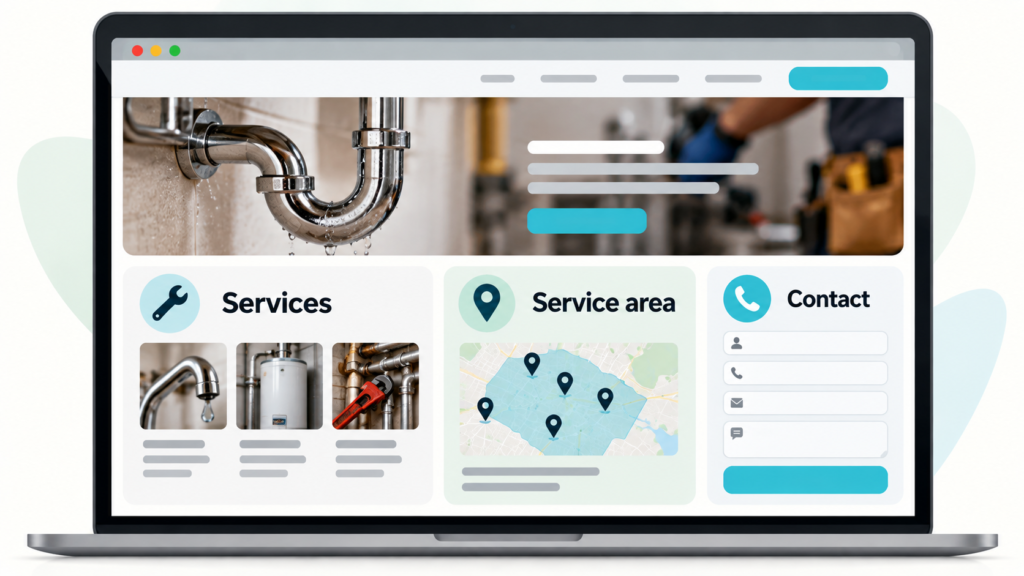
Local SEO depends on these pages naming the actual cities, neighborhoods, or counties served, rather than a vague “serving the greater area” line. SEO for plumbers works best when each service page and each location page includes specific, real details, licensing information, service radius, and local landmarks or neighborhoods, instead of copying the same paragraph across every page with the city name swapped. A reader comparing the fine details of lead response and site structure can find more on how missed calls cost service businesses.
What Makes a Plumbing Website Easy to Use and Trust?
A plumbing website earns trust through speed, mobile usability, and visible proof that other customers were satisfied. Design choices that look polished on a desktop monitor often fail on the phone screen where most emergency searches happen.
Mobile-first design means building for the phone screen first, then adjusting for desktop, not the reverse. Responsive design, where the layout adjusts automatically to any screen size, is the baseline requirement now, not an upgrade. Fast loading speed matters just as much: a site that takes more than a few seconds to load on a phone loses visitors before they read a single word. Compressed images and simple code keep load times low.
Readable fonts and high-quality images round out the basics. Skip decorative scripts or small gray text on a white background. Use real photos of the team, trucks, and completed jobs instead of generic stock photography; a visitor can usually tell the difference, and real photos build more confidence.
Trust signals carry the rest of the weight:
- Customer reviews and Google reviews displayed on the homepage, not buried on a separate page
- Customer testimonials with real names, written in the customer’s own words
- An SSL certificate, shown by the padlock icon in the browser, confirming the connection is secure
A homeowner deciding between two plumbers in the same search results often picks the one with visible reviews and a site that loads instantly. For a deeper look at how slow lead response costs jobs even when the website looks fine, see opportunity cost of unanswered calls.
What Can Plumbers Learn from Real Website Examples?
The strongest plumbing website examples share a pattern: they keep navigation short, name their service area clearly, and put the contact method within reach on every page. Looking at a range of plumber website examples shows how different company sizes solve the same problem.
Jimmy Joe’s Plumbing keeps its menu concise and writes service labels in plain language instead of industry jargon, which makes it easier for a homeowner to find the right page fast. MNS Plumbing and Absolute Plumbing both lean on a clean, modern layout paired with visible scheduling tools, so a visitor can move from reading about a service straight into booking without hunting for a contact form. Circle Plumbing and Park Lane Plumbing use clear service categories and local detail to make it obvious at a glance whether the company covers the visitor’s neighborhood.
National brands offer a different lesson. Roto-Rooter pairs a location finder with its service categories, so visitors confirm coverage and need at the same time. Benjamin Franklin Plumbing builds its site around a promise-led trust structure, explaining what backs each service in plain terms, which gives visitors a reason to trust a company they have never used before.
The common thread across all of these: short navigation, visible local detail, and a contact path that never disappears, even on a long scroll. A solo plumber does not need the budget of a national chain to apply the same three principles.
Build for the Call That Comes Next
Good plumbing web design is not a one-time project; it is the front door for every plumbing lead the business will ever generate online. A site that loads fast, names the service area clearly, and keeps the phone number visible will keep paying off long after launch, while a cluttered or slow site quietly loses calls every week without anyone noticing.
The businesses that get the most out of their website treat it as part of a larger system: fast page load, clear service pages, visible reviews, and a reliable way to answer the phone when the call actually comes in. A polished site that sends every missed call to voicemail still loses the job to whichever competitor picks up. Anyone weighing that part of the equation alongside their website redesign can read more about what to automate first.
Frequently Asked Questions
How much does a plumbing website cost?
Plumbing website cost ranges widely depending on the build method. A website builder with a ready-made template can run a few hundred dollars a year, while a custom-built site from a designer often starts in the low thousands and goes up based on the number of service and location pages needed.
Should I use a plumbing website template or a custom build?
A plumbing website template works well for a solo plumber or small team that needs to get online quickly and affordably. A custom build makes more sense for a larger company that needs specific features like online booking integrated with scheduling software or a large number of service-area pages.
Does my plumbing website need online booking?
Online booking helps capture leads outside business hours and gives visitors who prefer not to call an easy way to reach out. It should sit alongside a visible phone number rather than replace it, since many plumbing searches come from people who want to talk to someone right away.
How many pages does a plumbing website need?
A basic plumbing website needs a homepage, a page for each major service, an about page, and a contact or booking page at minimum. Companies serving multiple cities benefit from adding a dedicated page for each service area to support local search.