
More posts do not automatically mean more clients. If your content is getting likes and views but not calls, the problem usually isn’t your posting frequency. It’s the gap between content that gets attention and content that gets a response.
By Derrick L. Houston, Founder of DH Digital Consulting, LLC
I talk to a lot of agents who post constantly. Listing photos, market updates, the occasional personal post. Their engagement isn’t bad. Their pipeline is empty anyway. That disconnect confuses people, because everything they’ve heard says post more, stay consistent, show up every day. All true. None of it explains why the phone isn’t ringing. Content builds awareness. Conversation, the actual back-and-forth that leads to a client, requires something content alone doesn’t do: a clear next step and a way to respond to it fast when someone takes you up on it.
Key Takeaways
- Posting consistently builds visibility, but visibility is not the same thing as leads. Those are two different jobs, and most content strategies only do the first one.
- Online research now plays a documented role in how buyers and sellers choose an agent, which means your content does matter, but only if it leads somewhere specific.
- Content without a clear call to action asks the reader to admire your work instead of asking them to do anything with it.
- Businesses with a documented content strategy consistently perform better than those posting without one, according to industry research.
- The fix isn’t more content. It’s connecting each post to one specific next step, and making sure someone answers when a reader actually takes it.
The “Just Post More” Trap
Somewhere along the way, “stay consistent” turned into “post as often as possible,” and a lot of agents took that literally. More listing photos. More market update graphics. More generic advice posts that could belong to any agent in any city.
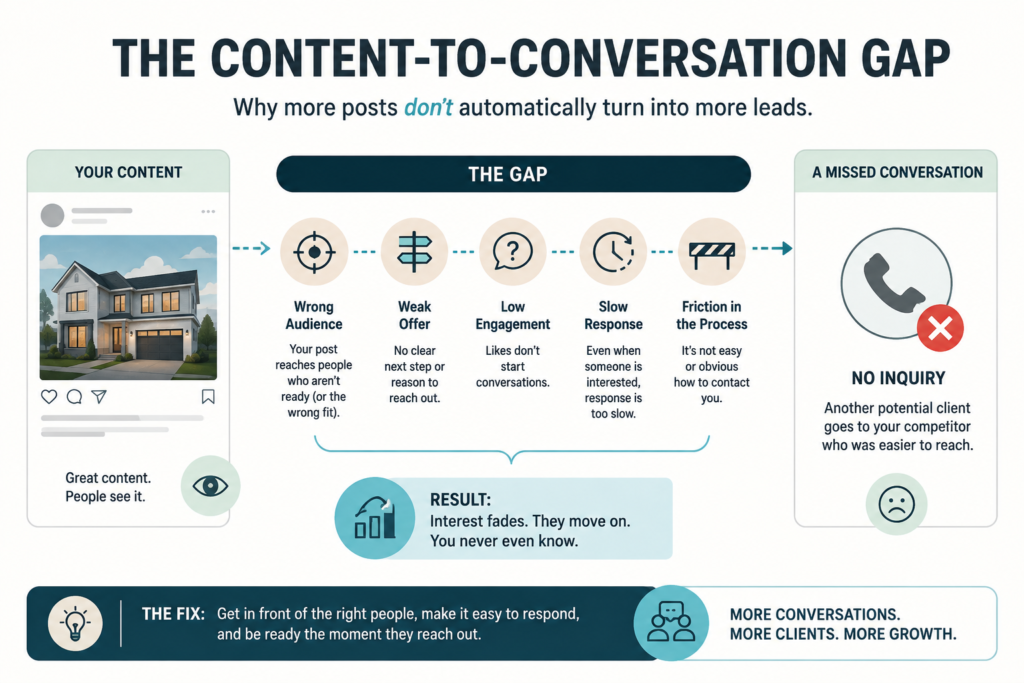
The problem isn’t that consistency is bad advice. It’s incomplete advice. Posting regularly keeps you visible, which matters, people need to see you around before they’ll trust you with something as big as buying or selling a home. But visibility isn’t the goal. It’s a step toward the goal. Somewhere between “they saw my post” and “they called me,” something has to actually happen, and for a lot of agents, nothing does. The post gets a few likes. Nobody clicks through. Nobody reaches out. And because the post technically “performed” on the platform’s terms, it looks like the content is working, even when it’s not producing a single conversation.
I’ve seen agents spend hours a week on content and treat a comment or a share as the win. Those aren’t nothing, but they aren’t clients either. If your content strategy stops at engagement, you’ve built a content strategy, not a lead strategy.
What the Research Actually Shows
Content does matter. It’s just not doing what most agents think it’s doing.
Zillow’s 2025 Consumer Housing Trends Report for Agents found that 36% of sellers now find their agent through online channels, more than double the 15% share reported in 2018. Among buyers, 33% said online research played a key role in how they chose their agent. That’s a real shift, and it means your online presence genuinely factors into whether someone considers you at all.
But presence isn’t the whole story. Real Brokerage’s January 2025 Agent Survey, drawing on responses from active agents, found that networking, referrals, and community engagement remain the most effective lead generation sources, with social media and digital tools serving a supporting role rather than the primary driver of new business. In other words, content builds the visibility that gets you into consideration. It’s rarely the thing that closes the loop on its own.
And the strategy piece matters more than most agents assume. Research from the Content Marketing Institute and MarketingProfs, surveying B2B marketers broadly, found that only 37% had a documented content marketing strategy. Among the most successful respondents, that number jumped to 62%. The gap between “posting content” and “having a content strategy” shows up directly in results, and that pattern holds whether you’re a national brand or a solo agent posting from your phone.
The Gap Isn’t Content Volume. It’s the Missing Handoff.
Here’s the reframe I bring to agents on this: think of every piece of content as an invitation, not a broadcast. A broadcast just goes out. An invitation asks for something specific back.
Most real estate content is built like a broadcast. It informs, it entertains, sometimes it even impresses. But it doesn’t ask the reader to do anything. No specific next step, no clear reason to reach out today instead of scrolling past. That’s the content-to-conversation gap: the space between someone seeing your work and someone actually starting a conversation with you about it.
Closing that gap doesn’t require posting less or more. It requires treating every piece of content as the first half of a conversation, not the whole message. A market update post can end with an invitation to find out what a specific trend means for the reader’s own home value. A listing post can end with an invitation to see similar homes before they hit the market. The content still does its job of building visibility and trust. It also does a second job: giving the reader somewhere specific to go next.
How This Actually Plays Out in a Content Plan
For the agents and service business owners I work with, closing this gap comes down to being deliberate about what each piece of content is actually for.
Start by sorting your content into two categories before you write a single post: content built to build trust and awareness, and content built to generate a specific response. Both matter. Most calendars are almost entirely the first category with none of the second, which is exactly why engagement looks fine while leads stay flat.
For the response-oriented content, the call to action needs to be specific, not generic. “DM me” or “reach out” asks for effort without giving the reader a clear reason. “See what homes in your price range have sold for this month” gives them something concrete to want. The more specific the invitation, the more likely someone actually takes it.
And this is where response capacity becomes part of the content plan itself, not a separate concern. If a post successfully gets someone to call or message, and that call goes to voicemail or that message sits unanswered for a day, the content did its job and the business still lost the lead. The content-to-conversation gap doesn’t close just because someone reached out. It closes when that reach-out gets a fast, real response. This is exactly why I built EchoAssist to answer every call your content generates, so a well-performing post doesn’t quietly leak leads at the exact moment it starts working.
Building a Content Plan That Actually Converts
- Audit your last 20 posts for a call to action. Go back through your recent content and count how many actually asked the reader to do something specific. If most of them didn’t, that’s the gap to close first, before worrying about posting frequency.
- Assign each post a single job. Before you write it, decide if this piece is meant to build trust or generate a response. Trying to do both in every post usually means it does neither well.
- Make your calls to action specific, not generic. Replace “reach out if you have questions” with something concrete tied to the post’s topic, like a specific market comparison, a listing preview, or a home-value estimate.
- Track responses, not just engagement. Likes and views tell you the content got attention. Track how many actual calls, messages, or form fills came from each piece so you know which content is doing the second job, not just the first.
- Confirm your response process can handle what your content generates. Before you push harder on content, check that every call or message your posts generate actually gets a fast answer. A great post that leads to an unanswered call is wasted effort.
- Repeat what worked, don’t just repeat what got likes. Revisit which posts actually generated conversations, not just engagement, and build more content around that specific angle and call to action.
Frequently Asked Questions
Should I post less if my content isn’t generating leads?
Not necessarily. The issue is usually the lack of a specific call to action, not the volume of posts. Keep your posting consistency and add a clear, specific next step to the posts meant to generate a response.
How do I know if a post is meant to build trust or generate a lead?
Ask what you want the reader to do after seeing it. If the honest answer is “nothing, just remember me,” it’s a trust-building post, which is fine. If you want them to reach out, the post needs an explicit, specific invitation to do that.
Does social media actually generate real estate leads?
It plays a documented role in how buyers and sellers choose an agent, but industry data shows referrals and networking remain the strongest direct lead sources. Social media works best as the visibility layer that gets you into consideration, not the sole closer.
What’s a content-to-conversation gap?
It’s the space between someone seeing your content and someone actually starting a conversation with you. Content that only informs or entertains without a specific next step leaves that gap open, no matter how much engagement it gets.
Why does response speed matter for content strategy?
If your content successfully gets someone to call or message you, and that inquiry doesn’t get a fast answer, the content’s work was wasted. A content plan and a response plan have to work together, or the leads the content generates leak right back out.
More Content Won’t Close the Gap. A Clear Next Step Will.
Go back to the agent posting constantly with strong engagement and an empty pipeline. Nothing about that picture means the content is bad. It means the content never asked for anything, so nobody gave anything back. Every post is a chance to move someone from watching to reaching out, but only if you actually ask, and only if you’re ready to answer when they do.
Explore more of DH Digital’s tools built for real estate agents who want their content and their response process working together instead of as two separate problems.
Keep Learning
- How Missed Calls Become Lost Revenue for Service Businesses — How to estimate what unanswered calls are actually costing your business.
- How Customer Personas Improve Every Marketing Decision You Make — How knowing your real buyer shapes what you post and how you talk to them.
- Why Won’t a Better Website Fix a Broken Lead-Response Process? — Why generating interest and converting it are two different jobs, and what actually fixes the gap.
- How an AI Receptionist Works for a Busy Home-Service or Real-Estate Business — A full walkthrough of how EchoAssist handles a call from greeting to booking.
About the Author
Derrick L. Houston is the founder and CEO of DH Digital Consulting, LLC, based in Dallas-Fort Worth, Texas. He built EchoAssist, an AI receptionist service, for real estate agents and service business owners who lose leads to missed calls while they’re out doing the work that earns them. Derrick also builds digital products and content systems for real estate agents so their marketing and their response process work as one system instead of two disconnected efforts. Contact: dhdigitalconsulting@gmail.com or (469) 689-1107.