

TLDR
ChatGPT handles writing tasks well for real estate agents, but real estate AI tools that connect directly to MLS data, lead records, and follow-up sequences save more time because they do not require an agent to manually feed them context before every task. ChatGPT is a strong drafting assistant. A purpose-built real estate AI product acts more like a second set of hands that already knows the listing, the lead, and the deadline.
Key Takeaways
- ChatGPT is strongest for drafting listing descriptions, social captions, and email templates from scratch.
- Real estate AI tools save more time because they pull directly from MLS records and lead data instead of requiring manual input.
- General AI tools carry more fair housing and compliance risk because they do not know local rules or brokerage policy.
- Purpose-built tools like EchoAssist AI handle lead intake and follow-up without an agent typing a prompt for every task.
- The right first purchase depends on whether the agent’s biggest time loss is writing or follow-up.
Fun Fact
The term “artificial intelligence” was coined in 1956, decades before anyone imagined it drafting an open house flyer. Real estate did not see meaningful AI adoption until cloud-based MLS integrations matured, which is why purpose-built real estate AI tools are a much newer category than general chatbots.
Expert Insight
In my work with real estate agents and small service business owners, the agents who get the most value from AI are not the ones using the flashiest tool. They are the ones who match the tool to the task that actually eats their week.
Writing tasks go to ChatGPT. Lead intake, follow-up, and scheduling go to a purpose-built real estate AI tool that already sits inside the agent’s workflow. Agents who try to force ChatGPT to do both end up doing manual data entry that a connected tool would have skipped entirely.
ChatGPT vs. Real Estate AI Tools: Where Does the Money Go First?
Agents deciding where to spend money on AI usually face the same question. Should the first dollar go toward a general assistant like ChatGPT, or toward real estate AI tools built specifically for the job? The answer depends on what is actually slowing the agent down, not on which tool sounds more advanced.
A real estate AI tool is software designed specifically for property transactions. It connects to MLS data, lead records, and scheduling systems so it can act on information without an agent typing it in manually. ChatGPT, by contrast, is a general-purpose language model that generates text based on whatever an agent types into the prompt box. Both are useful. They are not interchangeable.
What Does ChatGPT Actually Do Well for Agents?
ChatGPT handles drafting tasks well, turning a rough idea into a polished listing description, email, or social caption in seconds, because that kind of writing does not require access to live property or client data. An agent can describe a three-bedroom colonial and get five variations of copy back within a minute. That speed is real and it is useful for routine writing.
Where ChatGPT works best is the blank page. Drafting a buyer’s guide, brainstorming captions for a new listing, or writing a template for a cold email are all tasks where the tool starts from nothing and produces something usable. According to MoxiWorks, ChatGPT is strong for drafting and brainstorming but falls short on compliance and fair housing language, since it has no built-in awareness of local regulations or brokerage policy.
A general AI tool only knows what an agent types into it, which means every task starts from zero.
That limitation matters more than it sounds. An agent using ChatGPT for lead follow-up has to manually pull the lead’s name, property interest, and last contact date before typing a single prompt. Multiply that across dozens of leads a week and the manual work adds up fast.
Where Do Purpose-Built Real Estate AI Tools Save More Time?
Purpose-built real estate AI tools save more time because they connect directly to MLS listings, CRM records, and calendars, so they can act on a lead or a listing without an agent manually feeding it context first. Instead of pasting property details into a prompt, the tool already has them. Instead of writing a follow-up message from scratch, the tool can trigger it automatically based on a lead’s activity.
Re-Leased makes this comparison directly, noting that general-purpose tools like ChatGPT and Claude require manual context-pasting and lack integration with lease and accounting systems, while vertical real estate AI tools deliver higher return on investment by sitting directly on top of structured property data.
- Lead follow-up triggered by MLS activity, not a manual prompt
- Scheduling that pulls directly from a calendar instead of requiring copy and paste
- Compliance-aware language built around fair housing rules
- Automated intake through tools like EchoAssist AI, which answers calls and captures lead details without an agent lifting a finger
EchoAssist AI is one example of this category: an AI receptionist built for service businesses that answers calls, captures lead information, and routes it into a workflow automatically. That is a different job than drafting a caption. It is closer to hiring a front-desk assistant who never takes a day off.
The tool that saves the most time is the one that already knows the context before the task begins.
ChatGPT vs. Real Estate AI Tools: A Direct Comparison
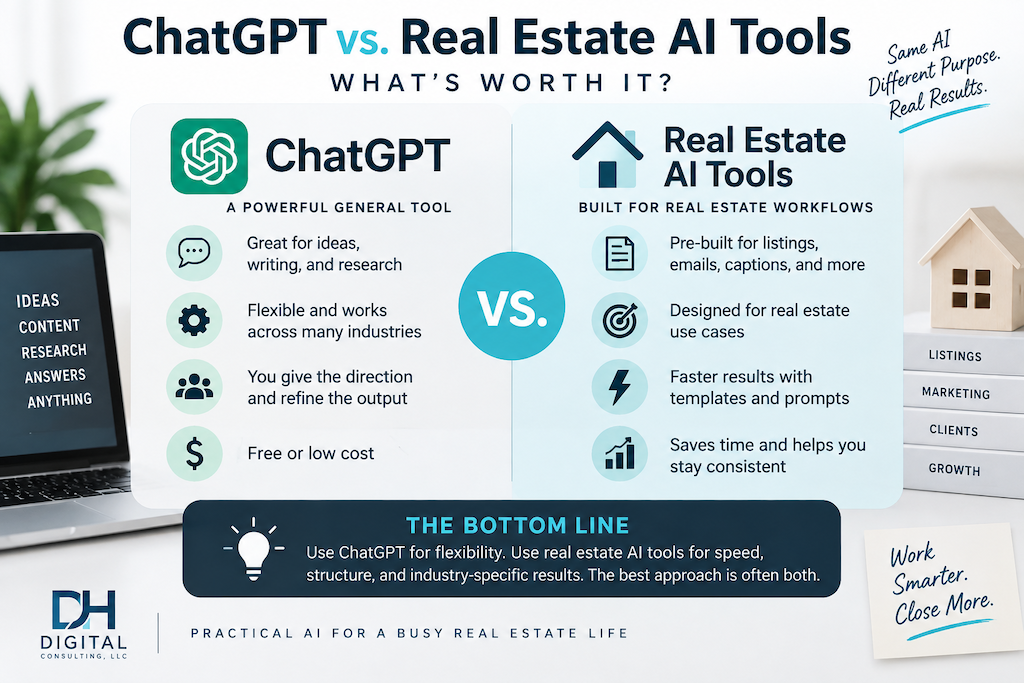
Data supports the idea that agents benefit from both categories, just for different reasons. Research from HousingWire on an NAR-subsidiary RPR survey found that 82 percent of agents have adopted some form of AI, with time savings as the top reported benefit, though many still lack confidence using AI for pricing or compliance work. That gap is exactly where a purpose-built tool earns its cost, since it is built around the compliance and data structure that ChatGPT was never designed to handle.
Interestingly, adoption data from Inman shows agents using their own external tools like ChatGPT or Claude report productivity gains at nearly double the rate of agents using brokerage-provided purpose-built tools. That does not mean general tools are better. It suggests agents pick tools that fit how they already work, and forced adoption of any tool, general or specialized, underperforms a tool an agent chooses on their own.
Adoption rate and time saved are not the same metric, and confusing the two leads to the wrong purchase decision.
How Should an Agent Decide Where to Spend Money First?
An agent should spend money first on whichever category matches their biggest time loss, meaning writing tasks call for a general tool like ChatGPT while follow-up, scheduling, and intake call for a purpose-built real estate AI product. The decision is not about which tool is more advanced. It is about which task is currently costing the most hours.
An agent who spends hours each week writing listing copy and social posts will get immediate value from ChatGPT at a low monthly cost. An agent who loses leads because follow-up happens too slowly needs a tool that acts automatically, not one that requires a prompt every time. The pattern I see across client conversations is that agents underestimate how much time gets lost to manual data entry between systems, and that gap is exactly what purpose-built tools are designed to close.
Frequently Asked Questions
Should real estate agents use ChatGPT or a real estate AI tool?
Agents should use both, but for different jobs. ChatGPT is well suited for drafting content from a blank page, while a purpose-built real estate AI tool is better for tasks that depend on live property or lead data, like following up with a prospect who just viewed a listing.
How much does real estate AI software cost compared to ChatGPT?
ChatGPT’s paid tier runs about twenty dollars a month, while purpose-built real estate AI tools typically range from fifty to several hundred dollars monthly depending on features. The cost difference is real, but so is the time saved on tasks that would otherwise require manual data entry between systems.
What can ChatGPT not do for real estate agents?
ChatGPT cannot access a live MLS feed, pull a specific lead’s contact history, or trigger a follow-up call on its own. It also carries fair housing and compliance risk since it has no built-in knowledge of local real estate regulations or brokerage-specific rules.
What is a real estate AI tool?
A real estate AI tool is software built specifically for property transactions that connects to MLS data, lead records, and communication systems to automate tasks like follow-up, scheduling, and lead qualification, rather than generating generic text from a prompt.
Is EchoAssist AI a replacement for a human assistant?
EchoAssist AI handles routine intake and follow-up tasks so a human assistant or the agent can focus on higher-value conversations. It is not designed to replace judgment calls on pricing, negotiation, or client relationships, but it removes the repetitive front-end work that eats into an agent’s day.
Why do general AI tools require more manual work in real estate?
General AI tools like ChatGPT have no direct connection to property databases or CRM records, so an agent has to copy and paste details into every prompt. That manual context-feeding adds up over dozens of leads and listings, which is exactly the gap purpose-built real estate AI tools are designed to close.
Next Steps
Deciding where to spend money first comes down to what is actually costing an agent time right now. If it is writing, a general tool covers that gap cheaply. If it is follow-up, scheduling, or lead intake, a purpose-built product pays for itself faster.
Compare DH Digital’s real estate AI products here: https://dhdigitalconsulting.com/services/.