
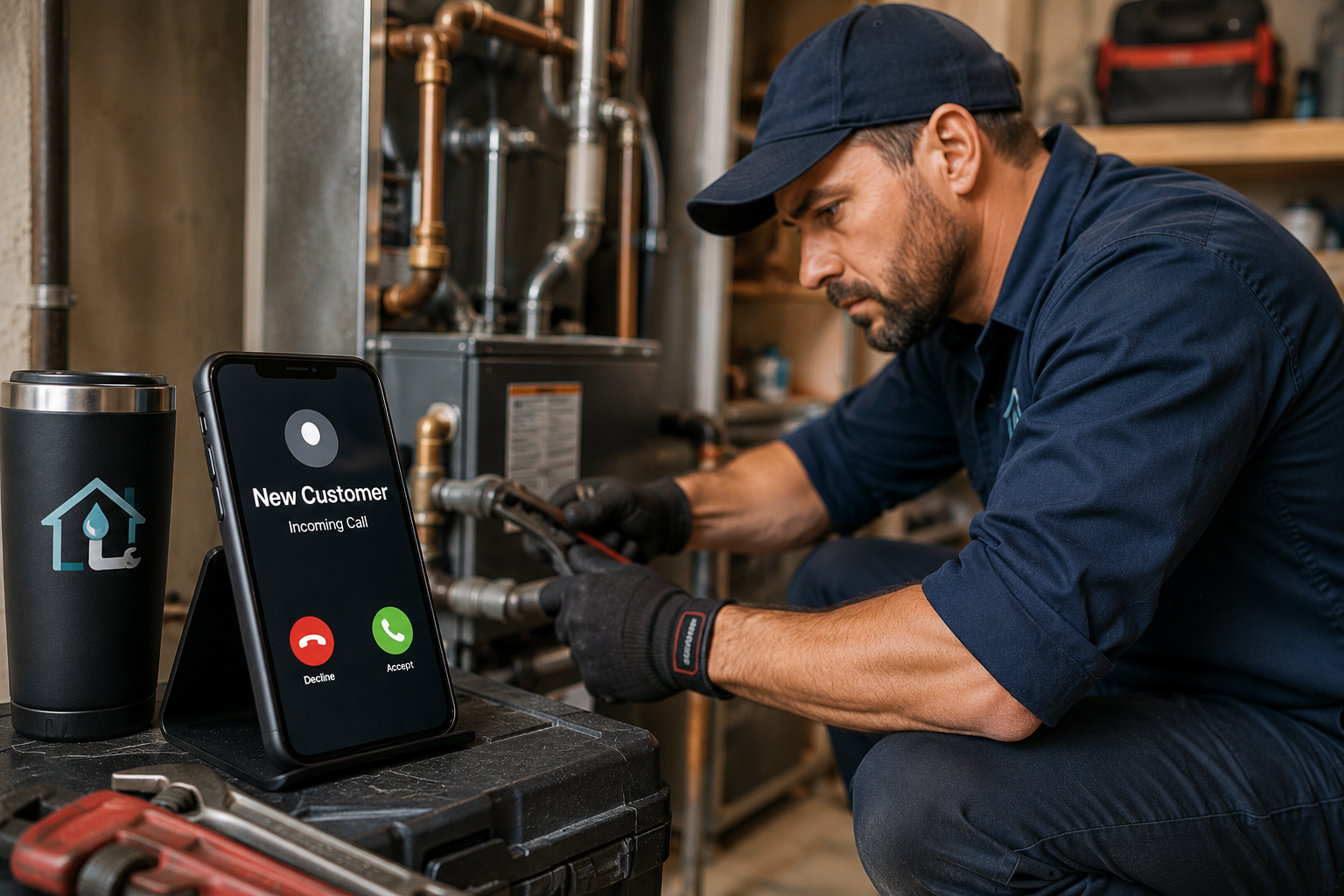
A plumber is on his back under a kitchen sink when his phone buzzes in his pocket. He can’t answer it, hands are wet, a wrench is in the joint, and the call goes to voicemail. Two miles away, a real estate agent is walking a buyer through a listing when her phone lights up with a number she doesn’t recognize. She silences it. Same story, different trade.
Here’s the direct answer: emergency calls, new-lead calls, and any call from someone who has never done business with you before should never go to voicemail. Existing clients who know you and trust you can leave a message and wait. A stranger with an urgent problem cannot, and they won’t. They’ll hang up and call the next name on their list.
That’s the whole idea behind this article. Not every call carries the same risk when you miss it. Once you know which calls are the expensive ones, you can build a system that protects those specific calls first instead of treating your entire inbound line as one undifferentiated stream that either gets answered or doesn’t.
Key Takeaways
- Not all missed calls cost you the same. A missed call from an existing client is an inconvenience. A missed call from a new lead or an emergency is often a lost sale.
- Research on caller behavior shows urgency, not politeness, drives whether someone leaves a voicemail. The more urgent the need, the less likely they are to wait.
- After-hours and weekend windows carry a disproportionate share of your highest-value calls, especially in trades like HVAC and plumbing.
- The fix isn’t answering every call yourself. It’s sorting calls by type first, then deciding who or what answers each type.
- A short, honest list of “never voicemail” call types gives you a system you can actually run, instead of a vague goal to “answer more calls.”
Why Voicemail Feels Like a Safety Net (And Isn’t One)
If you’re a service business owner or a real estate agent, you already know you can’t be on the phone and on the job at the same time. So voicemail becomes the default. It feels responsible. You’re not ignoring the call, you’re just catching it later, right?
I hear a version of this from almost every business owner I talk to: “I call people back the same day, usually.” The problem is that “later” and “the same day” mean nothing to a caller who is standing in a flooding kitchen or comparing three contractors in the same ten minutes. They don’t know you’re responsible. They know your phone rang and nobody picked up.
The mistake isn’t having voicemail. The mistake is treating every caller like they’ll behave the same way once they hit it. An existing client who has worked with you for years, who trusts you and just wants to confirm a appointment time, will leave a message and wait for your callback without a second thought. A first-time caller with an urgent problem and three other options open in another tab has no relationship with you to fall back on. Voicemail doesn’t feel like “we’ll call you back” to that person. It feels like “we’re not available,” and they act accordingly.
What the Research Actually Shows
I don’t like guessing at numbers, so here’s what the data says, not what feels true.
Research from BIA/Kelsey on local business calls breaks voicemail behavior down by the type of call, not just whether it happened. First-time callers, people with no existing relationship to the business, are far less likely to leave a message than returning customers. Price shoppers comparing several businesses at once are even less likely, since they can simply move to the next name without any cost to themselves. And callers with urgent needs are the least likely of all to leave a message, because waiting isn’t really an option for them. The pattern is consistent across all three groups: the less patience a caller has for the situation they’re in, the less patience they have for your voicemail greeting.
Speed matters just as much as availability. A widely cited Harvard Business Review study on lead response found that businesses who contacted a new inquiry within an hour were dramatically more likely to qualify that lead than businesses who waited even a little longer, and the gap widened the longer the delay stretched. Related research out of MIT and InsideSales found that leads contacted within five minutes converted at a far higher rate than leads contacted after thirty minutes. The lesson isn’t just “answer the phone.” It’s that the clock starts the second the phone rings, not whenever it’s convenient for you to check your messages.
The after-hours window makes this worse, especially in the trades. Industry data on plumbing service calls shows nearly half of plumbing emergency calls come in between six in the evening and eight in the morning, which is exactly when most small shops have no one covering the phone. HVAC data tells a similar story: a meaningful share of residential demand calls land outside normal business hours, concentrated in the exact hours when people get home from work and discover something is wrong. If your coverage stops at five, you are closing the door during some of your highest-value hours, not your slowest ones.
The Real Problem Isn’t Missed Calls. It’s Treating Every Caller the Same.
Here’s the reframe I use with every client I work with. Most business owners think their voicemail problem is a coverage problem: not enough hours, not enough hands, not enough time in the day. It isn’t. It’s a sorting problem.
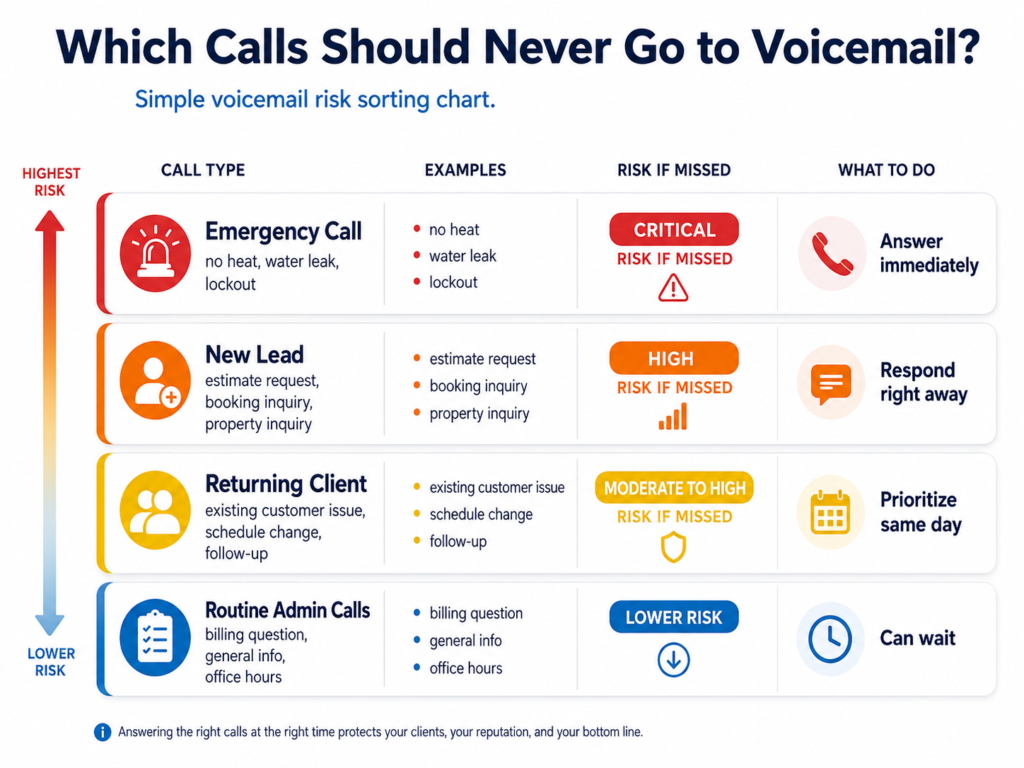
I call it the Never List. Instead of asking “how do I answer more calls,” ask “which calls, specifically, can this business never afford to send to voicemail?” For most service businesses and agents, that list is short: a first-time caller with a problem right now, anything that sounds like an emergency, and any lead coming in from paid advertising or a referral, because you already spent money or reputation earning that call. Everything outside that list, a returning client confirming a detail, a vendor, an internal call, can absolutely go to voicemail without real damage.
Once you build your Never List, the entire question changes. You’re no longer trying to answer every call, which is impossible if you’re the one doing the work. You’re building a system that guarantees the calls on that list get a real answer, every time, while everything else can wait for you the way it always has.
How to Apply This to Your Business
For the trades owners I work with, the Never List usually looks like this: no heat or no AC calls, active leaks, anything with the word “emergency” in it, and any call from a number that hasn’t called before. For real estate agents, it looks different: a buyer calling about a showing request, an inquiry from a listing they just saw online, or a lender or title contact on a deal that’s actively closing. In both cases, the pattern is the same. The calls that matter most are the ones with the least patience attached to them.
What changes once a business actually builds this list is that decisions get simpler. You stop treating your phone like an all-or-nothing problem and start treating it like triage. A first-time caller with an urgent need gets a live answer, whether that’s you, a team member, or an AI receptionist trained on your business. A returning client checking on a scheduled visit gets a callback within the day, which was always fine. The goal was never to answer everything. It was to stop losing the calls that were never going to wait for you in the first place.
This is also where I push back on the “just text me” habit I hear from a lot of owners. Texting has the same flaw as voicemail. If you can’t answer the phone while you’re working, you can’t answer a text either, and a text reply that comes six hours later gets read by someone who already booked with another business. The Never List isn’t about choosing the right communication channel. It’s about deciding, ahead of time, which calls require a real-time answer no matter what channel they arrive on.
Practical Steps to Build Your Never List
- Pull your last 30 days of calls. Most phone systems and CRMs log this. Look at every call you missed or sent to voicemail and note what kind of call it was.
- Sort those calls into three buckets. New lead, existing client, and everything else (vendors, spam, internal). This alone usually shows owners how many of their missed calls were actually new business.
- Write your Never List in one sentence per item. Keep it short. “Any call from a number that hasn’t called before” is a complete rule. You don’t need a paragraph.
- Decide who or what answers Never List calls first. That might be you during work hours, a team member on rotation, or an AI receptionist that can answer immediately and qualify the caller before handing them to you.
- Set one clear next step for everything else. A voicemail greeting that tells a returning client exactly when they’ll hear back is fine. The goal isn’t zero voicemail. It’s zero voicemail on the calls that can’t wait.
- Review the list every quarter. Your Never List will change as your business changes. A new service line, a new lead source, or a busy season can shift which calls are actually the ones you can’t afford to lose.
Frequently Asked Questions
How do I know if a call was actually an emergency or just felt urgent to the caller?
You often can’t tell until someone answers and asks a few questions. That’s why the Never List focuses on call type, not a judgment call in the moment. Route anything that could plausibly be urgent, like a first-time caller or a service disruption, to a live answer, and let the qualifying questions sort out true urgency from there.
Doesn’t answering every “never voicemail” call myself defeat the purpose of being out doing the work?
Yes, which is exactly why the Never List works best paired with coverage that isn’t you. A team member, a rotating on-call schedule, or an AI receptionist can handle the live answer while you stay focused on the job in front of you.
What about calls that come in while I’m already on the phone with someone else?
That’s still a missed call from the second caller’s perspective, even if your line technically rang once. Any coverage solution needs to handle simultaneous calls, not just calls that arrive when your line happens to be free.
Should my Never List be the same for every season or time of year?
No. A plumbing business’s Never List looks different during a cold snap than during a mild month. Revisit your list before predictable busy seasons so your coverage matches the actual call pattern, not last year’s assumptions.
Is it worth building a Never List if I only miss a handful of calls a week?
Yes. A handful of missed calls a week adds up to dozens a month, and the research is consistent that a meaningful share of those callers move on permanently rather than trying again. A short list costs you nothing to build and immediately tells you where to focus first.
The Bottom Line
Your phone is going to ring while you’re under a sink, on a roof, or walking a client through a listing. That’s the job. The question was never whether you can answer every call. It’s whether you know, ahead of time, which calls you genuinely cannot afford to lose, and whether something is in place to catch them when you can’t.
Build the list. Protect it. Let everything else wait the way it always has.
If you want help figuring out what belongs on your business’s Never List and setting up coverage that actually catches those calls, book your free EchoAssist demo and we’ll walk through it together.
Keep Learning
- How Missed Calls Become Lost Revenue for Service Businesses — The math behind what an unanswered call actually costs you over a year.
- Why Voicemail Is Not a Lead-Response Strategy — A closer look at why voicemail fails first-time callers specifically.
- The First Five Minutes After a Lead Calls: A Practical Follow-Up System — What should happen the moment a lead reaches you, from answer to booking.
- What an AI Receptionist Should Know About Your Business Before It Answers a Call — How to set up call coverage that actually reflects how your business runs.
Derrick Houston is the founder of DH Digital Consulting, LLC, based in Dallas-Fort Worth, where he helps solo entrepreneurs and small service businesses put AI to work capturing leads they would otherwise lose to a missed call. He built EchoAssist, an AI receptionist trained on each client’s actual business, service area, and call-handling rules, after watching too many real estate agents and trade business owners lose paid-for leads to a voicemail box nobody checked in time.