

TLDR
September has a way of asking a question most business owners avoid: do you still remember why you started your business, and does your current schedule reflect that reason at all. This post walks through how to compare your original motivation against your actual day-to-day, why the gap between the two widens quietly over time, and what to do once you notice it. It draws on empathy as a business skill, not just a personal one, and points to specific tools and habits that help close the distance.
Key Takeaways
- Most owners can state their original reason for starting instantly, but few can say their current week reflects it.
- The gap between founding purpose and daily operations widens slowly, not suddenly, which is why it goes unnoticed.
- Empathy toward yourself and your team is a legitimate business tool, not a soft add-on.
- Systems and automation, not more hustle, are usually what closes the gap between intention and reality.
- A short quarterly audit of your calendar against your original reason catches drift before it becomes a crisis.
Fun Fact
Surveys of small business owners consistently rank freedom and independence above income as the top reason people start a company in the first place. Money is rarely the founding reason, which is why a schedule packed with low-value tasks feels like such a betrayal of the original plan.
Expert Insight
In my work with real estate agents and small service business owners, the same pattern shows up almost every time a client feels burned out rather than proud of their growth. The business grew, but the owner’s role inside it never got redesigned, so they are still doing the tasks they meant to hand off years ago. The fix is rarely more effort. It is usually a hard look at which tasks actually require the owner and which ones a system, an assistant, or a platform like GoHighLevel can absorb instead.
Why You Started Your Business Is Worth Asking Again
September carries a specific feeling for anyone who grew up with school schedules. New notebooks, new routines, a quiet pressure to reset. That same feeling applies to running a business. It is a natural checkpoint to ask why you started your business and whether the answer still holds up against what your days actually look like now.
Why you started your business is the original, specific reason you left a paycheck, a job, or a stable routine to build something of your own. For some owners it was independence. For others it was frustration with how a previous employer treated customers or staff. Whatever the reason, it was concrete enough to justify real risk, and that specificity is worth revisiting rather than paraphrasing into something vague like passion.
The point of this reflection is not nostalgia. It is a comparison. You take the original reason, written in plain language, and hold it against your actual calendar from the last two weeks. The distance between those two things tells you more about the health of your business than your revenue numbers do.
What Changes Between Starting a Business and Running One
The change between starting a business and running one is that starting requires a single clear decision, while running one requires thousands of small decisions that quietly redirect your time away from the original plan. No single decision feels like a betrayal of purpose. Taking one more client, adding one more service, saying yes to one more request, each choice makes sense in isolation. The accumulation is what causes the drift.
Research on small business motivation backs this up. Freedom, independence, and the desire to build something meaningful consistently rank above money as the top reasons owners start businesses in the first place, according to Business News Daily. That means the erosion most owners feel is rarely about the business failing financially. It is about the business succeeding financially while quietly abandoning the reason it was built.
The businesses that struggle with purpose drift are usually the ones growing the fastest, not the ones failing.
A purpose-driven business intentionally connects day-to-day operations to a clear mission, using that mission as a reference point for everyday decisions, according to guidance from Capital One’s small business resources. Without that reference point, decisions default to whatever feels urgent that day, which is a poor substitute for a plan.
How Empathy Fits Into Remembering Why You Started
Empathy fits into remembering why you started your business because most founding reasons involve other people, whether customers, employees, or a community, and losing empathy for those people is usually the first sign that the original mission has been replaced by daily survival mode. Owners who started a business to serve clients better than their old employer did can lose that instinct entirely once staffing, invoicing, and scheduling take over their attention.
Empathy is a business skill because it directly informs decisions about hiring, pricing, and customer service, not because it makes an owner feel good. Research from Entrepreneur identifies empathy as a foundational skill that helps owners understand how employees and customers actually experience the business, which leads to better decisions overall, according to Entrepreneur.
Empathy is not a personality trait for business owners; it is an operational input that shapes pricing, hiring, and service decisions.
Sustainable business success requires aligning financial goals with human well-being, both for customers and for the team running daily operations, according to the International Council for Small Business. That alignment is exactly what erodes when an owner’s calendar fills with tasks that have nothing to do with the people the business was built to serve.
Comparing Original Intent Against Current Operations
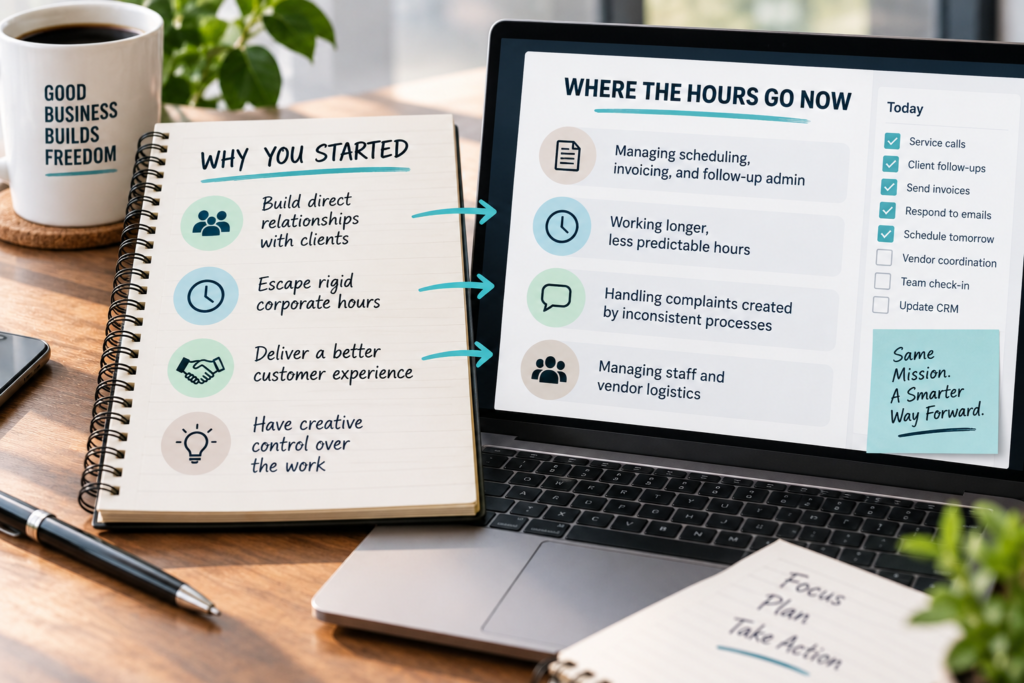
The clearest way to check for drift is a direct comparison. List your original reason for starting on one side. List where your actual hours go on the other. The table below shows a common pattern seen across small service businesses and real estate teams.
None of these shifts are unusual. They are the natural result of growth without redesign. The problem is not that the business changed. The problem is that the owner’s role never got renegotiated to match.
Growth without a redesigned role for the owner produces success that feels nothing like the original plan.
Closing the Gap Without Adding More Hours
Closing the gap between why you started your business and how you spend your days does not require working more. It requires identifying which tasks pulled you away from your original purpose and removing yourself from them specifically. A few practical starting points:
- List every recurring task from the last month and mark which ones connect directly to your founding reason.
- Move scheduling, lead intake, and follow-up communication onto a system such as EchoAssist AI so client contact stays consistent without consuming your personal time.
- Use a platform like GoHighLevel to automate follow-up sequences that used to require manual attention.
- Track recurring decisions in a tool like Notion so patterns and drift become visible over time instead of staying invisible.
- Revisit your written founding reason every quarter and measure your calendar against it directly.
None of these steps require abandoning growth. They require separating the parts of the business that genuinely need the owner from the parts that only need the owner because no system was ever built to replace that dependency.
If the September reflection surfaces a real gap, the next move is structural, not motivational. A calendar audit paired with a clear system for repetitive client communication, whether through an AI receptionist tool or a broader service review, tends to close more of the gap than a renewed sense of willpower ever does. Reviewing available service options is a reasonable next step once the specific gap is named.
Frequently Asked Questions
How do I remember why I started my business?
Write down the single sentence you would have used to describe your goal in your first month, before you knew what the business would become. Compare it, word for word, against how you spent your last five working days. The distance between those two things is your answer, and it is usually more revealing than a mission statement ever was.
What do I do if my business no longer matches why I started it?
Start by naming the specific tasks eating your week that have nothing to do with your original reason for starting. Then ask which of those tasks could move to a system, a platform, or another person without lowering quality. This is not about abandoning growth, it is about redirecting your time back toward the parts of the business you actually meant to build.
Why do business owners lose sight of their original purpose?
Growth adds tasks faster than it removes them, and no single day feels like the day purpose slipped. Each small addition, one more client, one more admin task, one more fire to put out, seems reasonable on its own. Add them up over a year or two and the owner is running a business that looks nothing like the one they set out to build.
Is empathy actually useful in running a business, or is it just a soft skill?
Empathy is a functional business skill because it improves decision-making about hiring, pricing, and customer service, not just morale. Owners who understand how their team and customers actually experience the business make fewer costly assumptions. Treating empathy as decorative rather than operational is a common mistake among owners focused only on output.
How often should I check my business against my original reason for starting?
Quarterly is frequent enough to catch drift without turning reflection into a distraction from actual work. A twenty-minute review, comparing your calendar to your founding reason, surfaces patterns you cannot see in the daily grind. Waiting a full year usually means the drift has already become the new normal.
What is a purpose-driven business?
A purpose-driven business is one where daily operations are intentionally connected to a clearly defined mission rather than running on autopilot. That connection acts as a reference point for decisions about hiring, pricing, and where owner time actually goes. Without it, a business can grow in revenue while drifting further from the reason it was built.
Next Steps
September asks a fair question. Most owners can still recite why they started their business, but far fewer can say their calendar reflects it. If the gap has grown wider than you expected, the fix is not more hours, it is a clearer system for handling the work that pulled you away from your original reason in the first place.
Tell us why you started, then see what DH Digital builds next: https://dhdigitalconsulting.com/blog/