TLDR
You can grow your business without more hours once calls, follow-up, and client onboarding stop requiring your personal involvement, because growth without more hours means building systems that run whether you are available or not. The belief that revenue and personal hours must rise together only holds true when the owner is still the one answering every call and chasing every lead. Once that work moves into documented systems and tools like EchoAssist AI or GoHighLevel, growth and owner time separate from each other. This piece names that belief directly and explains what actually has to shift.
Key Takeaways
- Growth without more hours requires removing the owner as the single point of contact for calls and follow-up.
- The belief that more revenue always demands more personal hours is a bottleneck problem, not a market problem.
- Documented systems in tools like Notion or GoHighLevel let work continue without the owner personally repeating it.
- Customer follow-up handled consistently, even without the owner, builds the kind of experience that drives repeat business.
- Owner dependence shows up most clearly in sales calls, lead follow-up, and client onboarding.
- Fixing owner dependence is a sequence: document the work, assign or automate it, then step back and monitor results.
Fun Fact
Derrick L. Houston has watched small service business owners answer their own phones at 9 p.m. on a Friday, convinced that if they stopped, the business would stall. The businesses that eventually grew past that point were the ones where the owner built a system to catch the call instead of catching it themselves.
Expert Insight
In my work with real estate agents and small service business owners, the pattern I see in nearly every stalled business is the same one: the owner is the system. Every lead routes through them. Every follow-up waits on their schedule. Every client question gets answered personally, at whatever hour it arrives.
Growth in that setup means one thing only: more hours from the same person. There is no other lever to pull because no other part of the business can absorb new demand. The fix is not working smarter within that structure. The fix is removing the structure’s dependence on one person entirely.
Why does growth seem to require more hours?
Growth seems to require more hours because in an owner-dependent business, every new client or lead adds work that only the owner is equipped or trusted to handle, so volume and personal time rise together by default. This is not a law of business; it is a symptom of how the business is currently built. When the owner is the one taking calls, following up on leads, and walking new clients through onboarding, there is no path for revenue to increase without that same person doing more of it.
What is owner dependence? Owner dependence is the condition where critical business functions, such as sales calls and client follow-up, cannot happen unless the owner personally performs them. It is the direct cause of the belief that growth and hours must move together.
Growth requires more hours only in businesses where the owner is still the one doing the work personally.
Once that dependence is named clearly, the fix becomes obvious. It is not about working harder during the hours you already have. It is about building a business where calls, follow-up, and onboarding do not stall when you are unavailable.
What actually has to change to grow business without more hours?
To grow business without more hours, the owner has to remove themselves as the single point of contact for calls, lead follow-up, and onboarding, replacing personal effort with documented processes and tools that handle the work consistently. This is a structural change, not a time-management trick. It requires deciding what work must happen every time a new client or lead appears, then building a repeatable way for that work to happen without the owner personally doing it.
Three things typically have to change:
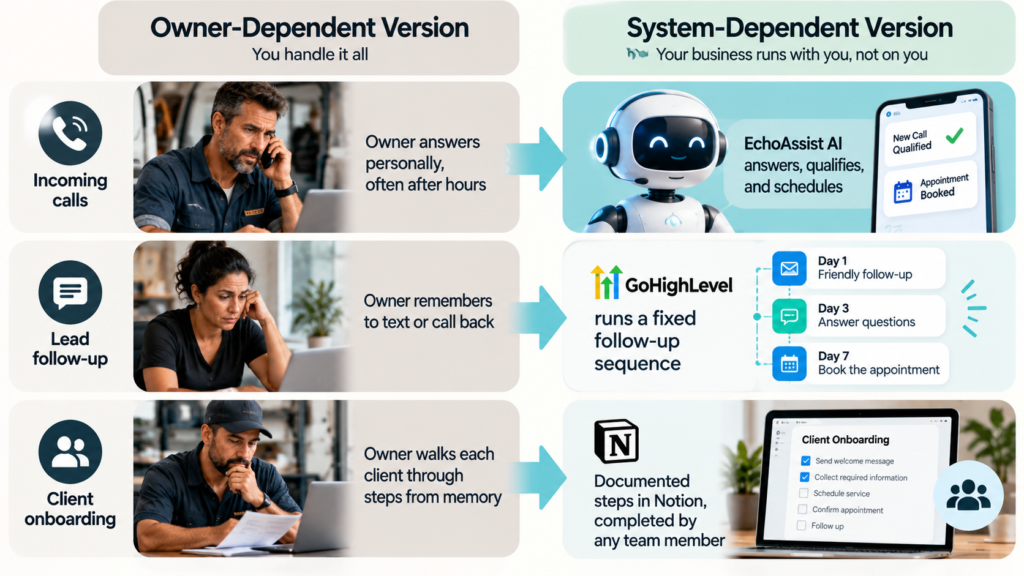
- Call handling moves from the owner’s phone to a system built to catch and route every call, such as EchoAssist AI.
- Follow-up sequences get documented and automated in a platform like GoHighLevel instead of relying on memory.
- Onboarding steps get written down in a shared space, such as Notion, so anyone on the team can walk a new client through them.
A Forbes analysis of owner-dependent sales structures makes the same point: when the founder is the sole salesperson, the business cannot scale past what one person can personally sell and follow up on. The fix described there matches what shows up in small service businesses too. Documented, repeatable sales and follow-up systems replace personal effort as the growth engine.
How do calls and follow-up stop depending on the owner?
Calls and follow-up stop depending on the owner when a documented system, not the owner’s memory or availability, determines what happens next with every lead and client, using tools that run whether the owner is present or not. This starts with mapping the current process: what happens the moment a call comes in, what happens after a lead goes quiet for three days, what happens on day one of a new client relationship.
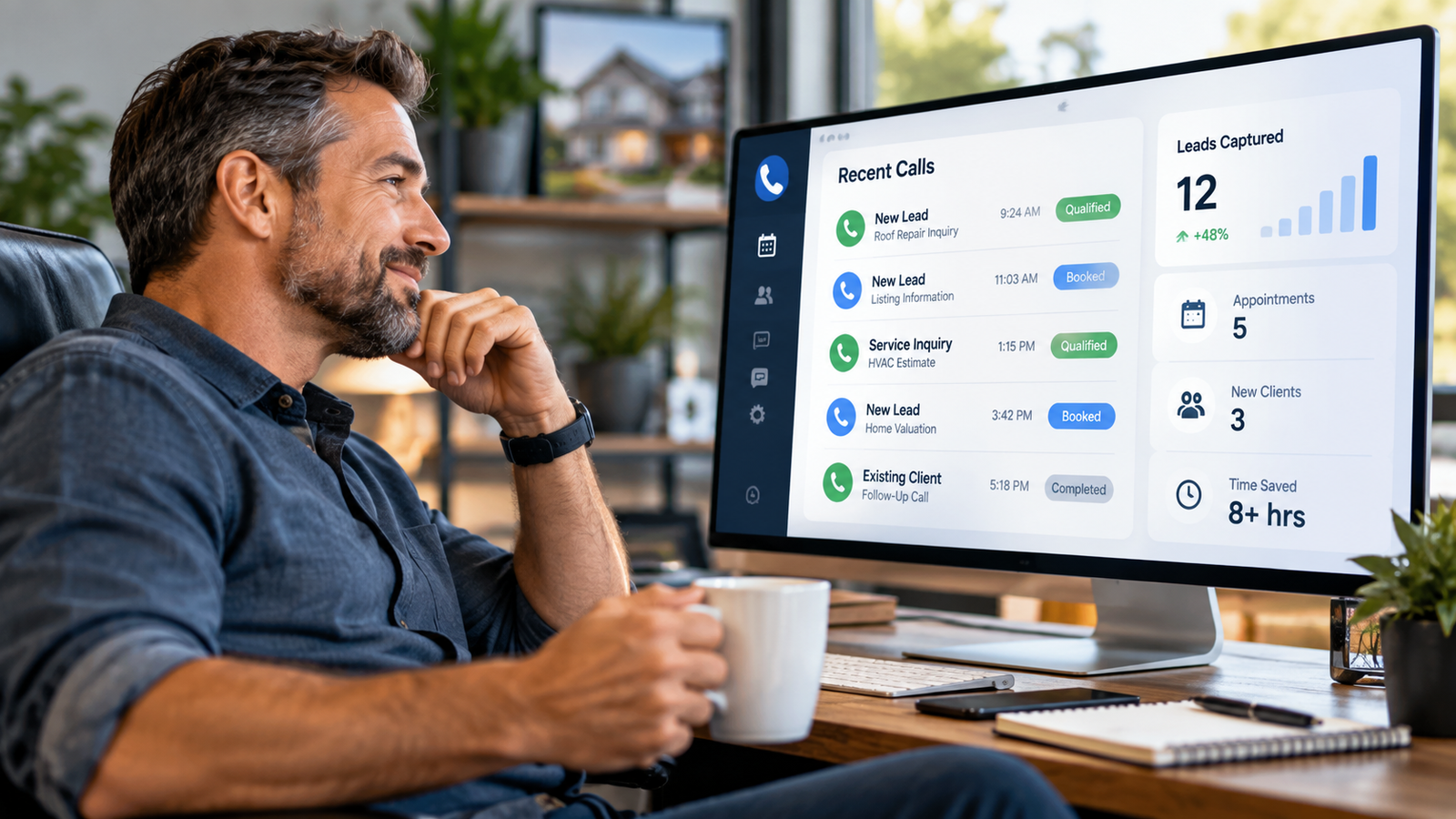
Once that map exists, each step gets assigned to a system rather than a person. A call that used to ring the owner’s cell phone routes through EchoAssist AI, which can answer, qualify, and schedule without a human on the line. A follow-up sequence that used to depend on the owner remembering to text a lead back runs automatically through GoHighLevel on a fixed schedule. Onboarding steps that used to live in the owner’s head get written into a shared Notion database so a team member, not just the owner, can complete them correctly.
A follow-up that runs on a schedule works whether the owner remembers it or not.
The Systems Effect outlines a similar sequence for reducing owner dependence, moving critical knowledge out of the owner’s head and into documented systems step by step. The order matters: document first, then assign or automate, then step back and monitor. Skipping the documentation step is why many automation attempts fail; there is nothing consistent to automate yet.
Does this change hurt the customer experience?
No, a documented follow-up and call system does not hurt customer experience; it typically improves consistency, because every client gets the same reliable response instead of one that depends on the owner’s mood, energy, or availability that day. Consistency is what customers notice, more than who specifically answers the phone.
Research from CSG on empathy-driven customer experiences found that businesses leading with customer-centered practices see up to 2.5 times greater revenue growth. That outcome depends on understanding what the customer actually needs at each stage, not on the owner personally answering every call. A well-documented system can reflect that understanding more reliably than an exhausted owner can at 8 p.m. on a Tuesday.
Consistency, not personal presence, is what customers actually experience as good service.
This is where the empathy angle matters most. Growth without more hours is not about caring less about clients. It is about building a system that carries the same care the owner already has, without requiring the owner to be the one delivering it every single time.
Where does the offer fit into this?
DH Digital Consulting builds the exact systems described above: call handling through EchoAssist AI, automated follow-up through GoHighLevel, and documented onboarding that does not depend on any one person. Research on owner dependency confirms growth should not automatically require longer hours once sales, follow-up, and customer management run on repeatable systems instead of personal effort.
If calls and follow-up currently stop the moment you step away, that is a system gap, not a personal failure. It is fixable, and it does not require working more hours to fix it. It requires building the pieces that let the business run consistently without you personally touching every step.
Frequently Asked Questions
How do I know if I have a systems problem?
You likely have a systems problem if the business slows down or stalls whenever you are unavailable, sick, or on vacation. If calls go unanswered, leads go cold, or new clients get confused without your direct involvement, the business is running on your personal effort instead of a repeatable process.
What is the fastest way to reduce owner dependence?
The fastest first step is documenting exactly what happens during a call, a follow-up, and an onboarding session, then assigning each step to a tool or team member instead of yourself. Documentation always comes before automation; skipping it leaves nothing consistent to build a system around.
Can a small business really grow without the owner working more hours?
Yes, growth and owner hours can separate once calls, follow-up, and onboarding run through documented systems and tools instead of the owner personally. The businesses that manage this typically see revenue rise while the owner’s personal workload stays flat or even drops.
What tools handle calls without the owner answering personally?
EchoAssist AI answers incoming calls, qualifies leads, and schedules appointments without requiring the owner or a staff member on the line. It is built specifically for small service businesses that lose leads to missed or after-hours calls.
How does GoHighLevel help with follow-up specifically?
GoHighLevel runs follow-up sequences on a fixed schedule, sending texts, emails, or reminders regardless of whether the owner remembers to send them. This replaces the owner’s memory as the mechanism that determines whether a lead gets contacted again.
Does documenting processes in Notion actually make a difference?
Yes, a shared Notion database turns onboarding steps that used to live only in the owner’s head into something any team member can follow correctly. This removes a common bottleneck where only the owner knows how to properly bring on a new client.
Is removing owner dependence the same as removing the owner from the business?
No, it means removing the owner as the only person capable of performing daily operational tasks, not removing them from strategic decisions or client relationships. The owner still leads the business; they simply stop being its single point of failure.
Next Steps
See what’s possible with fewer hours at https://dhdigitalconsulting.com/services/.