

- Adding hours to a business does not increase its capacity; it only delays the moment a broken process gets fixed.
- Growing a business with fewer hours means identifying which recurring tasks consume time without generating revenue, then removing them.
- Missed phone calls, manual scheduling, and repetitive admin work are common time drains in small service businesses.
- Delegation and automation, not longer workdays, are the direct mechanisms behind sustainable growth.
- Countries and companies with shorter working hours frequently show stronger productivity and output than those with longer hours.
What does it mean to grow business with fewer hours?
Growing a business with fewer hours means increasing revenue, output, or client capacity while reducing the number of hours the owner personally works, achieved by removing time-eating tasks instead of absorbing them into a longer day. It is a shift from personal effort as the engine of growth to systems and delegation as the engine of growth. The owner’s time becomes a limited resource to protect, not a resource to spend without limit.
Most small business owners equate effort with progress. Working late feels like commitment. But a business that only grows when the owner works more hours has a ceiling built into it. That ceiling is not a marketing problem or a pricing problem. It is a time problem, and time problems get solved by removing tasks, not by adding hours to absorb them.
Why do owners confuse working more with growing more?
Owners confuse working more with growing more because effort is visible and immediate, while systems work is slow and invisible, so a long day feels productive even when it produces the same output as a shorter one. Working late gives a feeling of control. Fixing a broken intake process or automating a scheduling task feels less urgent because the payoff shows up weeks later, not that same night.
This confusion gets reinforced by comparison. An owner sees a competitor working long hours and assumes that effort explains their growth. It rarely does. Growth usually comes from what that competitor stopped doing manually, not from the hours they logged.
A business that only grows when its owner works more hours has a revenue ceiling that has nothing to do with marketing.
What actually eats the hours in a small business?
The hours in a small service business get consumed by repetitive, low-value tasks such as answering the same scheduling questions, chasing missed calls, manually entering data, and handling admin work that does not require the owner’s judgment. These tasks feel small individually but compound across a week. A real estate agent who answers 15 calls a day about showing times is spending capacity that should go toward closing deals.
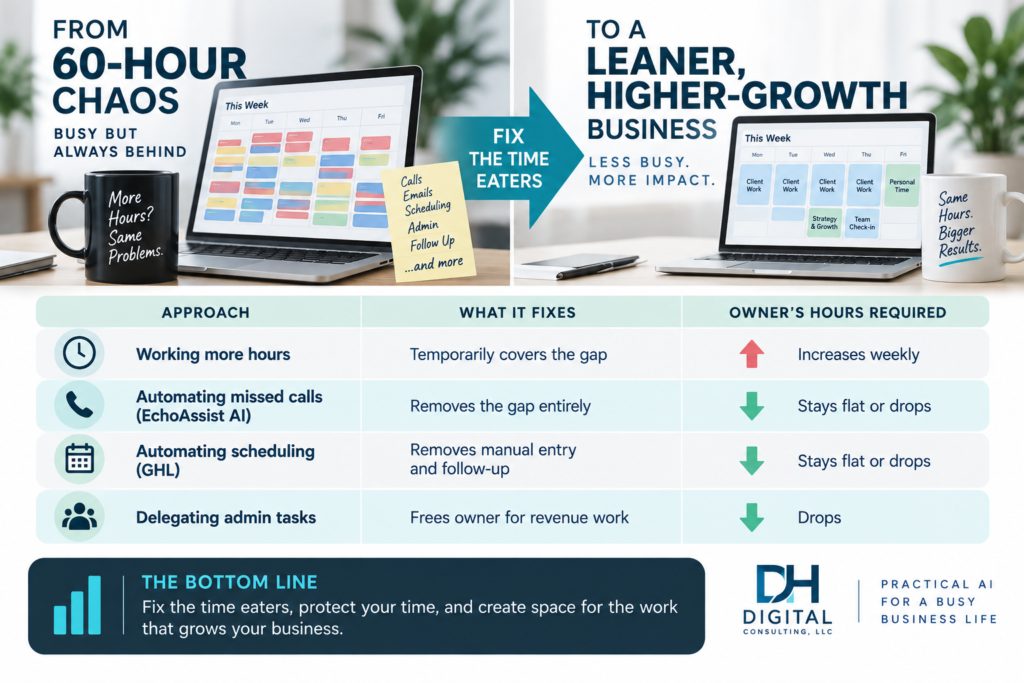
Two examples make this concrete.
Example one: the missed call problem
A service business owner misses calls during appointments, during drive time, and after hours. Each missed call is a potential customer who often calls a competitor next. The owner’s instinct is to work longer hours to answer more calls personally. The actual fix is removing the need for a human to answer every call. A tool like EchoAssist AI, an AI receptionist that answers and routes calls automatically, closes that gap without adding a single hour to the owner’s day.
Example two: the manual scheduling problem
An agent manages showings, follow-ups, and lead intake by hand inside a spreadsheet or a paper calendar. Every new lead means manual entry, manual follow-up, and manual reminders. A platform like GoHighLevel (GHL), a customer relationship and marketing automation platform, replaces that manual chain with automated sequences. The lead still gets contacted. The agent’s calendar does not absorb the extra work.
How do I know if I have a time problem or a systems problem?
You have a systems problem, not a time problem, if the same tasks repeat every week without change and the only response has been to work longer to keep up, since a true time shortage would resolve once volume drops, and a systems problem does not. Ask whether the task could be documented, handed off, or automated. If yes, it is a systems gap, and more hours will not close it permanently.
- Does the task repeat in a predictable pattern every week?
- Could someone else do it with clear instructions?
- Does it require the owner’s specific judgment, or just their presence?
- Has adding hours to cover it stopped being enough?
If the answer to the first three is yes, delegation or automation fixes it. If the answer to the last one is yes, the current approach has already failed.
Why does delegation drive growth more than extra hours?
Delegation drives growth more than extra hours because it converts the owner’s limited time into a resource that scales through other people or systems, while extra hours only add a fixed, non-repeatable amount of output capped by human endurance. An hour worked personally produces one hour of output. An hour spent training someone else or setting up automation produces output every week going forward.
Research backs this pattern directly. Entrepreneurs who delegate specific tasks see substantially more growth than those who do not, according to Gallup data cited by Entrepreneur. The data shows growth follows delegation, not the reverse.
Growth comes from delegation, not before it.
A separate case study from the Business Development Bank of Canada found that entrepreneurs work an average of 49.7 hours a week, with over 40 percent reporting overwhelm. The owners who reduced hours did so by handing off specific, named tasks, not by working harder within the same tasks.
Does working fewer hours actually correlate with stronger output?
Yes, national and workplace data show that fewer hours often correlate with higher productivity, since countries with shorter average workweeks frequently outperform countries with longer ones on output per hour worked. This is not an argument for working less in general. It is evidence that hours worked and output produced are not the same measurement.
TIME Magazine reports that knowledge workers frequently fill extra hours with low-value activity such as unnecessary meetings, and that countries with shorter workweeks tend to have stronger economies. Business News Daily cites 2023 research showing the twelve nations more productive than the United States all logged fewer annual hours worked. One industry expert quoted there put it plainly: hours spent in the office do not necessarily equate to business success.
Hours spent in the office do not necessarily equate to business success.
What should replace the extra hours?
The extra hours should be replaced by identifying the two or three tasks that consume the most time without requiring the owner’s judgment, then either automating them with a named tool or delegating them to a specific person with clear instructions. This is not a one-time project. It is an ongoing audit, repeated as the business changes.
- List every recurring task from the past two weeks.
- Mark which ones required the owner’s specific judgment.
- For the rest, assign a tool or a person by name, not a vague plan.
- Set a date to check whether the handoff worked.
Tools like Notion can hold this list in one place, so the audit does not disappear into memory after a week.
Frequently Asked Questions
How do I know if I have a systems problem?
You have a systems problem if the same task repeats every week and the only fix has been to work longer. Check whether the task could be documented and handed off, or automated with a specific tool. If either is true, more hours will not solve it long term.
What is the fastest task to fix when trying to grow business with fewer hours?
Missed calls are usually the fastest fix because they have a direct, measurable cost: a lost lead. Routing calls through an automated receptionist removes the gap without changing anything else in the business.
Why does working more hours feel productive even when it is not?
Effort is visible and immediate, so working late feels like progress, while systems work pays off weeks later and feels slower. That timing gap is why effort gets mistaken for growth.
Does automation replace the need for good judgment in a business?
No, automation replaces repetitive tasks that do not require judgment, freeing the owner’s judgment for decisions that actually need it, such as pricing, client strategy, or negotiation.
How many hours should a small business owner work per week?
There is no fixed number that applies to every business. The better question is whether the current hours are covering gaps in a broken process or genuinely producing new revenue.
What tools help a small business owner delegate without hiring more staff?
Platforms like GoHighLevel automate follow-up and scheduling, and an AI receptionist like EchoAssist AI handles missed calls, both reducing the owner’s manual workload without adding headcount.
Can a business grow without the owner working weekends?
Yes, if the tasks currently filling weekends get automated or delegated instead of absorbed personally. Weekend work is usually a sign of a coverage gap, not a genuine time shortage.