

TLDR
Business systems vs hustle comes down to this: working more hours without a repeatable system only delays the same bottleneck, while one documented system keeps producing results every week without additional owner effort. An owner stuck at the same revenue for months or years usually has a process problem, not an effort problem. Adding hours patches the symptom. Building a system removes the cap. This piece breaks down why hustle has a hard ceiling, what a real business system looks like, and how to tell which one you actually need next.
Key Takeaways
- Revenue that depends on the owner’s personal hours has a fixed ceiling equal to that owner’s time.
- A repeatable system, once built, produces output on days the owner is not working.
- Hustle fixes today’s fire. Systems prevent tomorrow’s fire from starting.
- The four core systems every small business needs are marketing, sales, fulfillment, and administration.
- Tools like GoHighLevel and EchoAssist AI turn manual, owner-dependent tasks into automated, repeatable ones.
- The fastest way out of a revenue plateau is documenting one bottleneck process, not adding more hours to the week.
Business systems vs hustle is not a philosophical debate. It is a math problem. An owner who adds five more hours a week gets, at best, five more hours of output. An owner who documents one repeatable process gets that process running every week going forward, whether they personally show up or not. Only one of those choices compounds.
What is a business system? A business system is a documented, repeatable process that produces a consistent outcome without requiring the owner’s direct, ongoing involvement each time it runs. It can be as simple as a written follow-up sequence or as involved as a fully automated intake-to-close pipeline. The defining feature is repeatability without dependency on one person’s memory or presence.
The owners who stay stuck at the same revenue for a year or more almost always share one trait. Every key task, from responding to leads to onboarding new clients to closing out invoices, lives in their head. Nothing is written down. Nothing runs without them. That setup feels productive because the owner is always busy. It is also the exact structure that caps growth.
Why does hustle have a ceiling?
Hustle has a ceiling because personal effort is a finite resource tied directly to hours in a day, so revenue built on hustle can never exceed what one person can personally produce or personally oversee. A system has no such limit. Once built, it runs on its own schedule, processes leads or clients in parallel, and does not degrade when the owner takes a day off. That structural difference is the entire reason one approach compounds and the other flattens.
Effort has a ceiling equal to the hours in a day; a system has no ceiling at all.
This is why two owners working the same number of hours can land in very different places a year later. One owner spent those hours doing the work. The other spent a portion of those hours building something that now does the work for them.
What does a repeatable system actually look like?
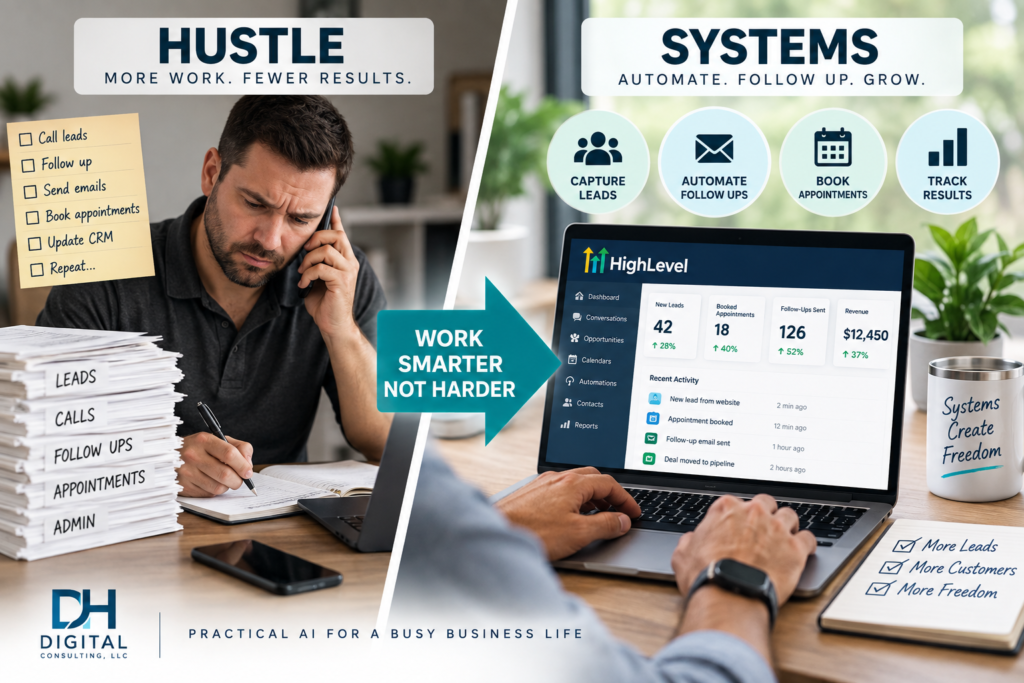
A repeatable system is a written or automated sequence of steps that produces the same result every time, regardless of who or what executes it, and it typically covers one of four areas: marketing, sales, fulfillment, or administration. It is not a vague policy or a mental checklist. It is specific enough that someone unfamiliar with the business could follow it and get a comparable outcome.
Consider the four core systems most small businesses need:
- Marketing systems generate a predictable flow of leads without the owner manually prospecting every week.
- Sales systems convert those leads through a consistent, repeatable conversation or sequence.
- Fulfillment systems deliver the actual product or service the same way each time, regardless of who handles it.
- Administration systems manage billing, scheduling, and reporting without requiring the owner’s constant oversight.
Real tools make this concrete rather than abstract. GoHighLevel can run an automated follow-up sequence for every new lead, sending texts and emails on a fixed schedule so no one falls through. EchoAssist AI can answer and qualify inbound calls around the clock, so a missed call during a showing or a job site visit no longer means a lost client. Notion can hold the documented step-by-step process so it is not trapped in one person’s memory.
| Approach | What it produces | What happens when owner is unavailable | Growth pattern |
|---|---|---|---|
| Working more hours | More output, limited to owner’s personal capacity | Output stops or drops sharply | Linear, capped by hours in a day |
| Building a system | Consistent output independent of owner’s schedule | Output continues unaffected | Compounding over time |
Why does adding hours just delay the same bottleneck?
Adding hours delays the same bottleneck because the underlying process that caused the slowdown never changes, so the exact same limitation reappears the next time volume increases, only later and with more accumulated stress on the owner. This is the pattern I see in roughly half the owner consultations I run. Revenue climbs, the owner works harder to keep up, revenue plateaus, and the owner works even harder rather than examining the process itself.
An undocumented follow-up process is a clear example. If every lead follow-up depends on the owner remembering to call back, the business can handle exactly as many leads as the owner can personally track. Doubling the owner’s hours does not double the number of leads that get proper follow-up. It just delays the moment leads start slipping through, because the underlying process still has no structure.
A revenue ceiling caused by a missing process cannot be worked around with more effort; it can only be removed by fixing the process.
This is the core argument for prioritizing systems over hustle. One fixes the symptom temporarily. The other removes the cause permanently.
How does one system compound while more hours do not?
A system compounds because it keeps operating and improving after it is built, meaning the return on the initial time investment continues to accrue every week without additional input, while hours worked only produce value for the exact time spent and disappear the moment the owner stops working. This is the mathematical core of business systems vs hustle.
Compare the two paths over a year:
- Path one: the owner adds five hours a week to personally handle more leads. Output rises briefly, then plateaus at the owner’s personal capacity, and the owner is now working more for the same eventual ceiling.
- Path two: the owner spends five hours one week documenting and automating the lead follow-up process. That system now runs every week afterward with no additional hours required, and the owner’s time is freed for the next bottleneck.
Only the second path produces something that keeps working after the initial effort ends. According to Lean Marketing’s analysis of business systems, an owner without documented systems is the business, which means revenue growth stays directly proportional to hours worked no matter how skilled that owner becomes. Strategy and Execution describes this same trap as the Founder’s Trap, where every decision routes through one person and caps revenue at that person’s personal bandwidth. AG Management Consulting makes the same case directly: more owner effort cannot fix a structural bottleneck, only a repeatable operational system can.
Which bottleneck should get fixed first?
The first bottleneck to fix is whichever process directly touches revenue and currently depends entirely on the owner’s personal availability, since fixing that process produces the fastest and most visible change in the revenue number. For most service businesses and real estate agents, that process is lead follow-up or client onboarding, not internal reporting or paperwork.
A simple way to identify it: list every task that happened this week, then mark which ones would not have happened if the owner had been unreachable for three days. Whatever sits at the top of that list, particularly if it involves a lead or an active client, is the system to build next. ASBN’s coverage of ActionCOACH founder Brad Sugars makes a similar point: a business stuck in owner-operator mode functions like a job rather than a scalable enterprise, and standardized, documented systems are what let growth compound independent of the owner.
Building that first system does not require a large team or a big budget. It requires identifying one process, writing down every step, and either assigning it or automating it with a tool built for that specific task. GoHighLevel handles the follow-up sequence. EchoAssist AI handles the inbound call. Notion holds the documentation so the process survives even if the person running it changes.
Fun Fact
The term “systemize the business, not the person” traces back to Michael Gerber’s book The E-Myth, published in 1986. Gerber’s core observation still holds decades later: most small business owners are technicians who started a business, not business builders who happen to do the technical work. The gap between those two roles is exactly where business systems vs hustle debates live today.
Expert Insight
In my work with real estate agents and small service business owners, the plateau almost always shows up the same way. Revenue holds steady for two or three quarters, the owner works longer hours to push past it, and the number does not move. That is not a motivation problem. It is a structural one.
A business that requires the owner’s constant presence to function is not a business, it is a job with overhead.
Once a task lives only in the owner’s head, every unit of growth requires another unit of the owner’s time. That relationship never improves on its own. It only breaks when a process gets documented, assigned, or automated so it no longer needs the owner to run it.
Frequently Asked Questions
How do I know if I have a systems problem?
You have a systems problem if your revenue has not moved in the last two to three quarters despite working the same or more hours. Other signs include feeling like the business stops the moment you step away, repeating the same client conversations from scratch every time, and having no written process for your top three recurring tasks. If your calendar is full but your revenue line is flat, the issue is structural, not a lack of effort.
What is the difference between business systems vs hustle?
Hustle is additional personal effort applied to existing processes. A business system is a documented, repeatable process that produces the same result without the owner performing it each time. Hustle scales with hours worked. Systems scale independent of hours worked, which is why one compounds and the other does not.
Why does working more hours not fix revenue stagnation?
Working more hours does not fix revenue stagnation because the bottleneck is usually a process, not a lack of labor. If the intake process, follow-up sequence, or fulfillment steps are undocumented and owner-dependent, adding hours just processes more of the same broken workflow faster. The ceiling stays exactly where it was.
What are the four core business systems every owner needs?
The four core systems are marketing, sales, fulfillment, and administration. Marketing systems generate consistent leads without manual prospecting. Sales systems convert those leads on a repeatable schedule. Fulfillment systems deliver the product or service the same way every time. Administration systems handle billing, scheduling, and reporting without owner intervention.
How long does it take to build a repeatable business system?
Most single-process systems, such as lead follow-up or client onboarding, can be documented and automated within two to six weeks depending on complexity. The documentation itself often takes a few days. The remaining time goes into testing the automation or training whoever runs the process, and adjusting based on what breaks in the first few cycles.
Can a solo business owner build systems without hiring staff?
Yes, a solo owner can build systems without hiring by using automation tools that replace repetitive manual tasks. Platforms like GoHighLevel handle follow-up sequences and appointment reminders, while an AI receptionist like EchoAssist AI can field and qualify calls around the clock. Staff eventually help scale further, but the first systems can run on software alone.
What should I systemize first if I’m stuck at the same revenue?
Start with whichever process touches the most leads or clients and currently depends entirely on you. For most owners that is lead follow-up or client onboarding, since a missed follow-up call directly costs revenue while a slow internal report does not. Fixing the highest-leverage bottleneck first produces the fastest, most visible change in the revenue number.
Next Steps
The pattern is consistent across owners at every revenue stage. More hours protect the current ceiling. One documented system raises it. If you know which process is holding your revenue flat but do not have the time or team to build the fix, see the client add-on support that builds these systems for you: https://dhdigitalconsulting.com/services/.