TLDR
AI receptionist response speed decides whether a lead stays yours or moves to the next business on the list, because the data shows contact and close rates collapse once a callback slips past five minutes, regardless of how friendly that callback sounds. A business owner calling back at 5 p.m. after a lead called at 9 a.m. is not competing on warmth. They are competing on a window that already closed.
A lead calls a plumbing company at 9:14 a.m. No one answers. The lead leaves a voicemail, hangs up, and calls the next plumber on the search results page. That plumber answers on the second ring. The first business owner calls the lead back at 5:30 p.m., leaves a warm, professional message, and never hears back. This is not a story about bad customer service. It is a story about response time.
AI receptionist response speed refers to how quickly an automated phone system answers, qualifies, and routes an inbound call compared to a human returning that call later. This comparison sits at the center of a decision small business owners face constantly: hire more staff to answer phones, accept missed calls as a cost of doing business, or deploy a system like EchoAssist AI that picks up every time. The answer has less to do with technology preference and more to do with what actually happens to a lead in the minutes after they call.
Why does calling a lead back later in the day fail so often?
Calling a lead back later in the day fails because the lead has already moved on to a competitor by the time the callback happens, and the data confirms this is a predictable pattern, not bad luck. The MIT Sloan lead response study found that the odds of successfully contacting a lead drop by a factor of 100 when response time slips from five minutes to thirty minutes. A callback at the end of the day is not a delayed connection. It is often no connection at all.
Leads rarely call one business. They open a search results page, a directory, or Facebook Marketplace, and they work down a list. The first business to answer the phone gets the conversation. Everyone else gets a voicemail box.
The business that answers first gets the conversation. Everyone else gets a voicemail box.
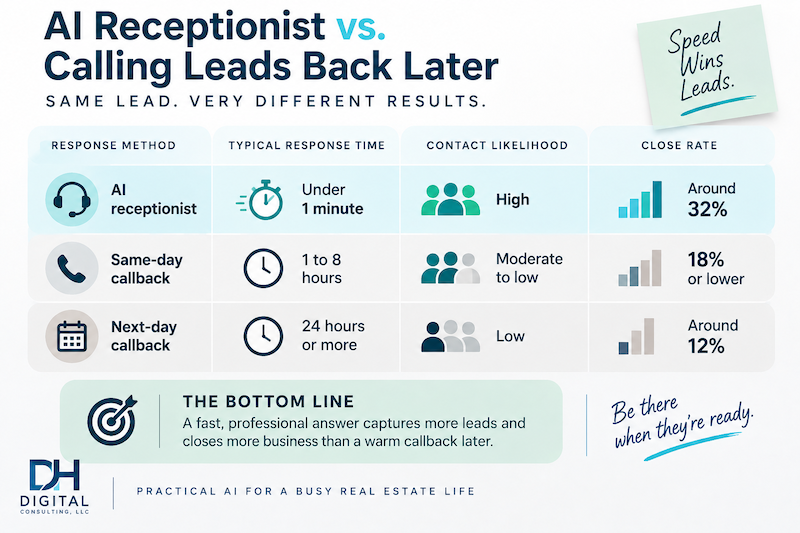
According to timetoreply’s research on lead response time, leads contacted within five minutes close at 32 percent, while leads contacted after thirty to sixty minutes close at 18 percent. That gap widens further the longer the wait stretches. A same-day callback at 5 p.m. for a 9 a.m. lead falls well outside any window where contact, let alone conversion, is likely.
What does AI receptionist response speed actually change?
AI receptionist response speed changes the outcome of a call by removing the gap between when a lead reaches out and when someone responds, converting a delayed callback into an immediate answer at the exact moment the lead’s interest is highest. An AI receptionist is a software system that answers inbound calls automatically, gathers information, and either books an appointment or routes the call, all without a human picking up the phone.
Interest in a service decays fast. A homeowner with a leaking pipe wants an answer while the water is still running, not after dinner. A lead who fills out a contact form at 11 p.m. wants confirmation before they fall asleep, not a callback the next afternoon. Speed to answer is not a courtesy. It is the mechanism that keeps the lead in the pipeline at all.
- Instant pickup removes the moment where a lead starts dialing the next business.
- Automated qualification captures the details a human would ask, before a human is even available.
- Immediate booking locks in the appointment while the lead is still motivated.
- Consistent answering means no lead is lost because of lunch, a job site, or after hours.
Vendasta documented this directly in its coverage of Elite Web Professionals, where adopting an AI receptionist cut response times from hours down to minutes and eliminated missed calls altogether. The change was not a personality upgrade. It was a timing fix.
Is a warm callback ever better than a fast automated answer?
A warm callback is not better than a fast automated answer when the lead has already been lost to a faster competitor, because warmth only matters once a conversation is happening, and a missed call never becomes a conversation. Tone, empathy, and rapport are real factors in closing a sale, but they only apply after contact is made.
This is where the comparison gets misread. Business owners assume the choice is between a robotic voice and a friendly one. The real choice is between a voice that answers now and a voice that answers later, if it answers at all.
Warmth only matters once a conversation is happening. A missed call never becomes a conversation.
Optifai’s 2026 benchmark study of 939 B2B companies found that leads contacted in under five minutes close at 32 percent, compared to 12 percent for leads contacted after twenty-four hours. Only 23 percent of businesses hit that five-minute window consistently. That means most callbacks, no matter how well phrased, land in the range where the lead has already moved forward without them. Details from Optifai’s lead response benchmark data back this pattern across industries, not just one niche.
The pattern I see across service businesses using GoHighLevel to track lead sources is consistent: the leads marked as won almost always show a call log timestamp within minutes of the original inquiry. The leads marked lost or unresponsive show call logs with gaps measured in hours.
How does an AI receptionist compare to hiring more front desk staff?
An AI receptionist answers every call around the clock without shift gaps, lunch breaks, or overtime costs, while hiring more front desk staff still leaves coverage gaps outside business hours and during peak call volume. Staffing solves part of the problem. It does not solve the after-hours or overflow problem that most missed calls come from.
A single receptionist can only handle one call at a time. When two calls come in at once, one goes to voicemail. When the office closes at 5 p.m., every after-hours lead waits until morning, which the data above shows is close to a lost lead already. An AI receptionist answers simultaneous calls and after-hours calls the same way it answers a call at 10 a.m. on a Tuesday.
- Cost stays flat regardless of call volume or time of day.
- No missed calls due to breaks, meetings, or job sites.
- Every lead gets qualified information logged the same way, every time.
- Scheduling and routing happen without waiting for a human to be free.
This does not replace the value of a real person handling complex conversations. It removes the bottleneck at the first point of contact, which is where most leads are lost in the first place.
Key Takeaways
- Contacting a lead within five minutes produces dramatically higher close rates than waiting hours or a full day.
- A same-day callback at the end of the day often falls outside any meaningful response window.
- AI receptionist response speed matters more than vocal warmth because warmth only applies after contact happens.
- Only a small share of businesses hit the five-minute response benchmark consistently.
- An AI receptionist answers simultaneous and after-hours calls in a way a single staff member cannot.
Fun Fact
The original MIT Sloan lead response study analyzed more than 15,000 web leads and found that the odds of qualifying a lead drop 21 times when response time slips from five minutes to thirty minutes. That number has held up as a benchmark for over a decade, even as the tools businesses use to answer calls have changed completely.
Expert Insight
In my work with real estate agents and small service business owners, the businesses that consistently win leads are not the ones with the best sales scripts. They are the ones whose phone gets answered first. A missed call is not a neutral event; it is an active handoff to whichever competitor picks up next. EchoAssist AI exists because the fix for this is not a training issue, it is a timing issue, and timing is something software handles more reliably than a human juggling a full schedule.
Frequently Asked Questions
How fast does a lead need to be contacted to close?
A lead needs to be contacted within five minutes to have the highest realistic chance of closing. Contact and close rates drop sharply as time passes, and the data from multiple independent studies places the steepest decline in that first thirty-minute window.
What is an AI receptionist?
An AI receptionist is a software system that automatically answers inbound phone calls, gathers caller information, and books or routes appointments without a human on the line. It functions like a front desk employee that never misses a shift or a call.
Why do leads call multiple businesses at once?
Leads call multiple businesses because they are comparing options and want the fastest available help, not necessarily the most polished pitch. Whoever answers first typically gets the first real conversation, which puts that business ahead regardless of how the other businesses eventually respond.
Does a friendly callback make up for a slow response time?
A friendly callback does not make up for a slow response time because tone only affects a conversation that is already happening. If the lead has already booked with another business, no amount of warmth in the callback changes that outcome.
Can small businesses realistically answer every call instantly?
Small businesses can answer every call instantly by using an AI receptionist system instead of relying solely on staff availability. This removes the constraint of one person handling one call at a time and closes the after-hours gap that causes many missed leads.
What happens to a lead that is not contacted within an hour?
A lead not contacted within an hour has a significantly reduced chance of converting compared to one contacted within five minutes. Benchmark data shows close rates falling from roughly 32 percent at under five minutes to well under 20 percent once an hour has passed.
Next Steps
Response speed is not a soft factor in lead conversion; it is the deciding factor. Businesses that treat every call as time-sensitive convert leads that businesses relying on callbacks lose without ever knowing it happened. See how EchoAssist answers every call the moment it rings: https://dhdigitalconsulting.com/echoassist-ai-receptionist/.