

TLDR
Working weekends business growth only happens when the hours go toward strategy, systems, and decisions that change the trajectory of the business; hours spent clearing a backlog that built up during the week are maintenance, not growth, no matter how tired you feel afterward. The two types of work feel identical in the moment but produce completely different outcomes over a year.
Key Takeaways
- Growth work changes what the business can do next; catch-up work only restores what it could already do before.
- Research on working hours shows output plateaus around 49 hours a week, so weekend hours past that point add little.
- Backlogs form because of specific, identifiable time sinks such as email, admin, and meetings, not because a founder lacks discipline.
- A short audit of the last four weekends usually reveals whether a person is building the business or just keeping it running.
- Systems like EchoAssist AI or GoHighLevel can absorb recurring catch-up tasks so weekends open up for actual strategy.
Fun Fact
Stanford economist John Pencavel found that productivity per hour starts dropping once a person passes roughly 50 hours of work in a week, and by 70 hours the extra output disappears entirely. A person working a 70-hour week produces about the same result as someone working 55. The math suggests weekend hours added on top of a full workweek are often close to worthless.
Expert Insight
In my work with real estate agents and small service business owners, the weekend pattern shows up the same way almost every time. The person believes they are being disciplined by working Saturday, but when you look at the actual task list, it is inbox cleanup, invoice chasing, and rescheduling missed calls. None of that moves the business forward. It just prevents it from sliding backward. The founders who actually grow are the ones who protect a block of weekend time for one thing: deciding what the business should look like next, not fixing what already went wrong this week.
What Is Working Weekends Business Growth?
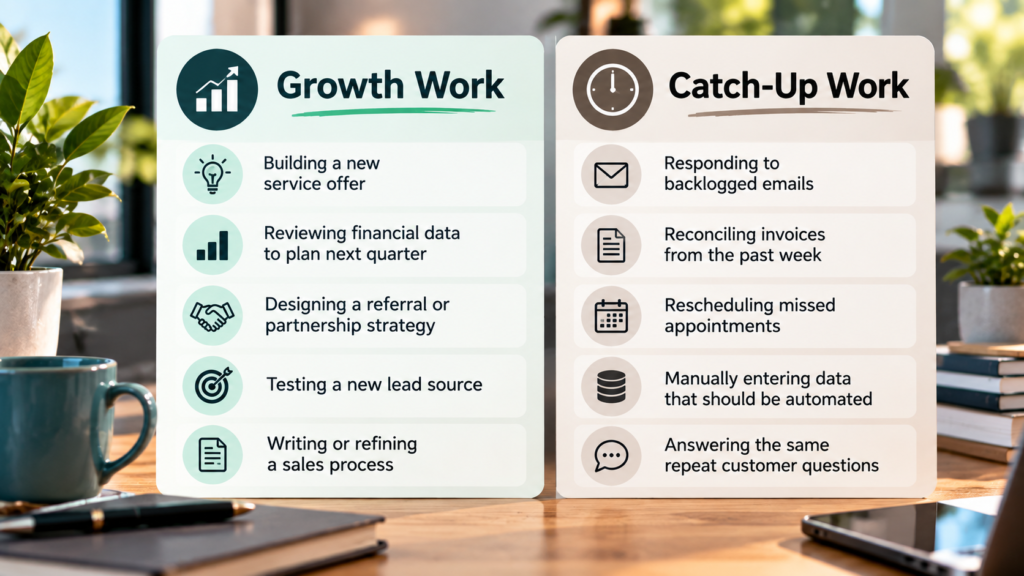
Working weekends business growth is the practice of using Saturday or Sunday hours for tasks that directly expand what a business can do, such as building a new offer, refining a sales process, or reviewing financial data to make a decision, rather than tasks that simply maintain the current state. The distinction matters because both types of work look identical from the outside. A person sitting at a laptop on Saturday could be either building or bailing water, and only the content of the task tells you which.
Most founders never separate the two categories, so weekends blend into one long block labeled work time. That blending is the actual problem. Once catch-up tasks and growth tasks live in the same bucket, a person can work every weekend for a year and still not be able to point to what changed.
Why Do Weekends Fill Up With Catch-Up Work Instead of Growth Work?
Weekends fill up with catch-up work because specific, recurring time sinks during the week never get resolved, so they roll forward and land on the only unscheduled hours a founder has left. Email, administrative paperwork, and unproductive meetings are the usual culprits, and they consume time that should have gone to planning or client work in the first place.
A survey from The Alternative Board found that 84 percent of small business owners work more than 40 hours a week, and poor time management ranks as the top productivity killer among them. Email alone eats roughly a quarter of the average owner’s time. That number matters because it shows the backlog is not random. It is coming from the same three or four sources every single week.
- Unanswered emails from Monday through Friday
- Invoices and paperwork pushed aside during busy days
- Missed calls or leads that never got followed up
- Scheduling conflicts that pile up until someone forces a decision
A weekend spent clearing a backlog is a weekend spent paying for a Monday-through-Friday problem, not building anything new.
Franchise Growth Solutions describes this pattern as founders staying stuck at the technician level of the business, doing the operational work instead of the strategic work that actually builds brand, systems, and reach. Weekends become an extension of that technician role instead of a break from it.
How Do I Know If My Weekend Work Is Actually Growth?
Weekend work counts as growth if it produces something that did not exist before, such as a new process, a completed strategy document, a signed partnership, or a decision that changes how the business operates going forward. If the task simply returns the business to where it was supposed to be by Friday, it is maintenance.
A quick test works well here. Ask what would happen if the task never got done. If the answer is nothing changes except a client waits longer for a reply, that is catch-up. If the answer is the business misses an opportunity or stays stuck at its current size, that is growth.
Does Working More Hours Actually Increase Output?
No, output does not scale with hours worked past a certain point; research on working hours shows productivity per hour declines once a person passes roughly 49 hours a week, and a person working 70 hours produces about the same total output as someone working 55. The extra 15 hours are essentially wasted.
This finding comes from economist John Pencavel’s study on working hours, cited by workforce researchers at Myshyft. The implication for weekend work is direct. If a founder already put in a full 45 to 50 hour week, the Saturday and Sunday hours added on top are operating in the zone of diminishing returns before they even start.
Adding weekend hours to an already full week does not add proportional output; it adds fatigue.
Wharton Executive Education researchers make a related point about weekends specifically. Their work on downtime and performance found that people who treat weekends as genuine recovery time, rather than a chance to catch up on unfinished tasks, return to work Monday more motivated and more productive than people who spend the weekend working through a backlog. The recovery itself becomes part of what drives the following week’s output.
What Should I Do With My Weekend Instead?
Reserve weekend work time, if any is used at all, for one clearly defined growth task decided in advance, and let recurring maintenance tasks either get handled during the week or absorbed by a system built for that purpose. The goal is not zero weekend work. The goal is weekend work that has a name and a reason.
- List every task that consumed a weekend hour over the past month.
- Sort each one into growth or catch-up using the test above.
- Identify the recurring catch-up tasks and trace them to their weekly source.
- Build or assign a system to intercept that source before it reaches the weekend.
- Protect one weekend task slot, if used at all, for strategy only.
Tools built for a specific job handle this better than general effort. A missed call tracker or an AI answering system like EchoAssist AI can catch weekday leads before they turn into a Saturday callback list. A platform like GoHighLevel can automate the follow-up emails that otherwise sit unanswered until Sunday. Notion can hold the recurring admin checklist so nothing depends on memory. None of these tools eliminate work. They move it out of the weekend and into a system that runs without a person sitting at a laptop on a day off.
A business that only grows when the owner sacrifices a weekend has a systems problem, not a discipline problem.
That last point is worth sitting with. The instinct is usually to work harder or work longer. The actual fix is almost always structural: find the source of the backlog and remove it, rather than absorbing it every week with unpaid weekend hours.
Frequently Asked Questions
Is it normal to work every weekend when running a small business?
It is common but not automatically productive. Roughly 84 percent of small business owners report working more than 40 hours a week, and poor time management is the most cited reason, which means the extra hours often come from unresolved weekday backlogs rather than deliberate growth work.
How do I know if I have a systems problem instead of a time management problem?
You have a systems problem if the same type of task lands on your desk every single weekend regardless of how hard you worked that week. A time management problem is occasional and task-specific. A systems problem is recurring and structural, meaning the same email backlog, the same missed calls, or the same paperwork shows up week after week no matter what you do differently.
What is the difference between growth work and maintenance work on weekends?
Growth work produces something new for the business, such as a strategy, a process, or a decision, while maintenance work simply restores the business to where it should have already been. If skipping the task would only delay something rather than lose an opportunity, it is maintenance.
Does working weekends actually help a business grow faster?
Not by default. Weekend hours only contribute to growth when they are spent on strategic tasks; hours spent clearing a weekly backlog keep the business at its current size rather than expanding it, and research shows output per hour declines the more total hours a person works.
How many hours a week is too many before output starts dropping?
Around 49 hours a week is the point where productivity per hour begins to decline according to Pencavel’s research. Beyond that point, additional hours, including weekend hours, produce far less output relative to the fatigue and burnout risk they create.
Can automation actually reduce weekend work for a small business owner?
Yes, automation intercepts the recurring tasks that typically pile up into a weekend backlog before they reach that point. Systems that handle missed calls, follow-up emails, and scheduling automatically remove the tasks that would otherwise sit unanswered until Saturday.
What should I track to figure out if my weekend work is worth it?
Track what each weekend task produced against what it would have cost to skip it. A running log for even four weekends usually reveals a clear pattern of which hours built something and which hours simply kept the business from falling further behind.
Next Steps
Separating growth work from catch-up work is easier once the recurring backlog sources are identified and handled by a system instead of a weekend. Read more on building a business that doesn’t run you at https://dhdigitalconsulting.com/blog/.