

TLDR
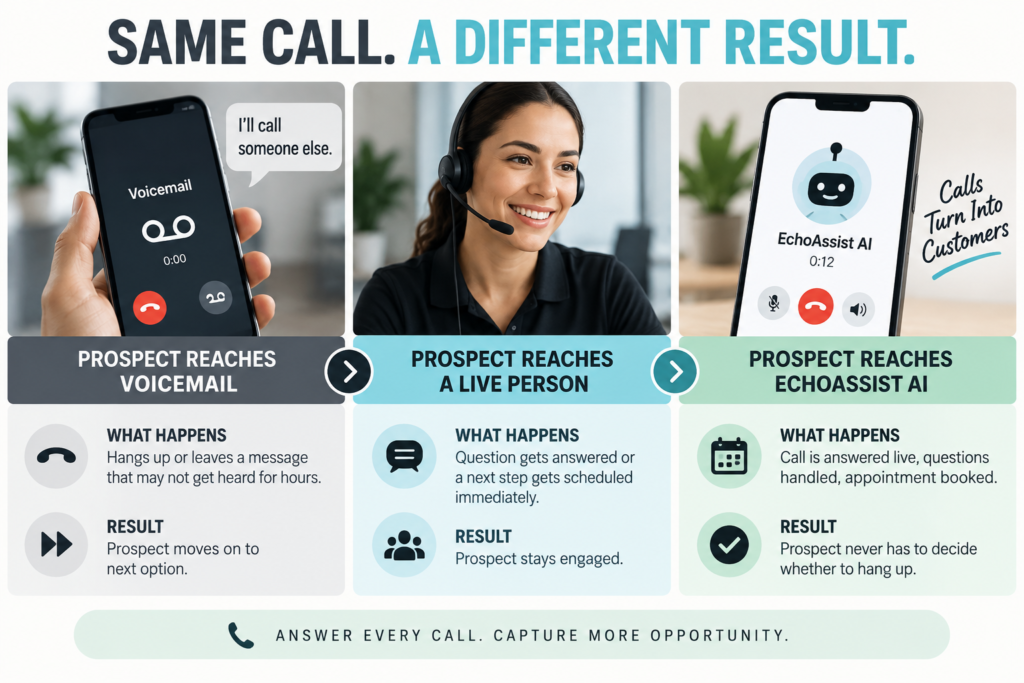
Prospects hang up voicemail instead of leaving a message because a recorded greeting signals that the response will be slow, generic, or nonexistent, and the prospect’s brain treats that delay as a signal to move on to the next option. The fix is not a better voicemail script. The fix is answering the call live so the prospect never reaches the point of deciding whether to hang up.
Key Takeaways
- Prospects hang up voicemail because leaving a message requires effort with an uncertain payoff.
- A missed call triggers a fast, often unconscious decision to try a competitor instead of waiting.
- Voicemail does not solve the trust and speed problem; it just delays the loss.
- Live answers change the outcome because they remove the moment of hesitation entirely.
- Tools like EchoAssist AI exist specifically to close that gap without adding staff hours.
Fun Fact
Gong Labs analyzed more than 300 million cold calls and found that prospects almost never call back after hearing a voicemail. The value of a voicemail message showed up in email reply rates, not in return phone calls. That single data point undercuts the common assumption that a well-crafted voicemail script closes the gap left by a missed call.
Expert Insight
In my work with real estate agents and small service business owners, the pattern I see across most missed-call situations is not a bad voicemail greeting. It is a structural gap between when the phone rings and when a real person responds. A prospect calling about a listing or a service quote is usually comparing three or four options at the same time. The business that answers first, live, wins the conversation before the others get a chance to return the call. Voicemail does not close that gap. It just documents that the gap existed.
Why Do Prospects Hang Up Voicemail Instead of Leaving a Message?
Prospects hang up voicemail because the moment they hear a recorded greeting, their brain reclassifies the call from a solved problem to an unsolved one, and leaving a message feels like extra work with no guaranteed return. That decision happens in under two seconds. There is no deliberation, just a reflex built from years of unreturned calls and slow callbacks from other businesses.
A voicemail hang up is a call where a person dials a business, hears the automated or personal voicemail greeting, and disconnects without recording a message. This behavior is common enough that sales teams track it as a distinct category separate from a missed call with a message left. Understanding the difference matters because the two outcomes require completely different fixes.
The prospect is not being rude. They are being efficient. If three other businesses can answer the phone right now, why invest thirty seconds explaining a need to a machine that might not even get checked until end of day?
A voicemail greeting tells a prospect exactly one thing: this business is not available right now.
What Is Actually Going Through a Prospect’s Mind During That Call?
A prospect who reaches voicemail runs a fast internal calculation weighing the effort of leaving a message against the likelihood of a timely callback, and in most cases that calculation resolves in favor of hanging up and calling the next option on their list. This is not laziness. It is a rational response to past experience with slow follow-up.
PhoneBurner’s research on sales prospecting describes a related pattern they call the telemarketer delay, where an unfamiliar tone or a pause before speaking primes a prospect to disengage before the conversation even starts. Voicemail compounds that same instinct. There is no live voice to answer the unspoken question every caller has: what happens if I leave this message?
- Will someone call back today, or in three days?
- Will the callback person even know why I called?
- Is there a competitor who will just pick up right now?
SalesRoads describes the buyer’s first reaction to an unexpected call as a defensive, almost fight-or-flight response. A live conversation gives a rep the chance to acknowledge that reaction and lower it. A voicemail greeting cannot do either. It just sits there, silent, waiting for a decision the prospect has already made by the second ring.
Why Doesn’t Leaving a Better Voicemail Script Fix the Problem?
A better voicemail script does not fix the problem because the core issue is timing and access, not wording, and no amount of polish on a recorded message changes the fact that the prospect wanted a person and got a machine instead. Script improvements help slightly with callback rates on messages that do get left, but they do nothing for the prospects who hang up before recording anything.
HubSpot’s sales team makes a related point about tone. A voicemail that sounds too enthusiastic or too generic actually gives the listener permission to ignore it, because it reads as a scripted pitch rather than a genuine need for connection. That insight cuts both ways. If the script itself can backfire, then optimizing the script was never the highest leverage move.
Voicemail does not fail because of what is said. It fails because of when it is heard.
Gong Labs found something even more direct in their analysis of cold calling data: leaving a voicemail can signal to a prospect’s caller ID or call-screening habits that this is a sales call, which lowers the odds of a future pickup. In other words, the voicemail habit can actively train a prospect to keep avoiding the business, not just this once but going forward.
Why Does a Live Answer Change the Outcome?
A live answer changes the outcome because it removes the decision point entirely; the prospect never has to weigh the effort of a voicemail against the odds of a callback, since the question gets addressed in the moment it is asked. That single difference explains most of the gap in conversion rates between businesses that answer live and those that route calls to voicemail during business hours.
This is not about hiring more staff to sit by the phone. It is about closing the window between the ring and the response. A business that consistently answers live, whether through a person or a system like EchoAssist AI, keeps prospects in the conversation instead of losing them to the next search result or the next name on a list.
The businesses that win the call are the ones the prospect never has to wait for.
Small service businesses and real estate agents feel this acutely because their prospects are almost always comparing multiple providers at once. A homebuyer calling about three listings will talk to whichever agent answers first. A homeowner needing a repair quote calls until someone picks up. Voicemail removes a business from that competition the instant the greeting starts playing.
What Should a Business Do Instead of Relying on Voicemail?
A business should route every incoming call to a live answer point, whether a trained employee or an AI receptionist system such as EchoAssist AI, so the prospect gets an immediate response instead of a recorded greeting that invites a hang up. This shift does not require a bigger team. It requires a different system for handling the call itself.
- Audit how many calls currently go to voicemail during business hours.
- Identify the peak call times when staff are unavailable.
- Route those gaps to a live-answer solution instead of a standard voicemail box.
- Track how many of those calls convert into booked appointments or qualified leads.
Tools like GoHighLevel can help track call outcomes and follow-up sequences once a lead is captured, but the capture itself still depends on someone or something picking up the phone in real time. That is the piece voicemail was never built to solve.
Frequently Asked Questions
Why do people hang up instead of leaving a voicemail?
People hang up instead of leaving a voicemail because recording a message feels like effort with no guaranteed payoff. The prospect assumes a callback might take hours or days, so they move on to a business or agent who can answer right now.
Does leaving a voicemail actually get a callback?
Rarely. Gong Labs’ analysis of over 300 million cold calls found that prospects almost never call back after hearing a voicemail, and the main benefit of leaving one shows up in email reply rates instead.
How do I know if my business is losing leads to voicemail hang ups?
Check call logs for missed calls with no message left during business hours. A high count of unanswered, unrecorded calls usually points to a live-answer gap rather than a voicemail script problem.
Is a better voicemail greeting enough to fix this?
No. A stronger script may slightly improve callback rates on messages that do get left, but it does nothing for the prospects who hang up before recording anything at all.
What is the difference between a missed call and a voicemail hang up?
A missed call includes any unanswered call, while a voicemail hang up is a missed call where the caller specifically declined to leave a message after hearing the greeting.
Can an AI receptionist actually replace live answering?
Yes, when built for the purpose. EchoAssist AI is designed to answer every call live, handle common questions, and schedule appointments without the prospect ever reaching a voicemail prompt.
Does this problem only affect sales calls?
No. Real estate agents, contractors, and other service businesses see the same pattern, since prospects calling about a listing or a quote are almost always comparing multiple options at once.
Next Steps
Voicemail was never designed to compete with the speed of a live conversation, and prospects prove that every time they hang up instead of leaving a message. See how EchoAssist answers every call live.